Brown Rat
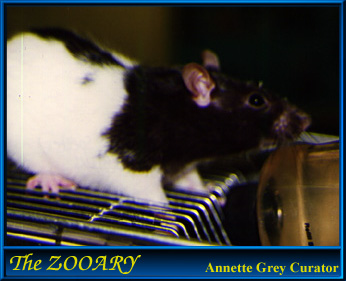
CLASSIFICATION
- KINGDOM: Animalia
- PHYLUM: Chordata
- SUB-PHYLUM: Vertebrata
- CLASS: Mammalia
- ORDER: Rodentia
- FAMILY: Muridae
- GENUS: Rattus
- SPECIES: norvegicus
Rat is the common name for about 1,000 species of rodents in 70 genera and
eight families. These species include the kangaroo rats, Dipodomys, family
Heteromyidae; wood rats, Neotoma, family Cricetidae; spiny rats,
Proechimys, family Echimyidae; and the typical rats, Rattus, family
Muridae. Most rodents called rats have an elongated body, a moderately
pointed snout, approximately equal-length legs, and a long, sparsely haired
or hairless tail. Rats are generally distinguished from mice by their
larger size.
A rat's incisors are open rooted which means they are continuously growing
(hypsodontic). They may need to be trimmed with clippers if there is
nothing for them to gnaw on. The space between the incisors and the moars
is called the diastema. Rats have twelve molars which are permanently
rooted and do not continuously grow (brachidontic).
An adult male rat weighs between 450 and 520 grams while the female is
between 250 and 300 grams. They have a diploid chromosome number of 42.
Their body temperature range is 35.9 to 37.5 C. They can grow to length
of 32-46 cm (12-18 inches). They have a chubby body shape.
Rats are burrowers and are nocturnal most of the time. Escaped rats will
often return to their cages. Rats have an excellent sense of balance, and
will usually land on their feet like a cat.
RANGE
The Norway rat, also called the brown rat, probably originated in eastern
Asia, possibly northern China. The first record of its appearance in Europe
was 1553, and it is now found throughout the United States.
HABITAT
Since rats live on all continents, they also live in all the different
environments. Therefore, they have no one specific niche.
They do however have special adaptations that allow hem to survive in their
type of habitat. For example, the rat's eyes. Rats have poor eyesight and
are color blind. They do well in dimly lit rooms or cages. They do have a
highly developed sense of touch because of sensitive whiskers called
vibrissae which compensates for the eyesight. They prefer to move along
walls using their whiskers to guide them. Behind the rat's eyeball is the
Harderian gland. This is a pigmented lacrimal gland. This red brown gland
is larger than the eyeball and secretes a lipid and porphyrin rich
secretion which lubricates the eyes and lids in stress situations such as
restraint, swimming, acute illness ect... The red tears overflow and stain
the face and nose. The dried red porphyrin crust fluoresces bright red
under an ultraviolet light. The secretion contains little blood however.
DIET
Most rats prefer food of animal origin, such as fish, mice, and chickens,
but are still highly omnivorous. As pets, they can be fed almost anything.
Average daily food intake for a rat is 10 grams per 100 grams body weight.
Average daily water intake is 10-12 ml per 100 grams body weight.
GESTATION
Rats often associate in packs of 60 or more animals, usually all closely
related and often all descended from a single pair. Norway rats breed
throughout the year. The breeding onset is between 65 and 110 days, and
they have a gestation period of 21 to 23 days and produce a litter of 6 to
12 young. Young are communally raised with shared nursing. Rats often set
up breeding harems of one male to 6 females. Newborn rats weigh between 5
and 6 grams.
Rats often associate in packs of 60 or more animals, usually all closely
related and often all descended from a single pair. If a nursing female is
killed, for example, other nursing females of the pack will raise her young
for her.
LONGEVITY
Life expectancy for the rat is between 2.5 and 3.5 years in the wild.
BIBLIOGRAPHY
1. Barnett, S. A., The Rat, a Study in Behavior, rev. ed. (1976)
2. Biology and Medicine of Rabbits and Rodents, The; 2nd ed, by Harkness
and Wagner, 1983, Lea and Febiger.
3. Greene, Eunice G., Anatomy of the Rat (1935; repr. 1971)
Simon and Schuster's Guide to Mammals, by Boiyani and Bartoli, 1983, Simon
and Schuster, Inc.
4. Hirschhorn, Howard, All About Rats (1974)
5.Rats- A complete Pet Owner's Manual, by Carl Himsel, 1991, Baron's
Educational
Series, Inc.
6. Rowett, H. G., Rat as a Small Mammal, 2d ed. (1965)
7. Simon and Schuster's Guide to Mammals, by Boiyani and Bartoli, 1983,
Simon and Schuster, Inc.
8. Zinsser, Hans, Rats, Lice, and History (1935).