CLASSIFICATION
CLASSIFICATION
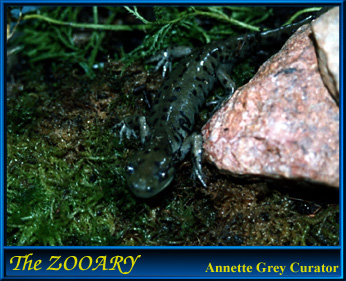
Salamander is the common name for about 320 species of amphibians with tails. They include all the members of the order Urodela, including the newts (family Salamandridae). Salamanders may live permanently in freshwater, but usually live their adult lives as terrestrials only returning to the water to breed. Newts are primarily aquatic, even as adults though those that live part of their lives on land may have a "warty" skin when out of water.
Salamanders are oftes mistaken for lizards, but they lack the scaly skin, external ears and claws that are characteristic of lizards. Salamanders are a very old group that diverged early from the other amphibian stocks (frogs and caecilians) but are related to them by characteristics of tooth form and skin structure. The families Hynobiidae and Cryptobranchidae comprise the most primitive salamanders, based on bonestructure and the fact that they have external fertilization (eggs laid in water and sperm deposited over them). Hynobiids live in eastern Asia, and the cryptobranchids live in China and Japan (the giant salamander) and North America (the hellbender). The family Ambystomatidae occurs in the New World from Canada to central Mexico and includes the tiger salamander and the axolotl. The families Sirenidae (sirens), Necturidae (mud puppy), and Amphiumidae (congo eels) occur only in the southeastern United States. All are permanently aquatic, with reduced limbs and some larval features. The family Proteidae occurs in the caves of coastal Yugoslavia. The animals are gilled, blind, and unpigmented--adaptations to life in darkness. The family Salamandridae lives on all continents except South America, Australia, and Antarctica. The most abundant family, containing about 200 known species of salamanders, is the Plethodontidae. Evolved in the Appalachian Mountains of the United States, it has many species in eastern and western North America, a group of species that has invaded the tropics and radiated extensively, and two species in Europe. This family contains burrowing, tree-living, stream-dwelling, and terrestrial species.
Salamanders occur mainly in the temperate regions of the Northern Hemisphere. They do not occur in Australia or south of the Sahara in Africa and are rare in South America. 7 of the 8 families of salamanders are represented in the United States.
Since salamanders are amphibians, their skins are sensitive to desiccation, therefore they are found in or near water and damp places. Many are brightly colored, such as the red eft of the eastern United States. Most adults hide by day and feed at night; some emerge only when moisture and temperature levels are suitable, or in the breeding season.
Many salamanders are 10 to 15 cm (4 to 6 in) long. The largest, the giant salamander of Japan, Andrias japonicus, grows up to about 180 cm (70 in) and weighs about 25 kg (55 lb). Salamanders externally are characterized by having short bodies with tails, usually 4 legs, well-developed heads often with large mouths and eyes, and a smooth, moist skin. They are brightly colored, often brown, black, yellow, or red, and often have light or dark spots, bars, or stripes. The skin contains many glands, some secreting mucus to help maintain moisture and others secreting a toxic or irritating substance when the animal is frightened. Internally, salamanders share a number of features with other amphibians, such as a three-chambered heart. The respiratory system typically involves gills in larvae and lungs in adults, and some adults also have gills. Oxygen uptake can also occur through the skin and the mouth membranes (as in the plethodontids, the lungless salamanders). Most are carnivores, feeding on insects, worms, and similar prey. Some plethodontid species can flip their tongues the lengths of their bodies to catch prey. As in other amphibians, water is absorbed through the skin.
The reproductive system of salamanders and newts has a number of modifications. Courtships are often species-specific and elaborate, featuring particular series of positions and movements. In all but the most primitive species, fertilization is internal. The male secretes a spermatophore, or sperm packet, and the female picks up the sperm with the lips of her vent, the external opening that leads to the cloaca (chamber), where the oviducts, intestine, and urinary ducts empty. Her eggs are fertilized by the sperm and may be laid right away or retained in her oviducts. The oviducts are modified so that they become glandular during the reproductive period. Several layers are secreted around the egg, including the "jelly" that swells with water to maintain moisture and to hold the egg mass together. In Salamandra atra of the Alps, the young are retained in the oviducts throughout their development and feed on oviductal secretions and other eggs in the ducts. One or two miniatures of the adult are born 3-5 years after fertilization.
When fertilization is external and eggs develop in water, several hundred eggs may be laid. They have two developmental phases before adulthood--the prehatching (in the egg) phase and the posthatching, or larval, phase. In the prehatching phase nutrition is derived from the yolk of the egg. Larvae are characterized by external gills, teeth in both jaws, and the lack of eyelids. They actively forage for food. The larvae usually then undergo a hormonally mediated metamorphosis, losing their gills and changing the structure of their skin, skull, hemoglobin, eye pigment, and excretory product.
Some species (for example, the axolotl) display neoteny--that is, the larval features persist into sexual maturity. In many terrestrial species having direct development (no larval stage), the females brood their eggs. They coil around the clutch, protecting it from predators and even from fungus. Some salamanders can breed as soon as they become adult, others 1 or 2 years later.
The life span of salamanders may be 1 to 60 years, depending on the species.
Salamanders are components of a balanced ecosystem. They serve as food items for various predators, including fish, snakes, and birds. Recently they have contributed much to science from studies of ecology and evolution, behavior, and general physiology to genetics, endocrinology, and cell structure and function.
Bishop, Sherman C., Handbook of Salamanders (1967)
Roberts, Mervin F., All about Salamanders (1976)
Twitty, Victor C., Of Scientists and Salamanders (1966)