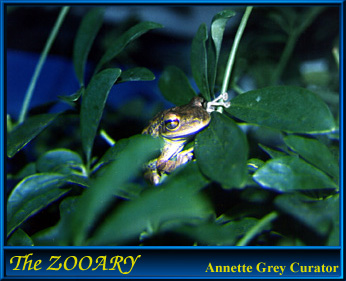
"Kermit"
Cuban Tree Frog
"Kermit"
Cuban Tree Frog
Tree frogs are small and have slender legs; their pupils are horizontal and about 600 species are known. Arboreal tree frogs are typically walkers and climbers--they are reluctant jumpers. Their toe tips are expanded into sticky adhesive pads and they have cartilage between the last two bones of each toe to aid in climbing.
Despite this drawback of a dependence on water, frogs have evolved and diversified in form to occupy a variety of habitats, from rainforests to deserts, from rock faces to subterranean burrows, from free water to sphagnum moss bogs - frogs are found in a surprising number of different spots. There is even a frog adapted to living in the desert.
Vegetation--trees and tall grass--near water.
As all frogs, tree frogs are carnivorous amphibians that are stimulated by movements, and will eat anything they can fit in their mouths.
Most frogs breed seasonally when conditions of temperature, day-length and moisture are right. It is common to see tadpoles (the name given to very young frogs) swimming in ponds at different times of the year. When a female lays eggs the male fertilizes them and the resulting floating mass of eggs (spawn) is left while the frogs develop. Hatching of the tadpoles may take several days, followed by a period when the tadpole develops and finally changes into the adult frog, a process called metamorphosis.
Approximately one to five years.
Frogs eat insects and overall must account for millions of insects daily. They also eat other small invertebrates. By eradicating millions of insect pest species frogs play an important role in maintaining the balance of nature. But something is happening to the environment, both within Australia and internationally, that is alien to frogs. In the past 15 years or so frog populations have declined dramatically, even in supposedly uncontaminated environments such as national parks. Something in the environment is killing the world's frogs. If we accept that frogs are indicator species and this is a warning that environmental changes are taking place, it is in our own interests to take heed of this potential tragedy.
This is the largest tree frog in N. America. It is high predaceous and with eat anything it can catch and swallow including other frogs and smaller Cuban tree frogs. This species was probably introduced by accident into Key West at the start of the century.
This attractive tree frog is a pale green or blue and native to Australia and New Guinea. It grows to about five inches while it's hardiness and calm disposition make it an excellent captive specimen. The skin secretions form this frog were once used to develop hypertension medications.
Behler, John and F. Wayne King. National Audubon Society: Filed Guide to
North American Reptiles and Amphibians (1994)
Longmore, Ric. Australian National Botanic Gardens