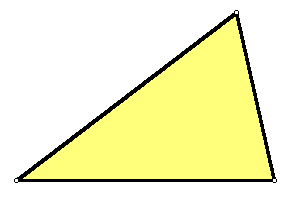
The problem: Dissect a triangle and assemble its parts into a square.
Begin with an arbitrary triangle. Stand it on the side that is the second largest. This orientation helps with the description, but it also may help you to avoid making cuts that are unnecessary.
Make the first cut through the midpoints of the two top sides.

Rotate the small triangle 180° about the midpoint of the longest side of the big triangle.
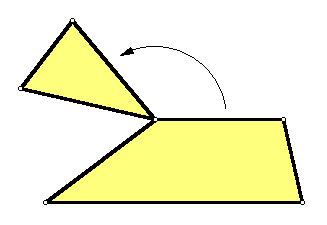
This gives us a parallelogram. Now make a vertical cut through the vertex of one of the obtuse angles (if it is not a rectangle).
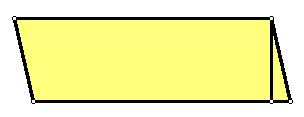
Translate the right triangle to the other side of the figure.
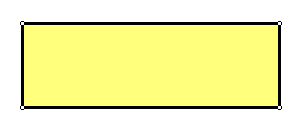
Now it is a rectangle. The longest sides are the horizontal sides. If the ratio of the length to the width is greater than 4:1, cut it vertically into two congruent rectangles and stack them into a rectangle with different dimensions. Repeat this until the ratio of length to width is less than or equal to 4:1.
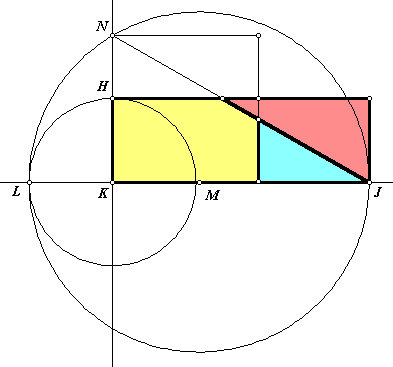
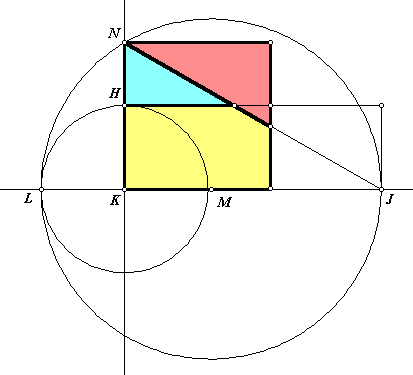
Now apply the dissection shown below.
KL = KH.
Point M is the midpoint of LJ.
MN = ML.
A square is constructed on KN.
And I'm grateful to Paul for allowing to use his file.