 |
Nick
Braybrooke's Euro Navy Report 2: January 2000 |
February sees HMS Invincible emerging from a 7 month, $40 refit to join her sister ship Illustrious in service. Unlike her sister, Invincible will have a new appearance, both have has their bow mounted Sea Dart launcher removed, but Invincible’s refit has gone further by removing the Type 909 radars and the fore and aft end of the Island. Apart from tidying up the appearance of the ship it also gives a much better location for the ships three 30mm Goalkeeper CIWS it remains to be seen whether the CIWS will be relocated however. The biggest change for both ships is the permanent embarkation of an RAF Harrier GR7 (AV8B) detachment to backup the existing Sea Harrier FA2. Up to 40 of the RAF’ Harrier GR7 fleet are to be upgraded with more powerful Pegasus engines as currently used by the USMC AV8B fleet. A likely airgroup for the Invincibles would be
8 X Sea Harrier FA2 fighters (equipped with AMRAAM missiles)
8 X Harrier GR7 Strike aircraft
4 X Sea King AEW 7 early warning helicopters
6-8 Sea King ASW helicopters (most of which would be embarked on escorting auxiliary ships)
All three ships have gone through a radical transformation to extract as much capability from their limited size. These latest refits will probably see all three ships through until around 2012 when they will be replaced by the UK’s new carrier CV(F).
The UK Government has now released funding for the design phase of the project. The choice of design will ultimately depend on the choice of strike aircraft. Whatever the type chosen, the probable size will be in the region of 45,000 tons, 950ft long and operating up to 40 fixed wing jets in peacetime with a wartime overload of 50.
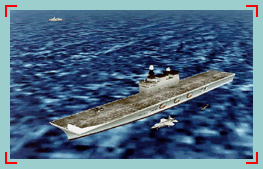
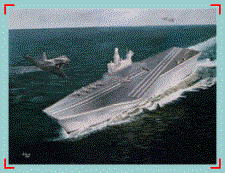
CV(F) STOVL design operating JSF CV(F) STOBAR design with Sea Typhoon fighters.
The trials and tribulations of the Charles de Gaulle continue. Originally conceived in the 1980s as a small (38,000t) nuclear powered carrier, the ship has been beset by numerous delays and problems associated with the design ranging from propulsion fires to corrosion.
During builders trials in 1999 a fire broke out in engine room, the cause of which was not fully resolved. In parallel with this approximately 10 miles of piping and conduits were found to have corroded and required replacement. This was a legacy of the long delays in the construction of the ship. Other problems include paint being burned on the ‘ships island by jet blast of her new Rafale aircraft and most importantly the flight deck being too small to safely operate E2C Hawkeye aircraft in adverse conditions. The latter problem requires a 12-meter extension to the ships angled flight deck. The Charles de Gaulle’s speed has also proved something of a problem. Her submarine based reactors are able to produce a maximum speed of 27kts but 25kts seems more reasonable without overstretching the machinery. Originally it was intended that the Charles de Gaulle would have a sister ship and these two ships would replace the two existing ships the Foch and Clemenceau. Given the huge cost, delays and embarrassment associated with this project it is very unlikely that a sister will ever be produced. Realistically, France would be advised to participate in the UK’s CV(F) program, but national pride will probably mean that this comes to nothing.
The Charles de Gaulle is due to commission in 2000 with an interim airgroup of subsonic Super Etendards, prior to receiving her main airgroup of Rafale M fighters in 2001
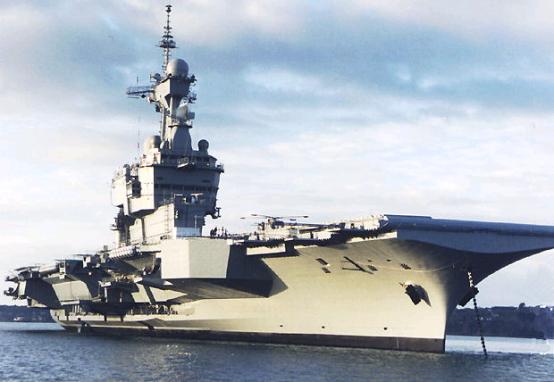
Charles de Gaulle at Brest,