|
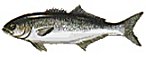
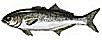
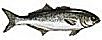
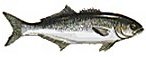
Younger fish are green on black, larger ones deeper blue
with silvery sides and white belly. They have short, stiff
spines on the front dorsal fin, a long, soft rear dorsal
opposite a smiliar anal fin and a forked tail. They are
highly predatory, with sharp teeth and powerful jaws. Blues
often travel in large schools. They range in size from
"snappers" of a foot less in length to "tailors" ( 2 or 3
pounds), "choppers" roughly to about 8 pounds and the
largest fish, often called "slammers," 10 pounds and up.
The largest specimens can top 3 feet and 20 pounds.
|
|
Bluefish are common on both sides of the north and south
Atlantic, though rare in the warmest tropical zone. They are
absent from the United States' West Coast, however. Bluefish
also show up in the Indian Ocean, the waters around Australia
(where they're known as "tailor") and in the Mediterranean
Sea. They migrate up the east coast from northern Florida to
Massachusetts and Maine between late winter and early summer.
They generally commence their return starting in September.
The largest fish appear to tolerate cooler water temperatures
better, so the beginning of the spring movement and the end
of fall run afford excellent chances for bruiser blues.
|