PREVIOUS PAGE
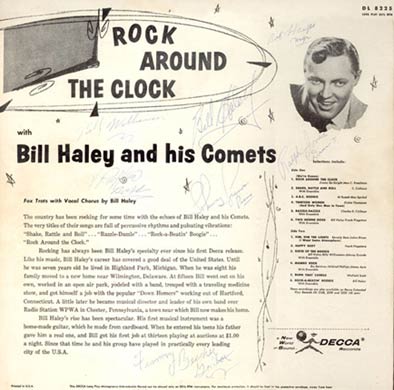
And here's the back of this unique album, with all the autographs!
In the above article, Bill explains at some length his decision to record in the Twist style. Bill's first release in this "new" rhythm was "Twist Español"; his second single would be "Cerca Del Mar", a Latin standard with a new arrangement.
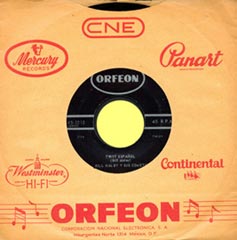
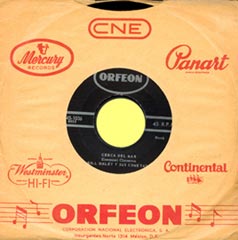
During the lifetime of my magazine, I had the opportunity of becoming friends with practically all the popular young recording artists in México, as well as meeting and interviewing several international rock and pop artists who visited us; such as Frankie Avalon, Chubby Checker, Little Richard, The Platters and Jackie Wilson.
Practically every one of the great Rock 'N' Roll interpreters appeared in the pages of the magazine; but Bill would usually receive top coverage, and Mexican teenagers could satisfy their appetite for his great brand of music with a very healthy dose of constant news on him and the Comets!
"La Historia del Rock 'N' Roll" would eventually last seven issues during its first incarnation; each new issue bringing loads of fan mail. So, when a local record company asked me to became a record producer (the first one in México to be exclusively devoted to produce rock recordings with the already vast pool of young talent available), I had to unwillingly discontinue the publication of the magazine. I hope that you will enjoy the covers of issues 3 through 7 (now, collector items!) You will notice that, partially to help promote Bill's Twist recordings, starting with issue number 4, I renamed the magazine as "La Historia del Rock 'N' Roll y el Twist".

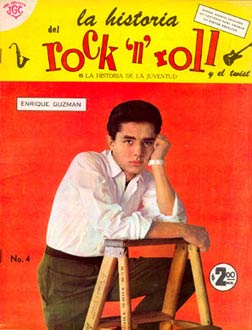
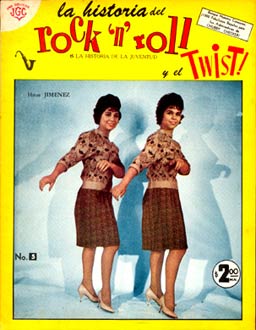
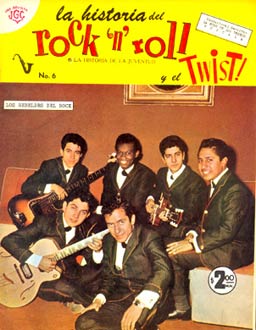
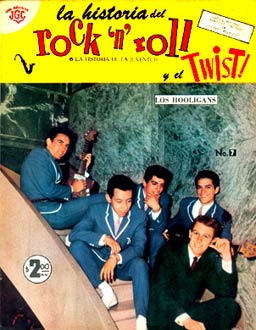
Many of my friends or people I knew would become connected with Bill Haley and his Mexican recordings. Antonio De La Villa, the lead singer of my old chums, "Los Locos Del Ritmo", wrote the Spanish-lyrics version of "Twist Español" (Spanish Twist). You saw his picture above, in the cover of the first issue of "La Historia del Rock 'N' Roll"; he is the one standing behind the piano. Toño, as we called him, collaborated in my magazine with an article defending rock 'n' roll, only a couple of months before he would die at a very young age.
The drummer of the same group, Rafael, "El Rebelde", did help Bill in some recordings, playing "footsteps", for instance, in "Tacos Twist". Ing. Manuel Díaz, a grandson of the former President of México, Porfirio Díaz, was the recording engineer in most of Bill's sessions, and Paco de la Barrera, one of the Orfeón in-house producers, would oversee Bill's recording sessions; he also authored (together with Ing. Díaz) the composition "Sonora Twist" for Bill's third album. Agustín Ysunza, a leading photographer, would become the official studio photographer for Bill and his Comets; their picture in the first Orfeón album was taken by him, as well as their pic on the cover for the second issue of "La Historia del Rock 'N' Roll" (you can tell that both pictures came from the same session).
And the list goes on and on!
* * * * * * * * *
As you probably know, at the time Bill was already being labeled as an "aging rock artist" within the music industry. The latter part of his career at Decca had been handled with the old mentality of "themed" albums, recording in the rock language, old standards from the 20's and 30's ("oldies" at that time), traditional folk melodies from around the world, old songs with ladies' names and/or just plain instrumentals.
With the exception of the first 10" album, no picture of him and/or The Comets ever appeared on any cover of the albums that Bill recorded for the label. As a result, most of his album covers were old-fashioned style photographs. The same stock type that had been used in albums by pre-rock interpreters. Even the same dancing "teenage" models that appeared in Bill's albums were utilized in album covers by other artists!
Possibly because rock 'n' roll was so new, there was a lack of an objective vision on the part of the label staff as to how to handle Bill. They knew that he was an incredibly experienced musician that had almost singled-handedly created a whole new sound, recording the most danceable music; but he was not a teen heart-throb.
At Warner, the approach was not much better. Bill's only two albums consisted basically of "covers" of other rock, country and R&B interpreters and three of Bill's own hits.
Bill would eventually find in México a second life, something that no other rock artist, before or after, has had. He would record over a hundred songs at Orfeón, his new recording company, and would go on to release eight albums and multiple singles and EP's, to the delight of his innumerable Latin American fans!
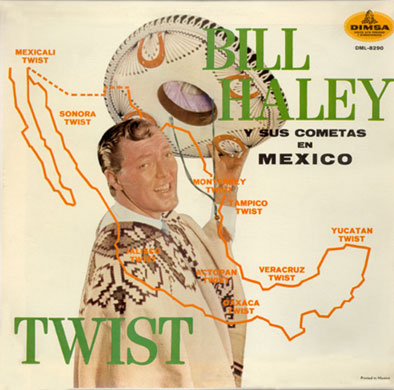
"La Historia del Rock 'N' Roll" in a way helped Bill's new life, and he would go on to sell millions of records throughout Latin America, in this stage of his career.
Bill was ecstatic about the reception that he was getting from his "new" fans. Here was practically a whole new continent, with exotic customs and languages based on Latin roots, as opposed to his very Saxon idiom, and yet, he was the idol of millions of these teenagers!
He was eager to please this unexpected audience, by riding along new musical fads, and his Mexican recordings give sufficient proof of this. First, it was "El Twist", followed by such other rock 'n' roll babies as "El Puré de Papas (The Mashed Potato)", "El Madison" and "El Go-go"; all of them summed up in "La Tierra de las Mil Danzas (Land of a Thousand Dances)". While some of these proved to be bona fide successes, Latin American teens embraced most of these recordings as Haley-stamped reasons for having a good-time. And a good time they had!
But, in time, everything started drifting apart. Bill's constant touring kept him away from a real base; his entrepreneurial instincts would collide with the logistics (or non-logistics) of doing business in foreign lands; The Comets, not wanting to be apart so long from their families (or move them to México), started to leave the band, sometimes to be replaced hurriedly; and, as a result, the quality of the recordings started to suffer. Even "La Historia del Rock 'N' Roll", that had given him such support, had folded.
All of the above would eventually take a toll on Bill's career and his undefatigable creativity would be taxed by these and other problems.
Sadly, I would never see Bill again, as his visits to México were not as publicized as before, and my own career would keep me away.
* * * * * * * * *
I will wrap up this Tribute to the Father of Rock 'N' Roll, by saying that Bill's music affected me in a very positive way and directed me to a wonderful music career. The kind of career that keeps you young, well after your teen years!
If you ever fell under the spell of the Big Beat, you know that, if Bill had not been there, music history would not have been the same.
Fortunately, Bill was there, right from the beginning; with his incomparable bag of ear-catching tunes, with his good-natured smile, his concerts, his films, his Comets! ...and everything else that filled our hearts with youthful enthusiasm and unending love for his magical music. It is fitting that his recording of "(WE'RE GONNA) ROCK AROUND THE CLOCK" would become the BEST SELLING ROCK SINGLE OF ALL TIME!
This tribute to BILL HALEY & HIS COMETS is also intended to pay homage to all the great ones, interpreters, songwriters, musicians and business people (Bill was all of that!) that made music such an enjoyable part of the 20th Century.
To all of them, and to you... May you ROCK AROUND THE CLOCK ('til broad daylight)!
© 2001 by JOSE G. CRUZ AYALA.
I would like to thank Giancarlo, my son, for helping with the preparation of this page. With his uncanny knowledge of computer graphics, he handled all the scans that appear above. He's such a groovy guy!
Many thanks also to my wife Constance, who proof-read the text; and enjoyed it!
 Back to Home Page
If you are a die-hard fan of Bill, click ahead for some more interesting info:
CLICK HERE!