| Srimushnam Kshethram |
Srimushnam is one of the world's eight great swayamvaktha kshetras (self-existent sacred places of Divine origin) held in very high esteem by the Hindus, especially Srivaishanavas. The sanctity of this place, the supreme glory of Lord Bhuvarahamurti who has incarnated therein, the special purity of the holy waters of this place are dealt with at length in the Skanda, tbe Brahmanda, the Varaha and Naradiya puranas, Vishnu purana, Sribhagavatam, Maha bharata and Padma purana. |
| Location | Srimushnam is situated in the westren part of the taluks of Chidambaram in the South Arcot district of Tamil Nadu (Madras State) in the southern part of Bharat. It is about 24 miles west of Chidambaram a elation on the main line of the Southern Railway; it is about 12 miles south-east of Vriddhachalam, a railway junction. |
| Temple Description & Sri Boovarahan Sannidhi |
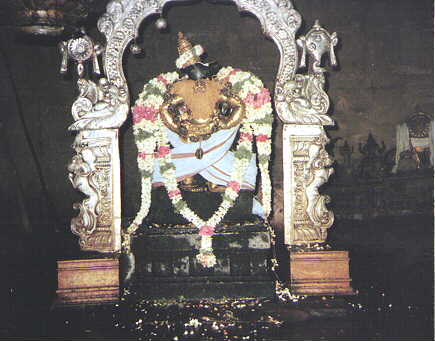
The
main shrine of Sri Bhuvarahaswami is provided with the
Gopuram on the Western side. The Lord, the presiding
Deity faces west; and although the Divine form is
disposed towards the west, the Thiru Mukhamandalam (the
Face of the Lord) is facing south, the region of the
asuras. The Lord is in tbe standing posture. Having
crushed the asura (hiranyakshasa) and rid the world of a
mighty force for evil, the Lord with tears of joy, with
His arms akimbo (hands on the hip), and face slightly
uplifted, presents the very picture of sublime Dignity,
grandeur and triumph - a sight to behold and enjoy and
Impossible to describe. The Mulavar is salagrama murti;
and it is daily anointed (Thirumanjanam). Above the crown
of the Deity stands the famous (Pavana) vimana. The
vigraha and vimana are transmaterial (aprakrita) purity
itself and self existent (swayamvyakta), The puranas tell
us how Brahma is ever engaged in worshipping this Deity. In front of the sanctum sanctorum on the western side of the Ardhamandapam are installed the Utsavamurthi, Yagnavaraha and his consorts, Sri Devi and Bhu Devi facing, west. By their side are seen utsavar, Sri Bhuvarahamurti and Kannan. The utsavamurti, Sri Yagnavaraha, is of transcendent beauty. Tradition has it that in response to the prayers of Sri Ambujavalli Thayar, the Lord appeared in human form - not as Varahamurti - as a Divine Bride groom. In the Sevakala mandapam in front of this, are present to view Bhoga Narayanaswami and his two consorts. During the five seasonal (Pancha Parva) festivals and other occasions the Lord is taken round in procession. For the main Deity there is Tiru vanazhi prakara. In front stands the sculptured Hall, the Purusha Sukta mantapam where Vedas are chanted. It is noted for its rare architectural treasures. Shaped like a ratha (car) it is replete with carvings of figures of warriors mounted on horses and elephants. The forms of lotuses, of parrots and other varieties of birds are chisselled on the canopy; and on the pillars in the centre are carved the figures of the members of the family of the Nayaks who built the temple. |
| Thaayar Sannidhi | The Thaayar Sannidhi, the shrine dedicated to Ambujavalli Thayaar is situated south - east of this beautiful hall. In front stands the unjal utsava mandapam. The Mulavar of this shrine is called Ambujavalli Thaayar and the utsavar is taken in procession round the precincts of this shrine. |
| Srinivasa Perumal Sannidhi | On the inner side of the main gopuram to the east of the entrance stands the sannidhi of Srinivasa Perumal at the, first tier. Facing east-tier, this shrine overlooks Sri Bhuvarahamurti sannidbi. It is interesting to note that just as at Thirumalai Tirupati, the devotee first worships Sri Varahamurti, the Lord of this place Srimushnam, installed in the shrine located at the bank ot Swami Pushbarini, before proceding to offer obeisance to Lord Srinivasa, it has been an age-old custom at Srimushnam for the devotee to worship Lord Srinlvasa and his blessed feet (Tiruvadi) installed down below in the first instance and then only proceed to the shrine of Sri Bhuvaraha Perumal for prayers. |
| Sri Andal Sannidhi | Sri Andal sannidhi is Located at the north west corner of the same prakara. |
| Udayavar Sannidhi | The shrine dedicated to Udayavar (Sri Ramanuja) is also situated in this enclosure, at the northern side. Here every month during the constellation of udayavar's advent into the world, and annually on this blessed occasion, festivals are conducted. During annual celebrations, udayavar is taken in Procession around the main shrine. Thirumanjanam (anointing) is arranged for tne Lord, His consorts and Udayavar, and at night there are chanting of the Vedas and religious festivities. |
| Venugopalan Sannidhi | Venugopalan sannidhi is also situated in the northern side of the same prakara. A ten day Krishna Jayanti utsavam is celebrated for ten days commencing from the date of the Lord's divine advent. |
| Vishvaksenar Sannidhi | Every time the utsavar, Yagnavaraha swami, and other deities are taken in procession round the prakaras, the chanting of the Tamil Prabandams commences at Vishvaksenar sannidhi. In the month Aippasi (October/November), during the constellation Puradam, the jayanti of Vishvaksenar is celebrated. |
| Yaga Salai | Before the commencement of any festival, the yagasalai is set up and initiatory rites are performed and worship offered at this place. |
| Vedantadesikar Sannidhi | This shrine facing west, is situated in the north-east corner of this prakara. Every month, on the constellation sravana, the divya mangala vigraham of Sri Vedanta Desika is taken out in procession, in the temple precincts; and anually the auspicious day of his advent is cdebrated with due enthusiasm and deep piety by taking the idol in procession to the oiher shrines for what is called mangalasasana and tirumanjanam is performed for Yagnavaramurthi, His Consorts, Sri Ambujavalli Thayar and Sri Vedanta Desika. In the night after Satbumarai, Sri Bhuvarahaswami and His Consorts, Ambujavalli Thayar and Sri Desikar are taken round in procession. |
| Thirumangai Azhwar Sannidhi | Tirumangai Azhvar sannidhi is also located in the same prakara. |
| Sri Manavala Mamunigal Sannidhi | Here also the monthly celebrations of the birth star of this Saint are conducted. During annual celebrations, the idol is taken round in procession to the main shrines and Thirumanjanam is arranged for the Lord, His Consorts and the Saint. There is chanting of the scriptures, and procession as part of the celebrations during the night.Thirukkacchinambi sannidhi is also found in the same prakara. |
| Kuzhandai Amman Sannidhi | On the northern side of this prakara near the gopuram is situated Kuzhandai Amman sannidhi. Here dwell Ambujavalli Thaayar's playmates and friends. This is devatantara puja and is under the management of the Devasthanam. |
| North Gopuram | The north gopuram is opened once a year dnring Vaikunta Ekadasi day (December/January) when the presiding Deity is taken out in procession through this gate, which has in consequence been called Vaikuntavasal, the Gateway to Srivaikunta. |
| Udayar Mandapam | During the regime of the Udayarpalayam Zamindars, they constructed this mandapam. It is on the northern side of this prakara. On occasions of festivals the Lord is taken to this place, installed on vahanas and decorated. On other occasions it is usual to install the Deity in the halls provided in this mandapam. Tbis mantapam also houses an artistic glass house constructed. Thanks to the efforts of the Archakas and the munificence of devotees. On festive occasions, the Lord and His Consorts are beautifully decorated and installed in the glass house to the delectation of devotees. Special festivals are conducted here, if devotees so desire. |
| Noorukaal Mandapam | To the west of the dvajasthamba (flag staff) and to the east of the main gopuram stands the hundred pillared mandapam; at tho southern side thereof stands Nammalvar Sannidhi. It is here that the special illumination ceremony known as Tiruvandikkappu is oondncted. |
| Nammazhwar Sannidhi | The advent of Nammalvar is celebrated annually with Thirumanjanam, chanting Thiruvaimozhi and the like. |
| Chakravarthi Thirumagan (Sri Raman) Sannidhi | The shrine to Sri Rama is located in the midst of a flower garden to the northwest of the temple and is overlooking. Sri Bhuvaraha Swammi Sannidhi. Here one beholds Sri Rama along with Sita, Lakshmana, Bharata, Satrugna and Anjaneya as on the coronation (pattabishekam) celebrations. The idols are of unsurpassed beauty. At this temple are also found the images of the Lord in His Mathsya (Fish) and koorma (Tortoise) avataras. (There are no utsava murtis here). Sri Ramanavami festival is celebrated here annually. |
| Vidi Anjaneyar Sannidhi | Right opposite the Bhuvaraha murti temple, in the sannidhi street near the western end stands the Anjaneya Sannidhi. It is known as 'Thiruvadikoil'. This Hanuman is reputed to be be granter of boons (varaprasaadhi). The Lord is taken our in procession to this sannidhi during festivals. |
| Lakshmi Narayanan Sannidhi. | This is situated on the eastern bank of the Nityapushkarini. The presiding Deity of this shrine is of puranic fame. The Puranas describe God when the Lord Boovarahan killed the asura Hiranyakshasa and His anger had not yet subsided, Brahma and other devas beseeched Sri Bhudevi to intervene and induce the Lord to control His ire, and that accordingly Sri Varahamurthi became calm, embraced Bhumi Devi and placed her on His lap and appeared as Lakshminarayana as in Vaikunta to the assembled devotees, Brahma, Rudra, Indra and other Devas & Rishis. The Puranas narrate how for a muhurtha (while) the Lord sported in the waters of Nityapushkarini and took the place for His abode· In this mantap, every morning at an early hour Brahma Yajna Prasna and vedas are chanted. The Puranas give us an elaborate account of the importance of this place |
| Asvatha Narayanan Sannidhi | The Puranas say that at this Kshetra, Sri Bhuvarahaswami appears in the form of an Asvatha tree (Arasa Maram); and the shrine to Sri Asvathanarayana stands at the south-east corner of Nityapushkarini. This sacred Vriksha is reputed to date from the time of Varahavatara. Its sanctity is described in Skanda, Brahamanda, Varaha, and Naradiya puranas. While the management of this shrine vests with the Devasthanam, puja therein has been performed by madhva brahmins. The Triple Anjaneya sannidhis on the banks of the Nityapushkarini are likewise managed by the Devasthanam, while Puja kaingaryam is performed by madhva brahmins. |
| Festivals | Brahmotsavas are conducted twice a year. In the month of Masi (a nine day festival is celebrated and the Deity is taken to the sea 30 miles away near Killai. In Chitrai, a nine day festival and on the closing day, the full moon day, theerthavari are conducted. This festival is reputed to be specially sacred. At noon on the closing day, the Lord and Bhudevi are said to perform Jalakrida in the pushkarini; all the holy waters of the world are said to mingle in this Pushkarini then. A bath here on that occasion is said to rid a person from all sins. Other festivals are conducted every month. |
| Theerthams | Nityapushkarini is the main tirtha
(Sacred water shed) of this place. Ganga acquires
sanctity from its source, Toe of Lord Vishnu, this is
speciality sanctified as it has merged from His entire
body (Vishno: sarvaanga samparshat), and words are
inadequate to describe the merits of this Pushkarini. As
mentioned already, on the full moon day in (In the month
of Chittirai all the sacred waters of the world come and
take a bath mingle here). The puranas tell us about the
virtues of a bath in this tank under the shade of the
Holy Asvatha Vriksha. Lakshminarayana tirtha is to the east of the pushkarini and Varaha Tirtha stands on southeast side of the city. BRAHAMA TIRTHA is on the north; and PAVANA TIRTHA too lies in that direction. The entire water used for Tirumanjana of the Lord collects here through an underground connection. Agnitirtha is located in the north eastern direction. Sanka tirtha and Bhoo tirtha are found in the south. Sri Mrutyunjaya tirtha is reputed to have been specially sanctified by the drop of ambrosia that was spilt when Garuda carried the Amruta kalasa (pot of divine nector). Bhargava tirtha on the south and Danda tirtha are other holy tirthas of the place. The latter is considered by Madvas as of special importance. Tradition has it that during the visit of Madhva acharya it was created by the Acharya by inserting his dhanda in the ground and a spring of water appeared to allay the thirst of an expectant mother suffering from extreme thirst SUKLA THE VELLAR RIVER: The grand daughter of Hiranyaksha's (daughter of Gillika) was granted the form of this sacred river as a reward for devotion to the Lord. Krishna (Manimuttar) too is the daughter of Gillika who obtained this holy form through her intense. Valayamadevi Pavana Thirtha, the place where Ambujavalli Thayaar incarnated, is also reckoned as a thirtha belonging to Srimushnam. This kshetra is a symbol of Hindu-Muslim amity and concord. The strife and comunal discord, which we hear about in other places in our country, do not exist here. Lord Bhuvaraha had, and is still havin lot of moslem devotees, worshippers and admirers.A muslem ruler by name Hazarat Rahmatulla Waliyulla Suthari who was ruling this part of the country, and had his capital in a village called Thaikal near Killai, years ago, had endowed large tracts of land and constructed a mandapam in Killai. From out of the income of the lands, a great festivalis celebrated every year to Lord Bhuvaraha, in the month of Masi, while the lord is taken to the Eastern sea for Thirthavari. The deity is taken through the moslem village with music and bands, and offerings are made in front of the Darga, where the ruler is burried. A garland from the Deity is placed on the Samadhi and champour is burnt, while the Kazi of the mosque recites from the Koran. Again offerings are made to the Deity and prasadams taken and placed in the house of the decendents of the Nawab. In the night the Deity is taken again in a flower-palanquin, with music and fire works, upto the Darga and people of both communities Hindus and Muslems participate in the grand festival! |
| Holiness of Srimushnam | The Itihasas and Puranas tell us that there is no Kshetra comparable to Srimushnam. Sri Bhuvaraha Perurnal is worshipped all the time by Brahma, Indra and other devas, danavas, yakshas, rakshaas, gandharvas, kannaras; hosts of rights, vidyadaras, yogins-all dwell here and ceaselessly offer obeisance to Sri Bhuvarahamurti. It is said to be a hundred times more holy that Kasi reputed for taraka mantropadesa. Those who study the Srimushna mahatmika, worship the presiding Lord of this kshetra and bathe in the holy waters of the place cross the ocean of samsara and reach Srivaikuntam. If one happens to die in this holy spot, he attains moksha. A visit even once to this place during one's life time suffices to ensure for one spiritual salvation. |
| Communal Amity | This kshetra is a symbol of Hindu-Muslim amity and concord. The strife and comunal discord, which we hear about in other places in our country, do not exist here. Lord Bhuvaraha had, and is still havin lot of moslem devotees, worshippers and admirers.A muslem ruler by name Hazarat Rahmatulla Waliyulla Suthari who was ruling this part of the country, and had his capital in a village called Thaikal near Killai, years ago, had endowed large tracts of land and constructed a mandapam in Killai. From out of the income of the lands, a great festivalis celebrated every year to Lord Bhuvaraha, in the month of Masi, while the lord is taken to the Eastern sea for Thirthavari. The deity is taken through the moslem village with music and bands, and offerings are made in front of the Darga, where the ruler is burried. A garland from the Deity is placed on the Samadhi and champour is burnt, while the Kazi of the mosque recites from the Koran. Again offerings are made to the Deity and prasadams taken and placed in the house of the decendents of the Nawab. In the night the Deity is taken again in a flower-palanquin, with music and fire works, upto the Darga and people of both communities Hindus and Muslems participate in the grand festival! |
Respects to adiyen's grand father Sri Srinivasa Raghavacharyar, who was an eminent lawer, great Srivaishnava, at Vriddhachalam. Most of the above information came from his book. Please look forward for an elaborate site on this Kshethra alone in Tamil, based on his book.