El Salvador – The Lithographs of 1899 & 1900
And the Provisional Issues produced from them.
Although 1899 was the last year of the Seebeck contract with El Salvador the design used was carried forth into 1900 and this remained in use till a new definitive series appeared in 1903. However, during a stamp shortage in 1905-06 the earlier stamps were revalidated and used till the appearance of the Escalon Issue in 1906. In 1911 the same design was used to produce the Official stamps. Thus, we are examining about 140 major stamps without counting all the varieties.
This design was in use for over a decade and, in my opinion, offers an interesting and challenging area of collecting. In general, little is known about these issues for they have not been widely collected nor intensively studied.
I hope that these beginning efforts will provide some help to other collectors and serve as an impetus to others to examine their material. I certainly would like to hear from others with comments, suggestions, corrections to anything presented here.
1899 Issue
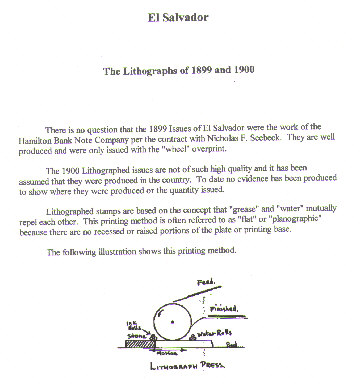
According to the contract between Seebeck and the government of El Salvador, all the issues he was to provide were to be engraved but this issue was lithographed. Although this was not the first time he provided a lithographed issue – see the 1891 officials of Nicaragua – it is the first time a definitive issue was provided as a lithograph. Not only was the 1899 issue of El Salvador a lithograph so was the 1899 issue of Nicaragua. There is a reason for this, which will be discussed a bit later.
I suspect that this 1899 issue may not have been issued on 1 January as most previous years issues were with the exception of the 1898 issue since there was a government decree that stated the 1897 issue was to remain valid till 1 February 1898. There was also a decree that the 1898 issue was to remain valid till February 1, 1899.
Seebeck was a very ill person now – he died in June 1899 – and he was not interested in renewing the contract for this and other reasons. I suspect that the government did not return the remainders of the 1898 issue, else where did they get the 1898 issues to overprint with the wheel device in 1899, or to produce the 1900 provisional issues with these 1898 stamps? I also suspect there were not a great number of remainders and the government was more interested in getting free stamps than in protesting the supply of lithographed ones. Besides, Seebeck’s brother-in-law, Ernest Schernikow, was the Consul General for El Salvador in New York and probably could help overcome any complaints about the lithographed issues. And there is no question that the government was interested in getting free or very cheap stamps since there was another attempt to get a contract similar to the one with Seebeck in 1900. Schernikow was one of the people who bid on supplying free stamps for this latter contract. It was never completed.!
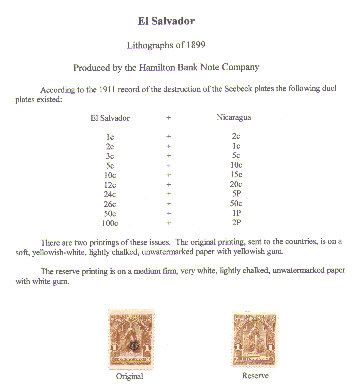
The 1899 issue was printed by the Hamilton Bank Note Company apparently in sheets of 200 stamps, 100 stamps of El Salvador (10 x 10) and 100 stamps of Nicaragua (10 x 10). Earlier research has shown that there is a 100% correlation of color and paper for the issues of El Salvador and Nicaragua for this issue and from the 1911 destruction of the Seebeck plates we know that there were engraved (!) blocks of 10 of El Salvador and Nicaragua on the same mini-plate.
For many, many years Scott did not recognize that the 1899 issue was a Hamilton Bank Note/Seebeck issue, but in the current (2004) edition they have corrected this and now do so recognize it.
At some time, probably after arriving in El Salvador, the lithographed stamps were overprinted by letterpress with a starburst wheel device. Apparently the government felt that lithographed stamps were too easy to counterfeit and that some additional security measure was needed to help prevent this. I believe the overprinting was done in El Salvador because: 1) the large number of reserve or over-run stamps that exist today without the wheel overprint and 2) the same device was used to revalidate the 1898 stamps in 1899. I submit that had the wheel device been available in New York, all the stamps would have been so overprinted.
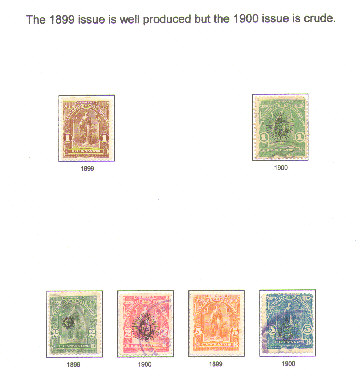
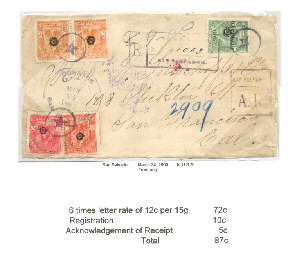
Eleven values from 1 centavo to 100 centavos were issued. The quantities are unknown, but probably were very small for the 50c and 100c as these values were seldom needed or used.
There is a great uniformity in the shades of these stamps and although there are some minor differences in some values, this could be accounted for as variations that can occur in the same printing. I know of the following varieties – Horizontal pair, imperf between, 1c, 2c, 3c, 10c, 26c and 100c; Imperf pair, 1c, 2c, 3c, 5c, 10c, 13c, and 50c. All of these varieties lack the wheel overprint and I consider them unfinished stamps.
The 1c, 2c and 5c are known perf 6 x 12, a condition that resulted from damaged pins on the perforating machine. All are also known in this perforation without the wheel overprint. This same perf 6 x 12 variety exists for the 2c and 5c values in the 1899 Nicaragua Issue and are very rare.
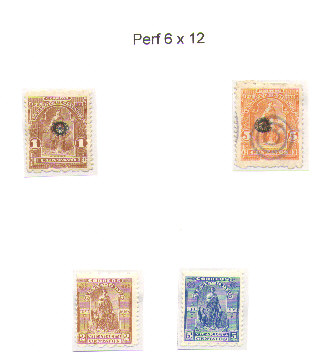
The 1c is known with a wheel in blue and with the wheel in red, this latter I suspect is a trial color as I do not think it was ever issued in this color. The 1c with wheel in blue is also known in the perf 6 x 12 variety. This value is also known with a double wheel overprint and a triple wheel overprint. Both of these varieties have been extensively counterfeited so care must be taken when obtaining them.
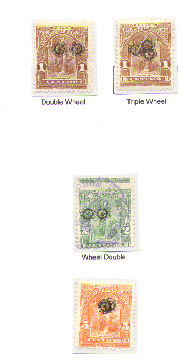
The 2c is known with a double wheel, as is the 3c value.
The 5c is known with a wheel in blue, with a double wheel in black and with a triple wheel in black. The triple wheel variety is also known on the perf 6 x 12 variety.
The 10c is known with a wheel in blue and with a triple wheel in black.
The 26c is known with a double wheel overprint in black.
All of the values with a genuine blue wheel I have seen are in a blue-black shade. These are known on cover but are very elusive.
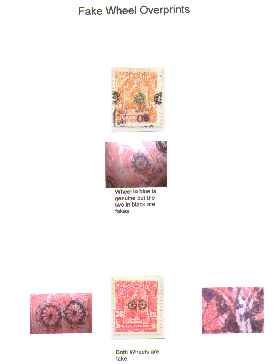
The wheel overprint has been counterfeited and this is especially true for the double and triple wheel varieties. Often with multiple wheel overprints, one wheel will be genuine and the others counterfeit.
These stamps were not issued without the wheel overprint, but through accident or design a few covers are known bearing stamps without the overprint and they have paid the postage and gone through the mail.
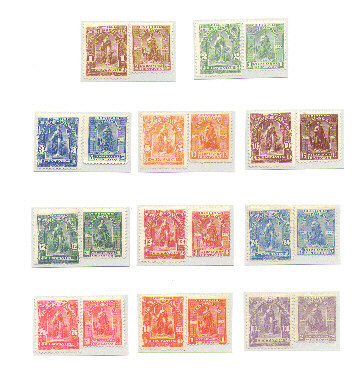
There is, what I consider to be a reserve printing of these stamps – all without the wheel and they can be identified as being on a medium firm, very white, lightly chalked paper with white gum. The shades are slightly different from the original printings.
The following varieties of this reserve printing are known – Imperf pair, 1c, 3c, 5c, 10c, 12c, 26c, 100c; Horizontal pair, imperf between, 1c, 2c, 3c, 5c, 10c, 12c, 13c, 26c, 50c & 100c; Vertical pair, imperf between, 1c, 2c, 5c, 10c, 12c, 13c, 26c, 100c.
The 11 values were overprinted with a "Franqueo Oficial" design for use as official stamps and were only issued with the wheel overprint although the 13c is known on cover missing the overprint. As with the regular issues there is a reserve printing missing the wheel overprint.
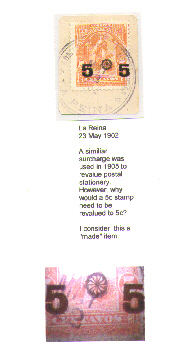
There is a bogus 5 - 5 overprint known on the 5c value but why a 5c stamp would need to be surcharged 5c I do not know.
Multiples of any of these stamps, including the reserve printing, are not common at all, although blocks of 4 may be found from time to time.
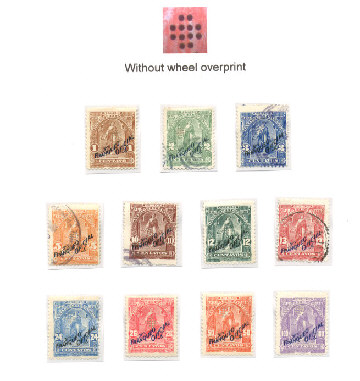
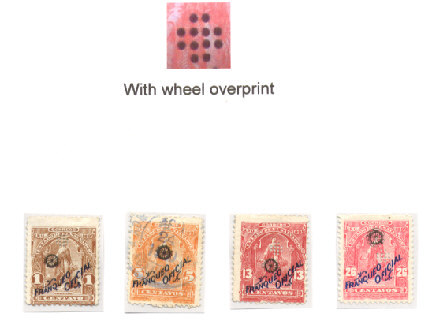
Sometime in 1900, apparently due to a shortage of stamps, the official stamps with and without a wheel overprint were perforated with a + type design of 12 holes to validate them as regular postage stamps. Some values are also known perforated with a $ device for the same reason. It appears that these were fiscal canceling devices used to change official stamps into a regular one. The only variety I have seen is a 1c without wheel double punched with the + design.