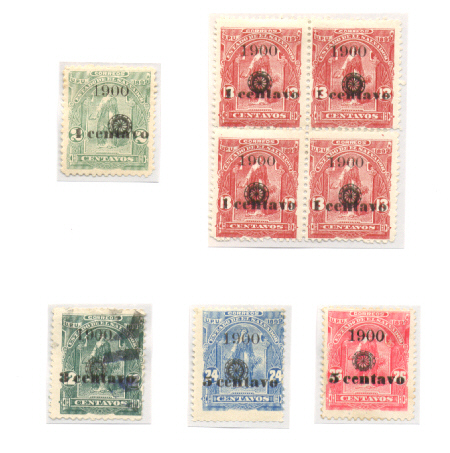
El Salvador
The Provisional issues of 1900 Produced from the 1899 Issue
In October 1899, an Emilio Ferrer proposed to print yearly issues for a 5-year period, but apparently no decision was made through June 1900. During this time radical changes were made in the national budget. Perhaps this was a reason for no decision, but whatever the reason it was apparent that certain denominations of stamps – mostly low values such as 1c, 2, and 5c – were in low supply and so less needed values, or values of which there was a plentiful supply, were surcharged to meet the needs of the country till a new issue could be provided.
According to Joseph B. Leavy, who wrote a long article on the "Stamps of Salvador" in Stanley Gibbons Monthly Journal in 1907/08, whatever supplies of these available stamps that could be found were utilized to produce the needed values. He states, and I had examples at one time, that single stamps were pasted onto strips of paper to be fed into the press for overprinting. He goes on to state and I tend to agree that the press was only large enough to handle 50 stamps at a time. My agreement is based on a block of 50 and a block of 45 of the "Transito Territorial" overprinted stamps I once had in my collection. From a study of these blocks it was apparent that only 50 types of the overprint existed. Leavy goes on to state that because the surcharge setting was of only 50, sheets of 100 stamps had to be fed through the press twice and this may be the cause of some of the "double surcharge" or "inverted surcharge" varieties. The clincher would be a vertical pair showing a tete-beche surcharge. I’ve never seen one. Leavy further states that there were 4 printings of these provisional surcharges, one in February, one in August, one in September and one in October although not all values were printed each time.
Since stamps were rounded up and surcharged there are no known records of the quantities printed of each surcharged value and it is doubtful if this will ever be known. Many of these provisionals are very elusive, especially mint. I believe two factors helped make this so. First, El Salvador was a "Seebeck" country and so not held in high collecting regard and Second, these were provisional surcharges, a variety of stamp held in even lower regard than a Seebeck. Even though packet makers were buying any cheap stamps for their trade, they certainly did not pay attention to various printings of the surcharge. Also, I suspect a few values were very short-term items because a new issue was expected momentarily.
The Printings
Leavy states, and I have not found anything to contradict him, that the first provisional stamp to be chronicled was the 2c green of 1899 overprinted with the wheel and surcharged "1900 / 1 centavo". He chose that as the first printing type so I shall continue with that designation. The distance between "1900" and "centavo" is 9 mm. Leavy says it was issued about February 1900. He lists the following denominations and varieties and I have placed a red x behind those values I have in my collection:
With Wheel
F1 1c on 2c x
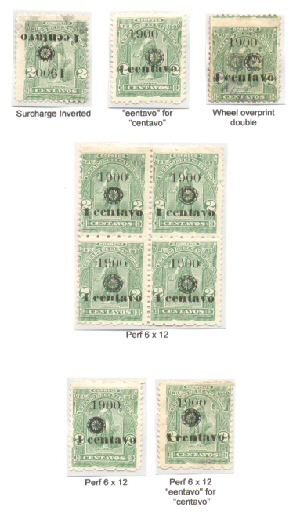
d1) perf 6 x 12, "eentavo" for "centavo" x
F2 1c on 13c x
F3 2c on 13c
F4 3c on 12c x
F5 5c on 24c x
F6 5c on 26c x
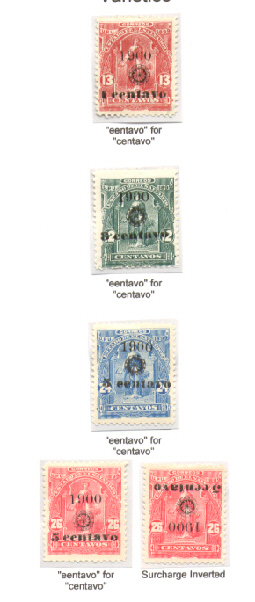
I have the following items not listed by Leavy"
F1NLd2 perf 6 x 12, wheel double x
FNL1 2c on 12c, "eentavo" for "centavo" x This is a denomination he does not list and since I have a variety, I suspect the "normal" items exists as well.
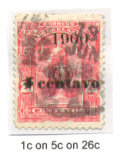
FNL2 5c on 1c on 26c. x
Without Wheel
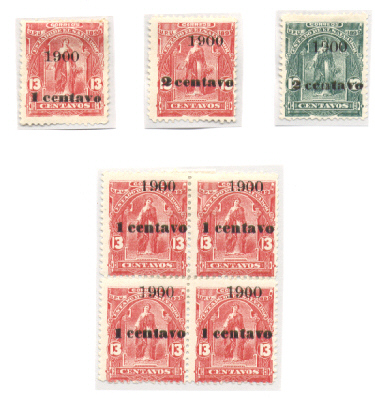
F7 1c on 13c x
F8 2c on 13c x
F9 3c on 12c x
I have the following items not listed by Leavy"
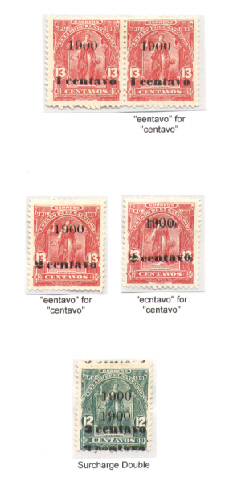
F7NL double surcharge x
F9NL double surcharge x
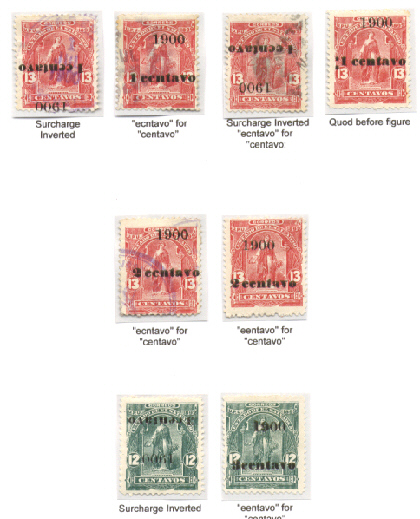
Leavy state that the 1c and 2c on 13c (F8 & F9) were the last stamps printed from this setting and in changing the figure of value the type became displaced in one surcharge resulting in the "ecntavo" error.
Second Setting
Leavy states that an additional printing was made about August 1900 with the spacing between "1900" and "centavo" being 8 mm this time. The earliest reported use I have seen is 8 August 1900 (see cover towards end of this commentary).
He lists the following denominations and varieties:
With Wheel
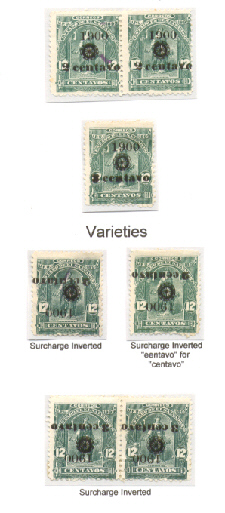
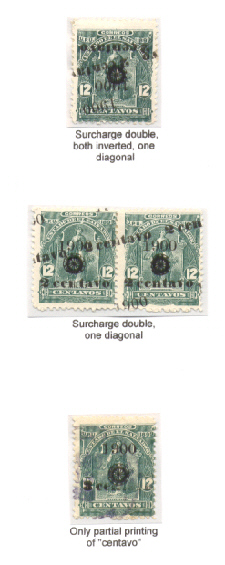
A1 2c on 12c x
A2 3c on 12c x
I have the following items not listed by Leavy"
A1NL1 surcharge double, both inverted, one diagonal x
A1NL2 surcharge double, one diagonal x
A2NL1 partial printing of "centavo" x
Without Wheel
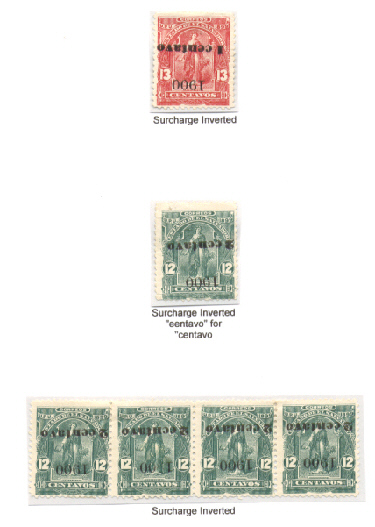
A3 1c on 13c
A4 2c on 12c
A5 3c on 12c
Third Setting
Leavy says that about September there was a third printing, but this was done only on the issue of 1898 so is outside the scope of this article. In this printing the space between "1900" and "centavos" is 6 mm. Note "centavos" is in the plural instead of the singular for this setting.
Fourth Setting
The fourth and final setting, which Leavy states as being done about October, has a distance of 6 mm between "1900" and "centavo" like the September setting, but this one has a numeral before and after the word "centavo". He lists only one denomination.
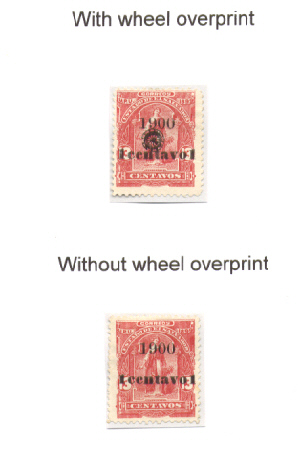
With Wheel
O1 1 centavo 1 on 13c x
Without Wheel
O2 1 centavo 1 on 13c x
Leavy notes, and my studies confirm, that while the space between "1900" and "centavo" never varies within a setting, the alignment of "1900" and "centavo" does vary considerably.
I consider the October setting to be a very short-term issue for two reasons. First, the new series made its appearance in October (Leavy says at the end) and Second, this stamp is very, very elusive. I suspect the quantity printed was very small and may have been done almost on a day to day basis.
Multiples of these provisionals are not common, even blocks of 4, and covers of any of these provisional issues are quite scarce and should be treasured.
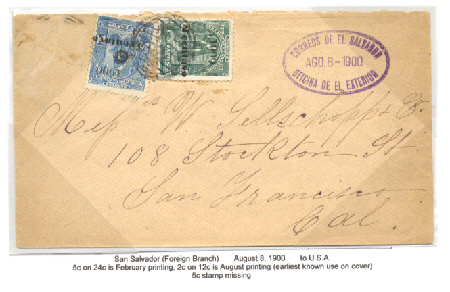
Counterfeits of the surcharge are commonly found and Bruce Ball, in an article in the Oxcart of March 1972, identified six different types. Care should be exercised when acquiring any of the varieties, as many of the double and inverted surcharges I have seen are counterfeits.
The following additional varieties have been reported in the now defunct El Faro, official publication of the Associated Collectors of El Salvador, but those I have not seen I cannot be sure are genuine, but since the listing was compiled by Pierre Cahen, a very knowledgeable collector and student of El Salvador, I suspect they may well be. Further, I do not have any information on what printing some of them may belong to. For example a 3c on 12c without wheel could be an F8 or A5.
No wheel overprint
1c on 13c "190 " ("0" omitted)
"1 centa " ("vo" omitted)
3c on 12c double surcharge, both inverted
With wheel overprint
1c on 2c horizontal pair, imperf between
2 wheel overprints, "eentavo" for "centavo"
1c on 13c 2 wheel overprints, "eentavo" for "centavo"
2c on 12c "2 cen o" ("tav" omitted)
2c on 13c double surcharge
3c on 12c double surcharge, both inverted
double "1900"
wheel double
I have not listed any of the counterfeit items as I consider such a listing to be meaningless since new items can appear at any time.