 |
|
|
|
|
|
|
|
|
|
|
|
|
|
|
|
|
|
|
1086 Robertus Fardenc - An administrator of royal estates, Robert claimed ownership of Stoke Ash as part of the royal manor of Mendlesham in Suffolk. The Norman scribe wrote the personal name Farthegn as Fardenc, literally translated as "Farthing". One historian believes that Robert was a Norman because he had the popular Norman name "Robert". But given the evidence that the Farthegn personal name was in use in England for generations before the Norman Conquest, it is possible that he was not 100% Norman. He may have been a product of intermarriage between English and Norman. If so, this would be an unusually early example of it.
THE VIKING AGE ENDS
1128 Leofwine Fardein / Farthein - donated a house and property to Whitby Abbey. It was located in Marske-by-the-sea in present day Redcar and Cleveland in northern England. The property once belonged to Leofwine's father, Walter Fardein / Farthein. Here is a very early example of a man with a Norman name (Walter) giving his son an English name! Leofwine was an Old English personal name meaning 'beloved friend'. |
|
|
|
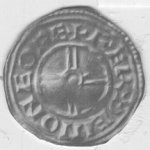
ca 1135 to 1142 Fardein / Farden - royal moneyer for King Stephen. He supported the Empress Matilda when she claimed the throne for herself and her son, the future King Henry II. Coin guides show Fardein and Farden to be forms of Farthegn. |
|
|
|
 |
|
|
|
|
|
ca 1140 to 1146 Richard Ferthing - witness in Yorkshire. Gillian Fellows Jensen, in her study Scandinavian Personal Names in Lincolnshire and Yorkshire, states that Ferthing is probably a misspelling of Farthegn.
ca 1150 to 1165 James the son of Fardin - official for St. James priory in Bristol.
ca1156 to 1184 Agmund Ferthig - witness in Yorkshire. Ms. Jensen, an expert on personal names of the period, believes Ferthig was probably another misspelling of Farthegn. Agmund is a Scandinavian name.
1163 to 1166 William the son of Fardain / William the son of Fardein / William Farthain (these three listings represent a single individual) - He proved his ownership of four dwellings in the town of Lincoln. |
|
|
|
1166 to 1169 Reinfred the son of Farthein - he paid 20 shillings in taxes in the towns of Ilchester and Axbridge in Somersetshire. Actually, only a small percentage of Englishmen paid taxes. Most were too poor to be taxed. Reinfred's tax alone could have purchased as many as 60 sheep, or 25 pigs, or 6 cows, or 6 oxen, or even 6 farm horses. At this time in history, Ilchester was the most important town in Somersetshire, and Reinfred was its wealthiest citizen.
Farthein may have named his son after the Norman knight turned monk of the same name. That Reinfred was an outstanding religious figure that had attracted many followers, especially Englishmen from the south. Two Norwegian kings were also named Reinfred. One was the son of Eric Bloodaxe, the last Viking king of York. |
|
|
|
 |
|
|
|
|
|
Previous Page......Next Page |
|
|
|
 |
|


