
2: And (Polysyndeton, by which in the 34 verses of this introduction, each one of 102 separate acts are emphasized; and the important word "God" in v.1 is carried like a lamp through the whole of this introduction.) the earth became waste, and void; and darkness was upon the face of the deep (The word "was" should be translated "became". God created the earth to be inhabited. Wisdom was with God. The earth became "tohu", that is to say void. Why? One third of God's children followed Satan at Satan's rebellion [Rev.12:1-4. Cp.Ezek.28. Jer.4:22-31. Isa.45:18,19]. Rather than destroy 1/3 of His children, God destroyed the first earth age. 2 Pet.3:6 also documents that the first earth AGE was destroyed, and continues on to declare there will be a third earth AGE. So here, God put the earth back in order. Beginning of the heaven and earth AGE which are now).
A  a  -2-5. Darkness and Light. Night and Day   1st Day.
    b  6-8. Waters. Division between them.      2nd Day.
     c 9-13. Earth. Fruit from it.              3rd Day.
   a  14-19. Day and Night. Sun and Moon.       4th Day.
    b  20-23. Waters. Life from them.           5th Day.
     c  24-31. Earth. Life from it.             6th Day.
And the Spirit of God (Elohim) moved (i.e put it back in order. 2 Pet 3:7. It is even so in the New Creation) upon the face of the waters.
4004 B.C. or 10,004 B.C.or if you consider one day with the Lord = 1,000 years with man.
3: And God (Elohim) said, "Let there become light:" and there
became light. (All prophecies given
concerning God's children are in days-solar. All prophecies given concerning Satan's children are in
\months-moons-night-darkness. Moon calendar is chaotic, it
is a mess. Solar calendar is perfect it, never
changes)
4: And God (Elohim) saw the light, that it was good (=beautiful. Each days work called "good",
except 2nd, because nothing created that day: only division made): and Elohim divided the light from the
darkness. (Compared to His glory He is the only light that we need. Sometimes you have to shut
your flesh eyes and open your spiritual eyes to see and
understand what our Father wants us to know. See Rev.2:1
Light of God, Darkness of Satan)
5: And God (Elohim) called the light Day, and the darkness He
called Night. And the evening and the morning were the day
one.
9004 B.C.
6: And God (Elohim) said, "Let there be an firmament (=expanse. Something spread out) in the midst of the waters, and let it divide the waters from
the waters." (He caused the water to
recede and put part of it in the atmosphere. Much of this
water came down in Noah's flood.)
7: And God (Elohim) made the expanse, and divided the waters
that were under the expanse from the waters which were
above the expanse: and it was so.
8: And God (Elohim) called the expanse Heaven (=high, lofty). And the evening
and the morning were day two.
8004 B.C.
9: And God (Elohim) said, Let the waters under the heaven be
gathered together to one place, and let the dry land
appear:" and it was so.
10: And God (Elohim) called the dry land Earth; and the
gathering together of the waters He called Seas: And God (Elohim) saw that it was beautiful. (i.e.coming back to beauty as it once
was)
11: And God (Elohim) said, "Let the earth bring forth grass,
the herb yielding seed after his kind, and the tree
yielding fruit after his kind, whose seed was in itself,
upon the earth:" and it was so. (Evolution has no answer to
this)
12: And the earth brought forth grass, and the herb
yielding seed after his kind, and the tree yielding fruit, whose seed was in itself, after his kind: and God (Elohim) saw
that it was beautiful.
13: And the evening and the morning were day three.
14: And God (Elohim) said, "Let there be lights (lightholders or luminaries) in
the expanse of the heaven to divide the day from the night; and let them be for signs (=things to come) and for
seasons (=appointed
times), and for days, and years: (You need these to become a successful farmer and seed planter.)
15: And let them be for lights in the expanse of the
heavens to give light upon the earth:" and it was so.
16: And God (Elohim) made the two great lights; the greater
light to rule the day, and the lesser light to rule the
night; He made the stars also. (i.e the Zodiac. Don't make a religion out of it just use it to observe. God's plan is
perfect)
17: And God (Elohim) set them in the expanse of the heaven to
give light upon the earth.
18: And to rule over the day and over the night, and to
divide the light from the darkness: and God (Elohim) saw that it
was beautiful.
19: And the evening and the morning were day four.
7004 B.C.
20: And God (Elohim) said, "Let the waters bring forth
abundantly the moving creature that has life (=soul, Heb. nephesh), and the
fowl that may fly above the earth in the open expanse of
heaven."
21: And God (Elohim) created great sea-creatures, and every
living soul that moves, which the waters brought forth
abundantly, after their kind, and every winged fowl after
his kind: and God (Elohim) saw that it was beautiful.
22: And God (Elohim) blessed them saying (note the threefold blessing-1:22,28;
2:3), "Be fruitful and multiply, and fill the
waters in the seas, and let the fowl multiply in the
earth." (to bring back that which was
taken away)
23: And the evening and the morning were day five. (#5=grace. No blessing till the 5th
day, when there was living souls to bless)
6004 B.C.
24: And God (Elohim) said, "Let the earth bring forth the
living soul after his kind, cattle, and creeping things,
and the beast of the earth after his kind:" and it was
so.
25: And God (Elohim) made the beast of the earth after his
kind, and cattle after their kind, and everything that
creeps upon the earth after his kind: and God (Elohim) saw that
it was beautiful.
26: And God (Elohim) said, "Let Us (In the Hebrew=elohim without the article=the heavenly host) make mankind in the likeness of
Our image (namely of Elohim [not
Yahaveh], the 2nd Person, who had taken creature form to
create [Col.1:15. Heb.1:3. Rev.3:14; cp. Prov.8:22-31, and
1 Cor.11:3-11]. Refers only to outward form, not to
attributes. So He afterward took human form in order to
redeem [John 1:14]. Cp. Rev.4:11 with 5:9. In any case the
"image and likeness" is physical, not moral. Man fell and
is in moral ruin, but some physical likeness to 'elohim
still remains. Gp. Gen.9:6. 1 Cor.11:7. Jas.3:9. No
indication that the similitude was ever lost. Gen.5:3. See
note on 3:7.): and let them have dominion over
the flesh of the sea, and over the fowl of the air, and
over the cattle, and over all the earth, and over every
creeping thing that creeps on the earth."
27: So God (Elohim) (The Heb. accent
[Pasek] places the emphasis on God, the Carrier-out of His
purpose) when He did create mankind (In the Hebrew adam without the article means mankind in general) in the image of Elohim when
He did create mankind; male and female created He them.
("Why was mankind created last" That
the heretics might not say there was a companion with Him
in the work": i.e lest man should have claimed a share of
it)
28: And God (Elohim) blessed them and God (Elohim) said to them, "Be
fruitful, and multiply, and replenish (why this word if there was nothing there to begin with? God took man, not in the flesh, but
angelic-spiritual form, from the earth. See
Jer.4:22-26) the earth, and subdue it: and have
dominion over the flesh of the sea, and over the fowl of
the air, and over every living thing that moves upon the
earth."
29: And God (Elohim) said, "Behold, I have given you every herb seed, which is upon the face of all the earth, and every
tree (which includes
fruit), in the which is the fruit of a tree
yielding seed; to you it shall be for meat. (=food of all kinds, no "meat" until after
the Flood. See 9:3. So we have hunters, fishers and fruit gatherers to this point. No farmers yet!)
30: And to every beast of the earth, and to every fowl of the air, and to everything that creeps upon the earth,
wherein there is a soul, I have given to them every green
herb for meat:" and it was so.
31: And God (Elohim) saw that everything that He had made, and, behold, it was very beautiful (includes all the races. They are all
special). And the evening and the morning were
the sixth day.
5004 B.C.
2: And on the sixth day God (Elohim) ended His work which He
had made; and He rested (i.e. from
achievement) on the seventh day (=1,000 years) from all His work
which He had made.
3: And God (Elohim) blessed the seventh day, and sanctified it: because that in it He had rested from all is work which God
(Elohim) created and made. (He was
pleased with it)
J¹  2:4-25. BEFORE the Fall. Man in probation.
J²  3:1-24. The FALL of man.
J³  4:1-26. AFTER the Fall. Man in ruin.
J¹  A  2:4,5-. The earth for man and woman.
     B  a  -5. For the ground, no man.
         b  6. The ground and vegetable creation.
          c  7. The formation of The man Adam.
           C  d  8. The Garden.
               e  9. The Trees.
                D  10-11. The Rivers.
           C  d  15. The Garden.
               e  16,17. The Trees.
     B  a  18. For The man Adam, no woman.
         b  19,20-. The ground and animate creation.
          c  -20-23. The formation of the woman Eve.
    A  24,25. Man and woman for the earth.
4: These are THE FAMILY HISTORYS OF THE HEAVENS AND OF THE EARTH when they were created, when that the LORD God (Yehovah Elohim) made the earth and the heavens. (From the beginning)
for the LORD God (Yahaveh Elohim) had not caused it to rain upon the earth, and there was not a man to till the ground. (=to farm it. He had created men to hunt, and fish, and gather. See 1:27)
6: And there went up a mist (=dew) from the earth and watered the whole face of the ground. (There still was a firmament overhead)
4004 B.C.
7: And the LORD God (Yahaveh Elohim) formed (i.e. as a Potter. Notice, not "created") the man Adam (=this very man Adam, Heb. eth ha Adam. Emphatic) of the dust of the ground, and breathed into his nostril the breath that is life; and the same man Adam became a living soul. (To till the soil)

8: {And the LORD God (Yahaveh Elohim) planted a garden in Eden (This garden may be additional to 1:11,12; 2:4,5-. That creation concerns the "plants of the field". This may have been a special planting, and lost when the garden of Eden was lost. Note the 3 gardens: [1] Eden, death in sin; [2] Gethsemane, death for sin; [3] Sepluchre, death to sin.), eastward; and there He put this very same man Adam whom He had formed (Not "created" as in 1:27).
9: And out of the ground the LORD God Yahaveh Elohim made to grow up every tree (includes fruit) that is pleasant to the sight, and good for food; the Tree supporting and continuing the life which had been imparted (i.e. Christ), also in the midst of the garden, and the tree of sense (or perception) of good and evil. (i.e. Satan) (This becomes law)
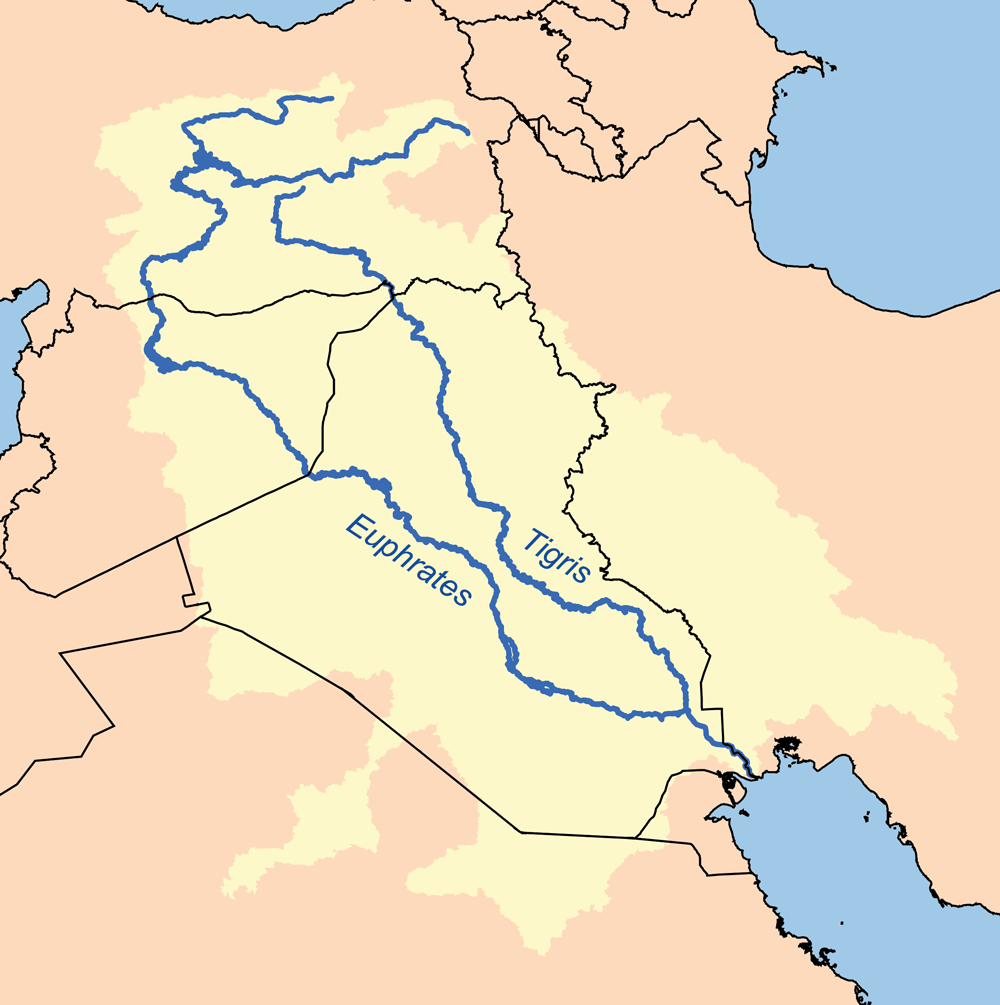
10: And the river (=the Persian
Gulf, known as such to the Accadians, in which the river
became 4 mouths, or heads at spots where they flowed into
the source which received and fed them) went out of Eden to water the garden; and from there it was parted,
and became into four heads.
11: The name of the first is Pison (=dispersive. The river W. of the Euphrates,
called Pallukat in reign of Nabonidos, last king of
Babylonia, or the Pallakopas Canal): that is it
which compasses (the Pallukat or Pison encircled the N. borders of the great sandy desert which
stretched westward to the mountain chains of Midian and
Sinai) the whole land of Havilah (=the region of Sand. Indicated in 2:18. 1
Sam.15:7. Shur would be the E. end of Havilah, the W. of
this region. Connected with Ophir in 10:29.),
where there is gold;
12: And the gold of the land is good: there is beryllium
and the onyx stone (has the
color of flesh through the nail of the human
body).
13: And the name of the second river is Gihon (=a stream. The river E. of the
Tigris): the same is it that compasses the whole land of Kas (=Accadian).
14: And the name of the third river is Hiddekel (=rapid. The Tigris): that is it
which goes toward the east of Ashur. And the fourth is
Euphrates (=the great river, Pura-nun. The Greek comes from the old Persian Ufratu, and this from
Purat or Puratu. The Hebrew=pherath).
15: And the LORD God (Yahaveh Elohim) took this same man Adam and put him into the garden of Eden (=pleasure) to dress it, keep it safe, and preserve it.}
16: And the LORD God (Yahaveh Elohim) commanded the man Adam, saying,
"Of every tree of the garden you may freely eat;
17: But of the tree of sense (or
perception) of good and evil (see v.9. Obedience proving what was "good"
[Deut.6:24], disobedience revealing what was "evil"
[Rom.3:20), you shall not eat of it: for in that day (=when. No one lived past
1,000 years=a day with the Lord) that you eat
thereof you shall surely die." (See
note on 26:28 for the emphasis of this Figure exhibited in
other ways; and cp. esp. note on Num.26:65. Here marked by
the word "surely", as in v.16 by the word "freely". This
certainly changed by Eve in 3:3 into contingency. No
"apple tree" mentioned. Note the 3 trees: "Knowledge"
[2:9], man's Ruin; "the Cross" [Acts 10:39; 5:30. 1
Pet.2:24], man's Redemption; "the Tree of Life" [2:9.
Rev.2:7; 22:2], man's Regeneration)
18: And the LORD God (Yahaveh Elohim) said, "It is not good that the man Adam should be alone; I will make him a help as his counterpart for him."
19: And out of the ground the LORD God (Yahaveh Elohim) formed every
beast of the field, and every fowl of the air; and brought
them to Adam to see what he would call them: and whatsoever Adam called every living soul, that was the name thereof.
(Domestic animals)
20: And Adam gave names to all the cattle, and to the
fowl of the air, and to every beast of the field; but for
Adam there was not found any help as his counterpart for
him.
21: And the LORD God (Yahaveh Elohim) caused a deep sleep to fall upon
Adam, and he slept: And He took one of his ribs
(Heb.=curve. DNA Helix? From the
Hebrew prime tsala'), and closed up the flesh
instead thereof;
22: And the rib
9see above), which the LORD God (Yahaveh Elohim) had taken from
the man Adam, made He a female, and brought her to the man
Adam.
23: And Adam said, "This is now bone of my bones, and
flesh of my flesh: she shall be called female, because she
was taken out of man."
24: Therefore shall a man leave his father and his
mother, and shall cleave to his wife: and they shall be one flesh. (.quoted Matt.19:5, &c. 1
Cor.6:16. Eph.5:31. Marriage is union).
25: And they were both naked (Heb.
'arum, a Homonym. The same spelling as word rendered
"subtitle" in 3:1), the man Adam and his wife, and knowing only good were not ashamed before God (Elohim).
J²  E  1-5. The Nachash: procuring man's death, in
             Adam.
     F  6. The Tree of knowledge. Eating of it.
      G  f  7-. Effect on both: Adam & Eve.
          g -7. Human provisions: man-made aprons.
           H  8-12. God's inquiry of Adam.
            I  13. God's inquiry of Eve.
             K  14. Sentence of the Nachash.
             K  15. Promise of the Seed.
            I  16. God's sentence on E
           H  17-19. God's sentence on Adam.
      G  f  20. Effect on both: Adam & Eve.
          g  21. Divine provision: God-made coats.
     F  22-24-. The Tree of Life. Expulsion from it.
    E  -24. The Cherubim: preserving mankind's
          life, in Christ.
Not allegory: but literal history, emphasized by Figures of Speech.
In Genesis Chapter 3 we have neither allegory, myth, legend, or fable, but literal historical fact set forth, and emphasized by the use of certain Figures of Speech.
All the confusion of thought and conflicting exegesis (Interpretation of Scripture) have risen from taking literally what is expressed by Figures, or from taking figuratively what is literal. A Figure of Speech is never used except for the purpose of calling attention to, emphasizing, and intensifying, the reality of the literal sense, and the truth of the historical facts; so that, while the words employed may not be so strictly true to the letter, they are all the more true to the truth conveyed by them, and to the historical events connected with them.
But for the figurative language of verses 14 and 15 no one would have thought of referring the third chapter of Genesis to a snake, no more than he does when reading the third chapter from the end of Revelation (20:2). Indeed, the explanation added there, that the "old serpent" is the Devil and Satan would immediately lead one to connect the word "old" with the earlier and former mention of the serpent in Gen.3: and the fact that it was Satan himself who tempted "the second man", "The last Adam", would force the conclusion that no other than the personal Satan could have been the tempter of "the first man, Adam."
The Hebrew word rendered "serpent" in Gen.3:1 is Nachash (from the root Nachash, to shine), and means a shinning one. Hence the Chaldee means brass or copper, because of its shinning. Hence also, the word Nehushtan, a piece of brass, in 2 Kings 18:4.
In the same way Saraph, in Isaiah.6:2,6, means a burning one, and, because the serpents mentioned in Num.21 were burning, in the poison of their bite, they were called Saraphim, or Seraphs.
But when the Lord said to Moses, "Make you a fiery serpent" (Num.21:8), He said, "Make you a Saraph," and, in obeying the command, we read in v.9, "Moses made a Nachash of brass," Nachash is thus used as being interchangeable with Saraph.
Now, if Saraph is used of a serpent because its bite was burning, and is also used of a celestial or spirit-being (a burning one), why should not Nachash be used of a serpent because its appearance was shinning, and be also used of a celestial or spirit-being (a shining one)?
Indeed, a reference to the structure of Gen.3 will show that the Cherubim (which are similar celestial or spirit-beings) of the last verse (Gen.3:24) require a similar spirit-being to correspond with them in the first verse (for the structure of the whole chapter is a great Introversion). The Nachash, or serpent, who beguiled Eve (2 Cor.11:3) is spoken of as "an angel of light" in v.14. Have we not, in this, a clear intimation that it was not a snake, but a glorious shinning being, apparently an angel, to whom Eve paid such great deference, acknowledging him as one who seemed to possess superior knowledge, and whom was evidently a being of a superior (not inferior) order? Moreover, in the description of Satan as "the King of Tyre" it is distinctly implied that the latter being was of a super-natural order when he is called "a cherub" (Ezek.28:14,16 read from v.11-19). His presence "in Eden, the garden of 'Elohin"(God) (v.13), is also clearly stated, as well as his being "perfect in beauty" (v.12), his being "perfect in his ways from the day he was created till iniquity was found in him" (v.15), and as being "lifted up because of his beauty" (v.17).
These all compel the belief that Satan was the shinning one (Nachash) in Gen.3, and especially because the following words could be addressed to him, "Your heart was lifted up because of your beauty, you have corrupted your wisdom by reason of your brightness: I will cast you to the ground, I will lay you before kings, that they may behold you." (v.17).
Even supposing that these things were spoken to, and of, an exalted human being in the later days (Ezek.28), still "the King of Tyre" is not compared to a being who was non existent; and the facts and the circumstances which never happened are not introduced into the comparison.
There is more about "the King of Tyre" in Ezek.28:11-19 then was literally true of "the prince of Tyre" (vv.1-10). The words can be understood only of the mightiest and most supernatural being God ever created; and this for the purpose of showing how great he would fall. The history must be true to make the prophecy of any weight.
Again, the word rendered "subtle" in Gen.3:1 means wise, in a good sense as well as in a bad sense. In Ezek.28:12 we have the good sense, "You seal up the sum, full of wisdom"; and the bad sense in v.17, "You have corrupted your wisdom" (referring of course to his fall). So the word rendered "subtle" is rendered "prudent" in Prov.1:14; 8:12; 12:23; 14:8; and in a bad sense in Job 15:5. 1 Sam.23:22. Ps.83:3.
The word "beast" also, in Gen.3:1, chay, denotes a living being, and it is as wrong to translate Zoa "beast" in Gen.3. Both mean living creature. Satan is thus spoken of as being "more wise than any living creature which Yahaveh Elohim had made". Even if the word "beast" be retained, it does not say that either a serpent or Satan was a "beast", but only that he was "more wise" than any other living being.
We cannot conceive Eve as holding a conversation with a snake, but we can understand her being fascinated by one, apparently "an angel of light" (i.e. a glorious angel) possessing superior and supernatural knowledge.
When Satan is spoken of as a "serpent", it is the Figure Hypocatastasis or Implication; it no more means a snake that it does when Dan is so called in Gen.49:17; or an animal when Nero is called a "lion" (2 Tim.4:17), or when Herod is called a "fox" (Luke 13:32); or when Judah is called a "lions whelp". It is the same figure when "doctrine" is called "leaven" (Matt.16:6). It shows that something much more real and truer to truth is intended. If a Figure of Speach is thus employed, it is for the purpose of expressing the truth more impressively; and is intended to be a figure of something much more real than the letter of the word.
Other Figures of Speech are used in vv.14,15, but only for the same purpose of emphasizing the truth and the reality of what is said.
When it is said in v.15, "you shall bruise His heel", it cannot mean His literal heal of flesh and blood, but suffering, more temporary in character. When it is said (v.15) "He shall crush your head", it means something more than the skull of bone, and brain, and hair. It means Satan's plans and plots, policy and purpose, will one day be finally crushed and ended, never more to mar or to hinder the purpose of God. This will be effected when Satan shall be bruised under our feet (Rom.16:20). This again, will not be our literal feet, but something much more real.
The bruising of Christ's heel is the most eloquent and impressive way of foretelling the most solemn events and to point out that the effort made by Satan to evade his doom, then threatened, would become the very means of insuring it's accomplishment; for it was through the death of Christ that he who had the power of death would be destroyed; and all Satan's power and policy brought to an end, and all his works destroyed (Heb.2:14. 1 John 3:8. Rev.20:1-3,10). What literal words could portray these literal facts so wonderfully as these expressive Figures of Speech?
It is the same with the other Figures used in v.14, "on your belly shall you go". This Figure means infinity more than the literal belly of flesh and blood; just as the words "heel" and "head" do in v.15. It paints for the eyes of our mind the picture of Satan's ultimate humiliation; for prostration was ever the most eloquent sign of subjection. When it is said "our belly cleaves to the ground" (Ps.44:25), it denotes such a prolonged prostration and such depth of submission as could never be conveyed or expressed in literal words.
So with the other prophecy, "Dust shall you eat". This is not true to the letter, or to fact, but is all the more true to truth. It tells of constant, continues disappointment, failure, and mortification; as when deceitful ways are spoken of as feeding on deceitful food, which is "sweet to a man, but afterword his mouth shall be filled with gravel" (Prov.20:17). This does not mean literal "gravel", but something far more disagreeable. It means disappointment so great that it would gladly be exchanged for the literal "gravel". So when Christians are rebuked for "biting and devouring one another" (Gal.3:14,15), something more heart-breaking is meant than the literal words used in the Figure.
When "His enemies shall lick the dust" (Ps.72:9) they will not do it on their knees with their literal tongues; but they will be so prostrated and so utterly defeated, that no words could literally depict their overthrow and subjugation.
If a serpent was afterward called a nachash, it was because it was more shinning than any other creature; and if it became known as "wise", it was not because of its own innate positive knowledge, but its wisdom in hiding from all observation; and because of its association with one of the names of Satan (that old serpent) who "beguiled Eve" (2 Cor.11:3,14).
It is so wonderful how a snake could ever be supposed to speak without the organ of speech, or that Satan should supposed able to accomplish so great a miracle.
It only shows the power of tradition, which has, from the infancy of each one of us, put before our eyes and written on our minds the picture of a "snake" and an "apple"; the former based on wrong interpretation, and the latter being pure invention, about which there in not one word said in Holy Scripture.
Never was Satan's wisdom so craftily used as when he secured universal acceptance of the traditional belief; for it has succeeded in fixing the attention of mankind on the letter and the names, and thus blinding the eyes to the solemn fact that the Fall of man had to do solely with the Word of God, and is centered in the sin of believing Satan's lie instead of Yahaveh's truth.
The temptation of "the first man Adam" began with the question, "Has God said." The temptation of "the second man, the Lord from heaven" began with the similar question, "if you are the Son of God", when the voice of the Father had scarcely died away, which said, "This is My beloved Son."
All turned on the truth of what Yahaveh had said.
The Word of God being questioned, led Eve, in her reply, 1) to omit the word "freely" (3:2, cp.2:16); then 2) to add the words "neither shall you touch it" (3:3, cp.2:17); and finally 3) to alter a certainty into a contingency by changing "you shall surely die" (2:17) into "lest you all die" (3:3).
It is not without significance that the first Ministerial words of "the second Man" were "It is written", three times repeated; and that His last Ministerial words contained a similar threefold reference to the written Word of God (John 17:8,14,17).
The former temptation succeeded because the Word of God was three times misrepresented; the latter temptation was successfully defeated because the same Word was faithfully repeated.
The history of Gen.3 is intended to teach us the fact that Satan's sphere of activities is in the religious sphere, and not the spheres of crime or immorality; that his battlefield is not the sins arising from human depravity, but the unbelief of the human heart. We are not to look for Satan's activities to-day in newspaper press, or the police courts; but in the pulpit, and in the professor's chair's.
Wherever the Word of God is called in question, there we see the trail of "that old serpent, which is the Devil, and Satan." This is why anything against the true interests of the Word of God (as being such) finds a ready admission into the newspapers of the world, and is treated as "general literature". This is why anything in favor of its inspiration and Divine origin and its spiritual truth is rigidly excluded as being "controversial".
This is why Satan is quite content that the letter of Scripture should be accepted in Gen.3, as he himself could say "It is written" (Matt.4:6) so long as the letter of what is "written" could be instead of the truth that is conveyed by it; and so long as it is misquoted or misapplied.
This is his object in perpetuating the traditions of the "snake" and the "apple", because it ministers to the acceptance of his lie, the hiding of God's truth, the support of tradition, the jeers of the infidel, the opposition of the critics, and the stumbling of the weak in faith.
6: And when the woman saw that the tree was good for food ("Lust of the flesh"), and that it was pleasant to the eyes ("Lust of the eyes"), and a tree to be desired to make one wise ("Boastful of life"), she took of the fruit thereof (i.e. the fruit coming from Satan's mouth, = lies), and did eat, and gave also to her husband with her (therefore Adam present); and he did eat. (They both partook of the same fruit. Is this where homosexuality was learned?)
7: And the eyes of them were both opened, and they knew that they were naked; (They knew before, but their knowledge now received a new meaning. Adam became "naked" by losing something of God's glorious likeness)
and they sewed fig leaves together (man-made covering. This is the root of the parable of the fig tree, see v.15), and made themselves aprons. (To girt themselves. Not napkins)
8: And they heard the sound of the LORD God (Yahaveh Elohim) walking in
the garden in the cool of the day: And Adam and his wife
hid (no "quest for God" in the
fallen man) themselves from the presence of the LORD God
(Yahaveh Elohim) amongst the trees of the garden.
9: And the LORD God (Yahaveh Elohim) called to Adam, and said to him,
"Where are you?" (The first question
comes from God to the sinner in Old Testament. First
question in the N.T. of the seeking sinner "Where is He?
Matt.2:2)
10: And he said, "I heard Your voice in the garden and I
was afraid, because I was naked; and I hid myself."
11: And He said, "Who told you that you were naked? have
you eaten of the tree, whereof I commanded you that you
should not eat?" (He knew. This was
not a question to get information)
12: And the man Adam said, "The woman whom You gave to be with me (Characteristic of fallen man,
implying blame to the Lord God as well as to his
wife), she gave me of that tree, and I did
eat."
13: And Yahaveh Elohim said to the woman, "What is this that you have done?" and the woman said, "The serpent (=the shining one, Satan) beguiled me, and I did eat."
14: And the LORD God (Yahaveh Elohim) said to the serpent (=Satan), "Because you have done this, you are cursed above all the cattle, and above every beast of the field; and upon your belly shall you go (Figure of Speech= utmost humiliation), and dust shall you eat all the days of your life: (Fig.=utter defeat. Statement of degredation)
15: And I will put enmity between you and the woman, and between your seed (Satan has seed=children. See Matt.13:37,38. Still holds true to this day. This was a warning) and her Seed; It (i.e. Christ) shall bruise your head, and you shall bruise His heel." (. Which were nailed to the cross. They denote the temporary suffering of the Seed, and the complete destruction of Satan and his works. Head=vital part, Heel=lower part. This is the first promise of prophecy.)
16: To the woman He said, "I will greatly multiply your sorrow and your conception (eating apples does this? see 4:1): in sorrow you shall bring forth children; and your desire shall be subject to your husband and he shall rule over you." (According to where you're at, work things out for yourself. If momma's happy, everybody is happy.)
17: And to Adam He said, "Because you have listened to
the voice of your wife, and have eaten of the tree, of
which I commanded you saying, 'You shall not eat of it',
(here is the sin. Man has had to grub
out a living ever since. See 4:17) cursed is the ground for your sake (nature
affected); in sorrow shall you eat of it all the days of your life;
18: Thorns also and thistles shall it bring forth to you
(The sign of the curse. What else what was brought forth is not stated; but the word may include
all kinds of noxious insects, &c., as well as poisonous
weeds [including tobacco maybe?]); and you shall
eat the herb of the field; (not the
fruit of paradise)
19: In the sweat of your whole body shall you eat all
kinds of food, till you return to the ground; for out of it you were taken: for dust you are, and to dust shall you
return."
20: And Adam called his wife Eve (=Life, Life-spring. Showing he did believe God) because she was the mother of all who should live after her. (Only because Christ the Living Word would come through her. If you are not in Christ you are dead. Remember Adam & Eve were not the first human beings. See 1:27)
21: To Adam also and to his wife did the LORD God (Yehovah Elohim) make coats of skin, and clothed them. (Blood shed because of their sin.)
22: And the LORD God (Yahaveh Elohim) said, "Behold, the man Adam is
become one of Us, to know general good from evil: and now,
lest he put forth his hand, and take (not touched as in v.3.) also of
the Tree of Life, and eat, and live forever:-" (clearly shows the nature of man. Salvation
was not available at that time.)
23: Therefore the LORD God (Yahaveh Elohim) sent him forth from the
garden of Eden, to till the ground from where he was
taken.
24: And He also drove out the man Adam; (notice the failure of man under every
dispensation)
and He placed (Heb. shakan=to place in a tabernacle, hence dwell) at the east of the garden of Eden Cherubims (Celestial spirit-beings), and the flaming sword which turned every way, to keep the way (same as it is today, Christ) of the Bread of Life. (=preserve, so that man should not "live for ever" in his fallen condition, but only in Christ)
