 |
| premiere |
|
 |
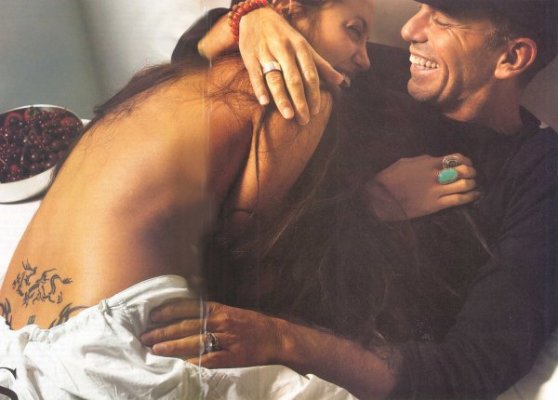 |
| They are soo cute together! Awww! |
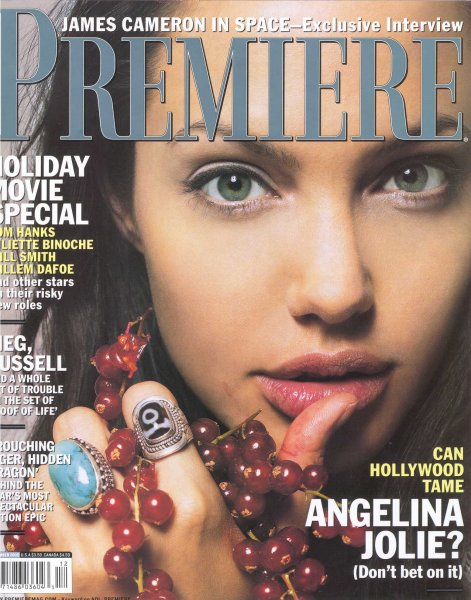
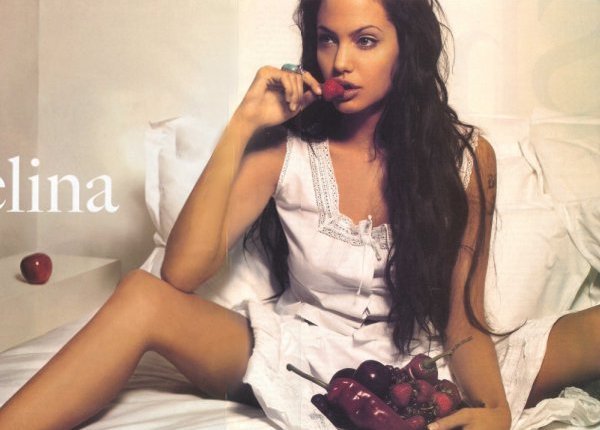
| Photographed by Stephane Sednaoui December 2000 In a year marked by a triumphant Oscar win and a sudden marriage, the actress seems to have undergone a startling transformation. Has the dark angel taken flight? She comes around the corner from the bank of elevators in the discreet London hotel where she’s been living for four months, and steps tentatively into the narrow lounge—which is elegant and almost empty—where you are smoking cigarettes and drinking red wine. Someone—a young, handsome hotel employee, dressed all in black—points her in your direction, and she takes a few more steps into the room, her head tilted to the side, curiosity growing soft in her eyes. Her hair has grown maybe three feet since you last saw her, just a year ago in Los Angeles, where she was doing press for Girl, Interrupted, and it has gone from short and brown, combed straight back, to very black and flowing nearly to her waist. Extensions, you guess, but what you’re really seeing is the angle of her body; how, along with the tilt of her head, it curves into an arc in the shape of a crescent moon, from her right shoulder to her right hip, with her right hand hanging, almost limp, from her sleeve. It is a gesture: the moment before a beautiful young woman reaches out to a wild animal. She stands like this, a few feet from you, and looks straight into your eyes. If her eyes were a dog’s and yours were a door, she would be nosing you open. You can tell she doesn’t remember you from a year ago, the year when she was in so much pain. Her famous pain: self-mutilation in her early teens, living too fast and a failed marriage in her early 20s, a famous dad who didn’t live in the same house, the backlash that in our puritan culture comes not only from mentioning her own bisexuality but also from kissing her brother in front of the world. She assumes (you’ll gather in the next few minutes) that you know she is thought of as dark and weird. She sits down beside you and expresses some regret that you’ve got cigarettes—she’s trying not to smoke—but she takes one anyway, and while she smokes (only half), she says that she’s just gotten off a plane from L.A., where she spent only a day with her husband of four months, Billy Bob Thornton. She doesn’t have to say much more, but the unspoken is sitting there in front of you: the body memory of being recently loved. The ache of leaving. “I went home just to lay next to him,” she says a few minutes later, in the small dining room (white tablecloths, candles, a woman playing a harp in the entranceway), “just to put my head near his neck.” She pauses, and you watch her eyes following some picture in her mind. “Yeah,” she says, “I lie in bed and, like, my feet, they just go searching for him. In the middle of the night, I wake up and I find his hand if I’m half-awake. And sexually he’s just the most . . .” Someday, her smile will most likely be famous, though it will remain mysterious. “We joke sometimes about it. We think we’re going to knock each other out, because you just love somebody so much, you just want to push them over. “I never liked being touched, ever,” she says quietly. “People used to say I held my breath when they were hugging me. I still do. But I’ve never liked . . . Everybody thought I was really sexual. You know, I was married young.” Jolie, now 25, was married at 20 to Hackers costar Jonny Lee Miller. Their marriage lasted a few years, disintegrating, along with Jolie herself, during the shooting of Gia, in which Jolie played the title role of Gia Carangi, a lesbian supermodel who burned hot and then died tragically young. “I was one of those people who felt like I didn’t really live in this world,” she says. “I was very dark, and just didn’t have very much hope, didn’t really settle, didn’t think I’d ever feel grounded or centered or warm and safe. I thought I’d burn until I went out. I didn’t . . .” She pauses and mulls this over. “And then I met Billy and it all changed. We have the same things that haunt us, maybe, in many ways. And I think we understand each other, and also we accept each other completely as we are. So nothing feels bad. It’s like being with somebody who really wants me to be who I am, and who lets me see who he is. And that just makes everything in life very real. And,” she says and then goes silent for a few seconds. “Yeah.” After working on Gia, an emotionally drained Jolie spent a year alone in Manhattan attending NYU and “reevaluating a lot of things” before returning to acting, with a role as Thornton’s wife in Pushing Tin. This was when she first met Thornton. “After New York, I was clearly just myself,” she says. “Billy and I don’t wear masks, so the two of us saw each other as who we were.” You interviewed Jolie then about Pushing Tin. You remember being amused by her enthusiasm for Thornton. You recall saying to her, “Billy Bob struck me as out there.” She replied, “He’s amazing.” You said, “Did you guys hit it off?” Clearly misunderstanding you—thinking you’d just asked, maybe, “Did you guys get it on?”—she said, shocked, “What?!” So you repeated, “Hit it off.” She recovered, then, and said, “Oh. Yeah. Sure. What’s not to . . . He’s. It’s. It was fun to be his wife. I think I was the first person to get Billy Bob as Billy Bob—not as some crazy character. I actually got to play opposite all of what is uniquely him. And he’s a very interesting man.” “as long as i don’t upset anybody with my work, that’s all that matters to me,” Jolie says as a waiter pours water into a crystal glass. “My dad always said: ‘If you can, explore things in life, and try to learn about life—try to just do things that say some little that’s good, and try not to do anything negative or bad.’ ” (Jolie used to quote her mother as saying, “Be brave, be bold, be free.”) “And it’s hard for me because I’m taken the wrong way a lot of the time. I’ve gone through periods where I just think I’m this dark, evil person, because I was somehow portrayed that way. And the part of me that’s funny, or the part of me that’s a friend, or the part of me that likes to think I’m not just a dark energy in the world—you start to wonder if you are.” “Angie is like a howitzer,” Girl, Interrupted director James Mangold said a year ago, talking about her role in that film. “There’s incredible control and lyricism and pain, but also rhythms and speed—the way she jumps from here to there is just a different kind of acting.” (About the fact that Jolie hung pornography all over her trailer walls during filming, Mangold said, “Angie was just playing at living in Lisa’s skin and pushing buttons anytime there was a button to push. Angie is that way: She’s a provocative person. She’s very challenging. She’s incredibly smart. She can be two or three steps ahead of you.”) “When I did Girl, Interrupted,” Jolie says, “I didn’t know how people were going to take that character. I didn’t know if anybody else would respond to her. And if nobody responded to her, then they’d agree with the statement of the movie, which is that people like her—and a bit of her is like me—that the world would be better off without them. People wish that she would be dead—that’s what the other characters say to her. And I thought if people agree with that when they see this movie, it’s going to hurt me so bad. And then the most amazing thing happened: People understood her.” “angie wasn’t in such great shape the year before we started shooting Original Sin,” says director Michael Cristofer, who also helmed Gia. “She’d done Gone in Sixty Seconds, and I think that was not a good time for her. So we kind of wrapped her in a blanket, took her down to Mexico, and took care of her.” Over time, Jolie got healthier, and considering that she portrays a con artist who deceives the man who loves her, she became, Cristofer says affectionately, “almost too happy.” In the midst of filming, she was nominated for and then won her first Academy Award, for her supporting role in Girl, Interrupted. Jolie flew from Mexico to L.A. for the Oscar ceremony, and flew back at about 4 a.m. that morning. She was asleep when the mariachi band that Cristofer and costar Antonio Banderas had hired began playing outside her trailer. “She stumbled out,” Cristofer says, “and everyone handed her a rose. Finally, she was standing there with about 200 roses in her arms. She was dripping roses.” This was a particularly important moment for Jolie: The director and much of the crew of Original Sin had also worked on Gia. These people handing her roses had seen Jolie, just a few years earlier, fall completely apart. “Everybody was emotional,” Jolie says about the day after the Oscars. “It was kind of like I was their little girl. And I felt like the little girl was going to survive, maybe, this business. I’d been very fragile with all of them, and then [while shooting Original Sin] they saw me fall in love, and they saw me find a home. But they also knew me when I was really, really worried that I would just die young and have very little life. So it was amazing.” Banderas, when asked if he knew that Thornton and Jolie were in love during the shooting of this film—a film so erotic that at press time Cristofer was reportedly battling hard for an R rating instead of an NC-17—laughs and says, “It was very obvious that this girl was in love. When somebody’s in love, you don’t hide it. I was very happy for her because actually I like Billy. In the case of Angelina, at least for me, there is nothing to criticize. I feel the opposite: I congratulate them.” “it’s hard to live in the world and still be honest,” Jolie is saying. The harpist is playing a shmaltzy version of “This Boy” by the Beatles. “That’s what I discovered during Girl, Interrupted. I felt that character was really honest, and it was awful for other people. People didn’t really want that.” She looks at you, and says, “I’m quite honest.” Uh-huh, you say, but most people aren’t. “And that’s so strange,” she replies. “Because then if they’re accepted, they’re accepted for something they’re not, really. Or if they’re loved, it’s going to be an effort their whole life ’cause it’s not really for who they are. That’s going to hurt at the end of the day. I know where I stand with everything. And I have no intention of hurting anybody. I don’t judge people. So there’s no reason I can’t be really honest. Then I get myself in trouble.” She drinks some water. “I used to think that being in love would be really hard somehow. But the thing is, it’s really easy. I’ve never been so open, and I suddenly felt I really wouldn’t want to live without him. I really wouldn’t . . . almost wouldn’t . . . I couldn’t.” You shake your head, and you both sit in silence. The background music plays on. The subject of Jolie’s sensuality comes up, and she bristles: It confounds her that people think she’s a big sex bomb. “I’ve kind of played the boyish person,” she says. “I really haven’t, you know, had big sex-scene movies. I remember reading about Lisa in Girl, Interrupted—that she was really sexual, and I was like, ‘Sexual?!’ She never wanted to have sex with anybody. She wouldn’t. It’s energy. I think it’s mistaken for—well, it’s not mistaken; I think it is sexuality. And when you’re really intrigued by people, really hungry for something in them, it’ll seem like a sex scene. Because that is sex, to me anyway.” Men in suits walk past the table, but none look at Jolie. “There’s only been a handful of people I’ve ever slept with in my life,” she says. You express doubt. “That’s absolutely true,” she insists. “Because I really don’t . . . I can be sexual with people, or talk to people, certainly, or feel intimate, but I never really did trust that somebody was really touching me or really looking at me or really . . .” Jolie kind of smiles to herself. It’s only when she’s two sentences into her next thought that you realize that when she had smiled, she had been thinking of Thornton. “But it’s really funny, ’cause I’m such a hungry little kid who just wants, like—I’m insane. I just want to touch him and hold him all the time.” The waiter interrupts with menus. But, you ask, is this your first experience of that kind of hunger? “Oh, absolutely,” she says. “Yeah.” The waiter smiles at Jolie but otherwise leaves her alone. She says she’s only eaten in the hotel restaurant once, because she’s been working on Tomb Raider, bringing cyber superhero Lara Croft to life. In order to get in shape for the role, she’s had to work out— learn to box, shoot a gun, paddle a canoe—and she’s on a strict diet to help her build muscle and get generally healthy. “I can only eat a few things,” she says. “I have steamed sea bass or steamed beef at this time of night. And vegetables. It’s a weird thing to eat a lot of food all throughout the day, but never have anything that weighs you down. I have no sugar now, and I switched to soy milk. All the stuff that they’re making me do is an interesting test because I used to smoke and drink and eat lots of sugar and anything else I wanted. And I used to not eat breakfast—I used to have a cigarette and coffee. But now I have less coffee and more tea in the morning. And I have lots of eggs and meat. I eat lots of meat.” Earlier, Jolie had said that though she wants very much to live now, she didn’t always. Now you ask why. “I never felt settled or calm,” she says. “You can’t really commit to life when you feel that. I think I just always wanted to be a good person, so I was always very worried, thinking that maybe I upset someone, maybe I wasn’t home enough for my family if I was off working, that I wasn’t there for my first husband, or that I wasn’t a good enough friend. And I’d go from film to film and almost detach from one world and jump into another. And I was living as these people and not having a self. So it was not only that I was not a good person; I didn’t know who I was. And things just get really dark. And when you’re in that dark space, you’re so busy saving yourself that you can’t really help other people. You’re very selfish. Those people who are in that dark space, they’re not bad people, but your world becomes isolated, very much about your survival, how much time you’re choosing to spend unhappy, trying to fill that void . . . “And I think that’s why I run home sometimes—’cause I’m running around and doing this film, and you don’t realize sometimes how you’re just doing it, and there’s no place to just curl up and . . . Usually, at the end of the night, you’re by yourself and you’re reading or something, but it’s not like it is with him. I’m calm with him. I’ve found that I can be really soft. And I never was before. When I go home, I can really breathe. And I feel so, it’s just . . .” She inhales. “I need it. Yeah.” She exhales. “He is the air I breathe,” she says, then laughs a familiar, mocking laugh. (Gia laughed that way sometimes, and Lisa, the sociopath Jolie played in Girl, Interrupted, laughed at everyone that way.) “It sounds so corny, it’s so terrible. Seriously, half the time when I talk to him I’ll go, ‘My God, what happened to me?! I’m like a fucking Hallmark card!’ But I think it’s just a welcome relief to be able to just be settled. To actually know what home is.” |
 |