
ALL MOUNTAIN,
ALL RIDER, ALL YEAR.
Umar Ridzuan > Mountain biking > Suspension
| Take a technical tour about suspension technology |
Disclaimer: Information in this website are only used for information purposes only, and cannot be used in any court or in any legislation issue.
We will start with full suspension technology, then re-look into hardtail MTB with front suspension.
Most of the opinions are based on my own after riding i.e. testing several type of full suspension MTB. The rest of the information are based on the following:
> manufacturer data
> the physics of path analysis
There are various categories of rear suspension technology, which are:
> Single pivot
> Virtual pivot
> Horst-link
> Monolink
The implementations of each category are different from one manufacturer to another, that lead to various name in suspension technology.
The table below shows the comparison between each suspension categories, with examples of the mountain bike.
|
Suspension Technology |
Technical Characteristic |
My Opinion |
Notes |
|||
|
Single pivot |
The rear wheel is located at the same axle as the rotating main pivot, i.e. the rear wheel is at the chain stay. It normally has a connecting pivot at the seat stay. Due to this, the rear movement is in arcing path, not vertical path. Hence, at different rear cog and front cog, there will be braking and "bob" effects.
However, there are several manufacturer that re-locate the main pivot strategically around the bottom bracket. This make the arcing path larger, hence for a small amount of suspension travel, it will travel in vertical path.
Some examples model (XC and trail) are Kona Kikapu, Kona Coiler, KHS XC504, Giant VT, Trek Fuel EX,
|
I tried Kona Kikapu and Trek Fuel EX.
Climbing: At the smallest front ring and largest rear cog, both Kikapu and Fuel EX tend to "bob". The Fuel EX "bob" more than the Kikapu. On the Fuel EX, it has lockout Rockshox MC 3R which I utilised to stop the "bob".
Descending: I feel like having a hardtail. Braking the rear brake while descending lock the suspension a little. I saw someone being kicked of the bike after the rear suspension lockout due to rear braking! I also experienced a lot of chain jump during fast and steep descending.
Sprinting: In the smallest and middle front rings, both exhibited "bob" effect. However, I used the lockout feature on the Trek Fuel EX to accelerate.
|
I also tested Merida Mission (LRS) full suspension that use the 1:1 rear suspension compression ratio and mounted the brake on the chain stay.
Climbing: Feel like hardtail, but need the platform type rear shock. The Merida uses the SPV valve platform.
Descending: Also feel like hardtail, except, it didn't lock the suspension. I like the Merida LRS.
Sprinting: Both has very little "bob" on the smallest front cog. |
|||
|
Virtual pivot |
Virtual pivot employs an extra pivot at the chain stay but put it very near to the bottom bracket. This create virtual pivot locations far from the bottom bracket, hence effectively creating a very large arc.
However, since the virtual pivot locations are not fixed, there is an interruption in the arc that prevent near vertical path during rear suspension travel.
From technical point of view, the VPP by Santa Cruz and Maestro by Giant are classified under virtual pivot technology. The difference is in the implementation.
|
I tried the Santa Cruz Blur LT and Giant Anthem.
Climbing: At the smallest front ring and largest rear cog, both Blur LT and Anthem "bob" like the Ellsworth Truth.
Descending: The suspension keep mull when there is small bumps or drops, especially during braking When the bumps get bigger or the speed get faster, the suspension reacted accordingly. Weird!
Sprinting: All have small "bob" on the smallest front ring and largest rear cog. No "bob" effect at middle and large front ring, but the lack of instant acceleration.
|
For freeride and downhill, I like the way virtual pivot reaction. But, not for cross country or trail where you need to feel the ground.
On one of the bike hash, I followed Intense 5.5 (it uses VPP technology) up the hill and observed it descending. I believed that the suspension reacted as the Santa Cruz Blur LT and Giant Anthem. |
|||
|
Horst-link |
The Horst-link in a connecting pivot that is located on the chain stay i.e. same location as the ratating main pivot. With this arrangement, both pivots are reacting to produce vertical path.
Since the brake is mounted on the same stay i.e. chain stay, with the the rear tyre, braking won't effect the suspension.
The Horst-link is a patented technology to Specialized, hence all Specialized full suspension MTBs utilised it. Other MTB that use the Horst-link technology are KHS XC904R, Titus Racer-X, Titus Moto-Lite, Norco A-Line, Wheeler Falcon, Turner Nitrous (05), Turner Flux (05) and Turner 5-Spot (05).
|
I own KHS XC904R and tested Specialized FSRxc and Stumpjumper. I also ride the Turner Flux (05) and Ellsworth Truth.
Climbing: All climb like a hardtail, except Ellsworth Truth. The Ellsworth Truth displayed a small "bob" at the smallest front ring and largest rear cog, but very much less than the Kona Kikapu and Trek Fuel EX.
Descending: They all tracked and sticked the ground even while braking. Hence, steering while sliding is possible, if necessary. The best descender is the KHS XC904R, as it head angle is slightly relax at 70 degrees.
Sprinting: All have very little "bob" on the smallest front ring and largest rear cog. A lock out features is needed to challenge hardtail. No "bob" effect at middle and large front ring.
Findings: After researching on Horst-link and comparing it with Ellsworth Truth rear suspension layout, I think the Ellsworth do not implement true Horst-link features. This explains the "bob" effect while climbing.
|
All MTBs I tested use Fox rear shock.
I'm eager to test the Titus Racer-X as it combined the Horst-link and MacPherson technologies. From my understanding, the MacPherson does not have any riding advantage except it offer simplicity in positioning the rear shock.
I'm also want to test the 2006 KHS XC904R as it comes with rear and front lockout simultaneously. |
|||
|
Monolink |
The monolink has the rear shock located on the bottom bracket, It still has the arcing rear wheel except that that arc is very big, hence it exhibit a near vertical path. |
|
Never tried them |
|
|
|
| If you're riding, know your limit |
Disclaimer: Information in this website are only used for information purposes only, and cannot be used in any court or in any legislation issue.
This section describes the kind of mountain bike style of riding. Most of the riders stick to one kind of riding, but with the advancement of technology and prices of quality mountain bike are getting lower, many people opted for 2 riding style.
|
Cross country (XC) |
Trail |
All mountain |
Freeride |
Downhill | |
|
Description |
Normally, divided into 2 sub-categories, Race and Cross country.
Terrain: Usually firm or slightly damped, Typical track width is 100 cm (app. 3 feet).
Obstacle: Maximum height is 100 cm (4 inches).
Uphill: Maximum of 45 degrees.
Downhill: Maximum of 10 degrees.
|
Terrain: Combination firm or slightly damped and loose rocks. Typical track width is 66 cm (app. 2 feet).
Obstacle: Maximum height is 204 cm (8 inches).
Uphill: Maximum of 35 degrees.
Downhill: Maximum of 25 degrees.
|
Terrain: Combination firm or slightly damped, loose rocks and boulders. Typical track width is 66 cm (app. 2 feet).
Obstacle: Maximum height is 254 cm (12 inches).
Uphill: Maximum of 15 degrees.
Downhill: Maximum of 35 degrees.
|
Terrain: Combination firm or slightly damped, loose rocks, boulders and man-made paths. Typical track width is 33 cm (app. 1 foot).
Obstacle: Maximum height is 380 cm (15 inches).
Uphill: Maximum of 10 degrees.
Downhill: Maximum of 45 degrees.
|
Terrain: Combination firm or slightly damped, loose rocks, boulders and man-made jumps Typical track width is 33 cm (app. 1 foot).
Obstacle: More than 380 cm (15 inches).
Uphill: Maximum of 5 degrees.
Downhill: More than 45 degrees.
|
|
Typical bikes |
Any hardtail with 60 - 100 cm of front fork travel.
Full suspension: Front> 60 - 100 cm Rear> 60 - 100 cm
My personal choices: Giant XTC Hybrid, Litespeed hardtail, Specialized Epic, Titus Racer-X |
Any hardtail with 80 - 100 cm of front fork travel.
Full suspension: Front> 80 - 120 cm Rear> At least 85 cm
My personal choice: KHS XC904R, Specialized Stumpjumper, Turner Flux (05)
|
Toughed hardtail with 100 - 135 cm of front fork travel.
Full suspension: Front> 110 - 150 cm Rear> At least 120 cm
My personal choice: Cove hardtail, Turner 5-Spot (05), Giant Reign, KHS AM2000, Santa Cruz Nomad
|
Hardtail not recommended.
Full suspension: Front> 130 - 170 cm Rear> At least 150 cm
My personal choice: Specialized Demo 8, Norco Six
|
Hardtail not recommended.
Full suspension: Front> At least 175 cm Rear> At least 175 cm
My personal choice: Specialized Demo 9, Norco A-Line
|
| Technological write-up by manufacturers |
Disclaimer: Information in this website are only used for information purposes only, and cannot be used in any court or in any legislation issue.
This section complies the technical write-up by several manufacturers on their suspension.
|
Ellsworth > |
ATLAS™ Technology: Anti-Torsion, Lower forward pivot, Active Suspension technology is Ellsworth’s single-pivot solution for riders seeking legendary Ellsworthian suspension performance, in a simple and affordable design. NEW for 2003, our patented, one-piece, 5-axis CNC-machined Anti-Torsion tube (see inset) ensures flex-free energy transmission between the rear swingarm and main pivot for incredible stiffness, precise tracking and powerful sprinting. Active Suspension provides a smooth, lock-out free ride while sitting, standing, coasting, pedaling and braking. ATLAS is incorporated into the Joker and Isis bikes, and it emulates the feel of ICT so well, it consistently outperforms the rest of the industry’s best four-bar linkage bikes—with an enhanced single-pivot design that could only come from Ellsworth.
|
||
|
Ellsworth > |
ICT™ Technology: Instant Center Tracking™ is internationally patented and quantifiably the most energy-efficient suspension design in the world, period. Internationally acclaimed, ICT four-bar linkage technology provides up to 100% pedal power efficiency by aligning the instant center of the linkage on the chain torque line and continually tracking it throughout the range of travel. What does that mean in layman’s terms? It means ICT allows pedal power to propel the rider forward without power loss, effectively avoiding the common suspension design flaw that divides pedal inputs into a wasteful combination of forward and vertical (jacking or bobbing) motions.
ICT-equipped bikes such as the Dare, Truth, Id and Witness—are legendary for their rare combination of responsive performance and plush suspension that can be found nowhere else. All ICT-equipped bikes feature 12mm pivot axles and oversized bearings for superior pivot stability and lateral stiffness under power. Our commitment to raising the limits of suspension technology, innovation and performance.
|
||
|
Giant > |
NO RESONANCE SYSTEM (NRS)
The NRS system eliminates bobbing by separating pedaling forces from bump forces. Impact forces from the ground compress the shock much like other suspension systems. However, since pedaling forces (torque) cause the shock to extend, NRS performs like a rigid frame when pedaling. Yet, even small bump forces will compress the shock (3.75" travel) and absorb impact. The key to the NRS design is the relationship between the main pivot and lower link pivot (chainstay pivot). Under torque, the drive line (chain) wants to pull the rear axle in a downward direction. This downward motion pulls on the upper suspension strut (seatstay) and rear point of the rocker arm, in turn forcing the forward point of the rocker upward to extend the shock under pedaling forces. Therefore, all your pedal input reaches the rear wheel for zero power loss.
Notions of the image at left:
DATA ACQUISITION
INFORMATION Many riders feel that weight is the only measurable statistic when it comes to performance, i.e., the less weight, the faster you go. However, studies have shown that a bicycle with suspension, while heavier than a bike without suspension, allows the rider to work more efficiently and therefore use less energy. Suspension also allows a rider to go faster over rough terrain. Our data acquisition shows this to be the case as well. When ridden over the same course, the Giant NRS was substantially faster than the lighter Giant hardtail, and the rider expended less energy.
Early test results during an 8-minute cross-country race (5 min. uphill, 3 min. down) showed the average maximum speed for the Giant NRS to be 2-4 km/h (1-2 mph) faster than for an already fast Giant MCM carbon composite hardtail. Even more impressive, the time gained on the downhill section was approximately seven seconds.
NOTE: |
||
|
Giant > |
Maestro Suspension - Technical Information The Maestro suspension gives you the five factor advantage:
Strategically positioned pivot points create a floating axis, or floating pivot point, that increases pedal efficiency by counteracting pedaling forces that would otherwise create suspension compression.
Maestro isn't entirely reliant on shock technology like soms suspension systems. In fact, the linear spring curve (or rising rate) created by our floating pivot point enables our bikes to be even more sensitive to small bump forces while pedaling and braking than those systems entirely reliant on the latest shock technology. It also allows for maximum shock compression without the harsh ramp up because our floating pivot point's ability to control smooth and consistent motion throughout the full range of suspension travel. Together you get all the suspension travel you need with no loss in acceleration power.
At the same time maestro suspension has increased sensitivity even under harsh braking so there's no loss in braking power. The instant rotation center is positioned on the direction of the brake-induced force. This separates the suspension from braking influences. Even if the wheel is blocked, the suspension still works and guarantees full control downhill.
Through the trapezoid rear triangle system, the distance for the chain, the chainlength will always kept the same. This provides optimum riding effeciency, because in that way, pedal-bob is avoided.
Traction is a matter of bringing the power to the ground and how it can be controlled. The Maestro system finds the optimum of all factors, Maestro gives you everything you'd want from a high performance dual suspension bike without sacrificing any ride characteristics. No matter what the terrain is like. The first no compromise suspension system.
|
||
|
Merida > |
MERIDA : LOW RATIO SUSPENSION (LRS)
Working closely with German MTB meisters Centurion and Bergwerk, we’ve created the perfect bike for cross-country riders with our revolutionary Low Ratio Suspension (LRS) system, featuring: Highly responsive, long travel, low pressure suspension, less ‘bob’, simple set up, low maintenance and reduced shock and frame fatigue.
Enough blurb, what does it do? ‘Low Ratio Suspension’ means the relationship (ratio) between the wheel travel and the shock stroke is the same (1:1). If the rear wheel moves 2cm, the LRS shock shaft is driven 2cm. ‘High ratio’designs, between 2:1 and 3.5:1. require higher shock pressure, giving poor performance and excessive force on the frame, reducing the life expectancy of both.
The LRS shock is attached rear of the seat tube by the pivoting I-Link and maintains a static relationship to the frame, isolating it from pedaling or body input, reacting only the bumps in the ground and freeing it from destructive bending and twisting forces.
The advantages of Merida LRS frame: 1. Conventional ‘double diamond’ frame layout makes the bike easy to shoulder. 2. Twin bottle cage mounts in the traditional seat and down tube positions. 3. Full insertion of the seat post is possible. 4. High resistance to lateral and torque forces. 5. Low weight (66 prolite alloy version is less than 2400g w/o shock), the Mission Carbon has just 2.050 grams of weight without shock). 6. The Mission XC-series offers 90mm of travel, the All-Mountain Trans- Mission series 120mm of 100% effective rear-wheel travel. 7. Spherical bearings inside the shock eliminate all lateral forces from the shock
|
||
|
Santa Cruz > |
VIRTUAL PIVOT POINT (VPP) LINKAGE:
VPP Sag and Active
Suspension:
VPP Shock Rates:
Frame Construction:
|
||
|
Tomac > |
Eli Suspension The new Eli full-suspension frame represents the next generation of Tomac suspension and gives mountain bike enthusiasts three very different bikes all wrapped in one exciting package. Whether you adjust the travel for 4", 4.75", or even 5.50" in the rear, the Eli automatically adapts to position the SPV shock perfectly for each mode. It does so by the use of a rocker and sub-link assembly unique to Tomac. The result is the smoothest, most consistent travel imaginable when active and a completely stable platform when climbing. No wasted energy and all the plushness you deserve, especially for those all-day epics.
THE SPV 4-WAY ADJUST REAR SHOCK WAS CHOSEN FOR ITS STABLE PLATFORM PERFORMANCE AND WORKS BIKE TUNABILITY
A 4.0"
[ 102mm ] of rear wheel travel In order to achieve optimal suspension performance, riders wanting to change travel modes must change both shock mounts.
The sealed ball bearings throughout the Eli's suspension system are virtually maintenence free and add stiffness to the design.
The direct vertical path of the rear wheel travel as shown in the two drawings demonstrates the "0 Effect" that the Eli swing-link suspension has on the bike's drive train during compression and vice versa. This is effective in all three travel options.
The sub-link attaches the super stiff swing arm to the rocker system and enables the rear end to have bomb-proof stiffness.
Most multi-travel bikes are designed for one mode and make compromises in suspension performance to achieve different lengths of travel. The Eli swing-link technology with perfectly located shock mount positions delivers optimal suspension performance in all three travel modes.
|
||
|
Tomac > |
Revolver Suspension The Revolver benefits from having an amazingly low center of gravity which makes it handle like a dream and it has proven itself to be one of the lightest and fastest cross-country rigs available. Now with the advantage of Manitou SPV, you can hammer the climbs with abandon with all your horsepower turning into forward motion. If you race and you haven't tried the Revolver, you're obviously still bringing a knife to a gunfight. Hence the name.
THE MANITOU SPV 3-WAY ADJUST REAR SHOCK DELIVERS AN ADJUSTABLE STABLE PLATFORM FUNCTION WITH TUNABLE SUSPENSION PERFORMANCE
The direct vertical path of the rear wheel travel as shown in the two drawings demonstrates the near zero effect that the Revolver suspension system has on the bike's drive train and vice versa. The sealed ball bearings in the swing arm pivots are virtually maintenance free and add stiffness to the design.
Doug's brilliant pivot location helps prevent chain tension from having negative effect on the suspension performance. The square chainstays and the CNC-machined yolks and dropouts provide incredibly smooth power transfer to the bottom half of the
|
||
|
Marin > |
QUAD-LINK SUSPENSION SYSTEM
|


 1.
NO POWER LOSS
1.
NO POWER LOSS 2.
LINEAR RISING RATE
2.
LINEAR RISING RATE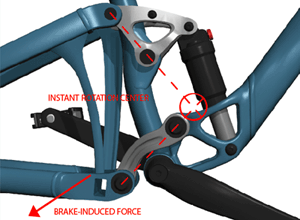
 4.
NO PEDAL KICKBACK
4.
NO PEDAL KICKBACK 5.
BEST TRACTION
5.
BEST TRACTION Light,
long travel, easy to maintain, simple to tune, zero ‘bob’ when climbing or
sprinting, mess up the handling or make the bike hard to carry. We gave you
LRS, the answer to your prayers.
Light,
long travel, easy to maintain, simple to tune, zero ‘bob’ when climbing or
sprinting, mess up the handling or make the bike hard to carry. We gave you
LRS, the answer to your prayers. I-Link
(The intelligent linkage)
I-Link
(The intelligent linkage)
 The
mini-rocker linkage system and CNC-machined yolks effectively tie the front
triangle to the rear swingarm and create an ultra-stiff bond that virtually
eliminates any and all side-loading of the rear shock. The result- a very
responsive, fully-active rear end that works in all conditions and allows
the frame to go where you point it.
The
mini-rocker linkage system and CNC-machined yolks effectively tie the front
triangle to the rear swingarm and create an ultra-stiff bond that virtually
eliminates any and all side-loading of the rear shock. The result- a very
responsive, fully-active rear end that works in all conditions and allows
the frame to go where you point it.

