 |
 |
|
|
The Earth may already have had visitors from Mars. We are not talking about the apparently intelligent lifeforms with the big black eyes we usually discuss at The Alien Exchange, but a simple, primitive form of life. And if there was life on Mars, is it possible that some of it reached Earth, and could have somehow seeded our planet with life? Could it be that we are the little green men from Mars?
The most compelling evidence for extraterrestrial life ever found hit the headlines with an announcement from NASA at a press conference on the 7th of August 1996. Following up research findings from The Natural History Museum and the Open University, NASA scientists believe they have found evidence of primitive life on Mars millions of years ago. The news sparked worldwide excitement and debate amongst scientists and the public alike. The evidence, however questionable, of other life in the solar system has dramatic significance for our life on Earth.
 |
In 1984 meteorite ALH 84001 was found in Allan Hills, Antarctica, after which it was named. Originally thought to have come from an asteroid, it was not until ten years later that the true origin of the rock came to light. NHM-OU scientists found that ALH 84001 contained more carbon than any other Martian meteorite. Carbon, the building block of all life on Earth, occurred as organic compounds and as carbonates. The carbonates (formed from fluids in contact with carbon dioxide in the Martian atmosphere) were present as bright orange patches. |
 |
Following on from this discovery, NASA scientists found that some of the organic compounds were present as polycyclic aromatic hydrocarbons (PAHs). On Earth, PAHs can be formed by the fossilization of living organisms and are often found in coal and petroleum deposits.
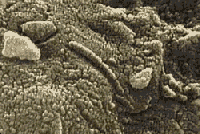
Under a high resolution electron microscope, individual grains of magnetite (iron oxide) were also found on the surface of the carbonates. Magnetite is known to indicate processes such as oxidation and reduction, which can be characteristic of biological activity. Scientists also found thread-like structures on the surface of these carbonates which they then concluded were the fossilized remains of primitive organisms - the first possible evidence of life on Mars. |
This exciting discovery was announced by NASA at their headquarters in Washington DC on the 7th of August 1996, and published in the journal Science on the 16th of August 1996. Although each of the observations made by scientists on the Martian meteorite can be explained by inorganic processes, the potential significance of this discovery will clearly accelerate further investigation. Although each of the observations made by scientists on the Martian meteorite can be explained by inorganic processes, the potential significance of this discovery will clearly accelerate further investigation. |

Satellite images of dry river beds and polar ice made of carbon dioxide, have already shown that water and carbon dioxide, essential for life, were present on Mars millions of years ago. Since then, Mars' atmosphere has disappeared - unprotected from the Sun's ultra-violet radiation, the planet's surface has become sterile.
But nobody knows what may be lurking beneath the surface. The structures found on ALH 84001 could indeed be the fossilized remains of life millions of years ago, or they could be dormant lifeforms, just waiting for environmental conditions on Mars to change. Equally, there could be nothing there at all.