 |
| "Keep the Antiques & Classics Flying!" |
NOTE:
For best results use Microsoft Internet Explorer 4.0 or later
Set monitor resolution to 800 X 600 with thousands of colors or more and this window maximized in browser.

Brief history highlights of The Golden Age of Aviation and how air racing furthered Engine Development

Page two of three
The Golden Age brought on the pressure of competition and did much to bring about aircraft engines of improved reliability and greatly increased horse power. The Schneider Trophy contests were started by Jacques Schneider, who was a well-known figure in France in motor racing and ballooning circles. He had seen how the spur of competition had developed the motor car into a reliable form of transportation, and he believed that similar competition between aircraft could achieve similar results. Why Sea-planes? He, like many others connected with early aviation, believed that aircraft flying from and to a water surface would prove ideal for long-range air travel. After all, seven-tenths of the Earth's surface is water. Schneider believed mistakenly that water would prove softer than land if a forced landing became inevitable.
In 1912 it is unlikely that anyone could have forseen the impact that the Schneider Trophy Contests would have, in the nineteen years from its beginning to end on the development of high-power engines. In America a very significant piston engine was developed for use in the Curtis Navy racers. Built to take part in the Pulitzer races and later modified to compete in the Schneider Contest. The Engine that powered them was the Curtis D-12, combined with a special all-metal Curtis/Reed propeller. With a very compact and small frontal area, it developed 480 hp.
When Britains Richard Fairey first saw this engine propeller combination he realized immediately its great potential and obtained license rights to build it in Britain. It was installed in a new two seat day-time bomber and proved to be very successful, for the Fairey Fox as it was called, could outrun any contemporary fighter aircraft in service.
For Italy, too, the Contest spurred development of a number of exceptional engines. The Penultimate Contest in which the Italian team competed in 1927, produced Fiat in-line engines of 1,000hp. At Calshot, in 1929, the Macchi M.67s were powered by Isotta-Fraschini engines of 1400 hp. The ultimate of Italian in-line engine was the Fiat AS.6, a 24 four cylinder Vee-type, in its final form installed in a Macchi MC.72 seaplane and burning an exotic fuel prescribed by Britain's F Rodwell Banks, it developed 3,100hp. With this aircraft/power plant combination Italy set a world speed record of 440.68mph, which remained unbroken until mid-1939.
In Britain Rolls-Royce began developing an engine known as the Buzzard to power the new Supermarine S.6 Seaplane to take part in the 1929 Schneider Contest at Cowes. A Vee-12 liquid cooled engine, it had developed 925hp on bench tests in July of 1928. Just over a year later, Rolls-Royce engineers advanced this engine to produce 1,900hp. Two years later, the same basic design know as the "R" (for racing) developed 2,350hp when it powered the Supermarine S.6B to carry off the trophy for Britain. This aircraft/engine combination had considerable influence on the Spitfire/Merlin configuration which by World War II expoits won a permanent place in the history books.
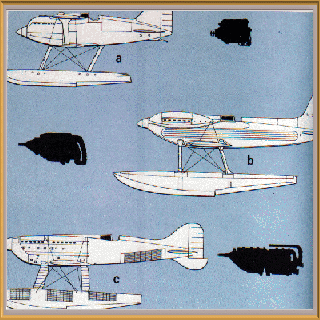
Engine development through the Schneider Trophy Racing.
a. Curtiss R3c-4, Curtiss V-1500 engine, 708hp.
b. Supermarine S6B,Rolls-Royce 'R' engine.
c. Macchi MC72, coupled Fiat AS6 engine, 3300hp.
Engines For The 1930s Thompson Air Races.
Air racing in the 1930s had to rely primarily on stock aircraft commercial engines for which repair parts were readily available for new and used engines at a reasonable price. There were many US engine manufacturers, but only two dominated the air races.
There were some reasons for this phenomenon. Pratt and Whitney considered it good public relations and a vehicle for high stress and development work. This interest included making custom modifications on certain models for racing and loaning or leasing engines and providing factory and field technical support to racing teams that showed promise.
With economic times the way they were in the thirties and with the high price of large radial engines,the lend lease program provided Pratt & Whitney presence in air racing. Pratt & Whitney earned a legacy of image and publicity in return for a relatively small expenditure on racing. It was probably the most economical and best advertising the company ever did .
The early Thompson Air Races had no rules on size, or piston displacement of engines so initially the biggest, most powerful engine one could squeeze into his particular aircraft was common. Later this changed to a choice of a smaller engine in a very small airplane, or a big radial or liquid cooled Vee-12 engine in a bigger airplane. This was one of the biggest controversies in early Thompson racer design. Thompson racers were restricted, surplus World WarI engines like the liquid cooled Hispano-Suiza V-8s and Liberty V-12s were much too big and heavy in relation to power. Curtiss D-12 variants from the early thirties had some potential, as proved by Steve Whitman, but size and weight was still excessive. This left the early Wright and Pratt & Whitney nine-cylinder air cooled radials with displacements from 975 to 1830 ci, for larger aircraft. These would include the Wright Whirlwind, Wasp Junior and Hornet. Their horsepower range was between 400 and 900 hp with 1930 technology and fuels. Prices ranged up to $15,000.
Menasco Inverted In-Line Engine
Albert Menasco was an aviation pioneer stunt flyer and master mechanic, and first got involved in the aircraft engine business in 1926, when he bought surplus French Salmson radial engines from World War I and converted them to American budget builders. His association with Northrup and their flying wing project in the late twenties convinced him of the need for a new configuration of aircraft engine: an inverted in-line air cooled layout that would have the propeller shaft on top.
When Al Menasco introduced his unusual inverted in-line engine in 1930, he probably had no idea that his products would become world famous in air racing. Menasco saw a definite commercial need for his design. But he had been a racer at heart from early youth. Before he ever produced engines, he was involved in racing motorcycles and midget race cars, World War I airplanes, and Model Ts. It was natural for Menasco to promote his new light weight engine among pylon racer builders. His first custom race engine was for the twin midget monoplanes built by Keith Rider.
For the racer who could not afford a large engine plane, or wanted a small displacement racer was even more limited. About the only practical configuration was the in-line air cooled inverted engine. The in-line cylinders were desirable to get a small, narrow, sleek fuselage with minimum drag. And of the cylinders needed to be inverted (turned upside down) to get the propeller shaft up high enough to allow prop diameter to absorb a decent amount of power and still have room for a light compact landing gear.
One of the less obvious benefits Menasco offered was simply his willingness to bulid custom engine combinations to fit special airplanes for reasonable prices. Menasco was interested enough in air racing to go far out of his way and often forgot his profit on a job. Another important advantage of Menasco engines was Als appreciation of the economics of using off the shelf interchangeable parts whenever possible.
In the case of Menasco Manufacturing. this company was really the only supplier in the early thirties of inverted in-line engines with reasonably high power, and with ready availability of complete engines and repair parts.
Menasco engines were not powerful enough to compete in the Thompson races until 1931 when Menasco offered special hand made supercharged inverted six cylinder engines.
Some of the weak points of the early Menasco Supercharged engines were that some engines had too much supercharge pressure and compression ratio for the fuels that were available. Detonation and preignition were a constant problem at high speeds using 87 octane. Other problems were aluminum alloy connecting rods not being strong enough, crankshaft thrust bearings were cracking, and the two magnetos on the back of the engine tended to absorb heat through their mountings and over heat, causing misfiring. Because of these weak points most early Menascos did most of their racing at 2200-2600 rpm with 30-40 inches of manifold pressure, causing planes that they were mounted to, to fly 20-40 mph below their potential.
Al Menasco was well aware of the problems with his early supercharged engines. He was on a learning curve just as everyone else was at that time. None of the early supercharged engines were production designs with ATC ratings. Actual production of engines did not begin until 1936 with the C4S(220-230 hp) and B6S(290 hp) engines which with the help of Art Chester, who was hired by Menasco for research and development. Chester had a reputation for getting the most horses out his four-Cylinder Menasco and keeping it reliable at the same time.
An entirely new engine appeared in 1937: the six-cylinder C6S-4 model, rated at 400 hp at 3300 rpm at 70 in of manifold pressure, and it was the first Menasco that really had the power potential to win the Thompson Trophy outright. The first proto type went to Rudy Kling for his new Folkerts SK-3 racer in early 1937.
The commercial version of the C6S-4 was ATC certified in 1938 at 260 hp.
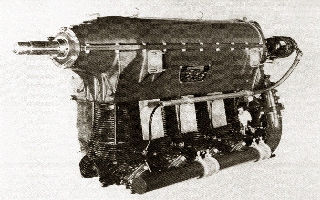
Menasco C6S-4
The Renault In-Line
One cannot discuss inverted in-line engines without mentioning the six-cylinder Renault Deutsch engine that powered the French Caudron to a runaway win in 1936. The engine was the closest to a custom-built factory design to ever fly in the Thompson races. When this engine was fitted to the highly refined Caudron airframe, it overwhelmed the grassroots racers and even some of the big Pratt & Whitney radial engine racers.
Please Click here to go to page 3
This site is for informational purposes only and I recognize that some words,logo,models,names and designations,mentioned and used on this site are the property of the trademark holder.I use them for identification purposes only.
Source: A History of Aircraft Piston Engines by Herschel Smith
© 1998 dgraves549@aol.com
This page hosted by  Get your own Free Home Page
Take a flight back in time and visit our Golden Age of Aviation and Antique/Classic Aircraft: Featured Topics
The Golden Age brought on the pressure of competition and did much to bring about aircraft engines of improved reliability and greatly increased horse power. The Schneider Trophy contests were started by Jacques Schneider, who was a well-known figure in France in motor racing and ballooning circles. He had seen how the spur of competition had developed the motor car into a reliable form of transportation, and he believed that similar competition between aircraft could achieve similar results. Why Sea-planes? He, like many others connected with early aviation, believed that aircraft flying from and to a water surface would prove ideal for long-range air travel. After all, seven-tenths of the Earth's surface is water. Schneider believed mistakenly that water would prove softer than land if a forced landing became inevitable.
In 1912 it is unlikely that anyone could have forseen the impact that the Schneider Trophy Contests would have, in the nineteen years from its beginning to end on the development of high-power engines. In America a very significant piston engine was developed for use in the Curtis Navy racers. Built to take part in the Pulitzer races and later modified to compete in the Schneider Contest. The Engine that powered them was the Curtis D-12, combined with a special all-metal Curtis/Reed propeller. With a very compact and small frontal area, it developed 480 hp. When Britains Richard Fairey first saw this engine propeller combination he realized immediately its great potential and obtained license rights to build it in Britain. It was installed in a new two seat day-time bomber and proved to be very successful, for the Fairey Fox as it was called, could outrun any contemporary fighter aircraft in service. For Italy, too, the Contest spurred development of a number of exceptional engines. The Penultimate Contest in which the Italian team competed in 1927, produced Fiat in-line engines of 1,000hp. At Calshot, in 1929, the Macchi M.67s were powered by Isotta-Fraschini engines of 1400 hp. The ultimate of Italian in-line engine was the Fiat AS.6, a 24 four cylinder Vee-type, in its final form installed in a Macchi MC.72 seaplane and burning an exotic fuel prescribed by Britain's F Rodwell Banks, it developed 3,100hp. With this aircraft/power plant combination Italy set a world speed record of 440.68mph, which remained unbroken until mid-1939. In Britain Rolls-Royce began developing an engine known as the Buzzard to power the new Supermarine S.6 Seaplane to take part in the 1929 Schneider Contest at Cowes. A Vee-12 liquid cooled engine, it had developed 925hp on bench tests in July of 1928. Just over a year later, Rolls-Royce engineers advanced this engine to produce 1,900hp. Two years later, the same basic design know as the "R" (for racing) developed 2,350hp when it powered the Supermarine S.6B to carry off the trophy for Britain. This aircraft/engine combination had considerable influence on the Spitfire/Merlin configuration which by World War II expoits won a permanent place in the history books.
Engine development through the Schneider Trophy Racing.
a. Curtiss R3c-4, Curtiss V-1500 engine, 708hp.
b. Supermarine S6B,Rolls-Royce 'R' engine.
c. Macchi MC72, coupled Fiat AS6 engine, 3300hp.
Air racing in the 1930s had to rely primarily on stock aircraft commercial engines for which repair parts were readily available for new and used engines at a reasonable price. There were many US engine manufacturers, but only two dominated the air races.
There were some reasons for this phenomenon. Pratt and Whitney considered it good public relations and a vehicle for high stress and development work. This interest included making custom modifications on certain models for racing and loaning or leasing engines and providing factory and field technical support to racing teams that showed promise.
With economic times the way they were in the thirties and with the high price of large radial engines,the lend lease program provided Pratt & Whitney presence in air racing. Pratt & Whitney earned a legacy of image and publicity in return for a relatively small expenditure on racing. It was probably the most economical and best advertising the company ever did .
The early Thompson Air Races had no rules on size, or piston displacement of engines so initially the biggest, most powerful engine one could squeeze into his particular aircraft was common. Later this changed to a choice of a smaller engine in a very small airplane, or a big radial or liquid cooled Vee-12 engine in a bigger airplane. This was one of the biggest controversies in early Thompson racer design. Thompson racers were restricted, surplus World WarI engines like the liquid cooled Hispano-Suiza V-8s and Liberty V-12s were much too big and heavy in relation to power. Curtiss D-12 variants from the early thirties had some potential, as proved by Steve Whitman, but size and weight was still excessive. This left the early Wright and Pratt & Whitney nine-cylinder air cooled radials with displacements from 975 to 1830 ci, for larger aircraft. These would include the Wright Whirlwind, Wasp Junior and Hornet. Their horsepower range was between 400 and 900 hp with 1930 technology and fuels. Prices ranged up to $15,000.
Menasco Inverted In-Line Engine
Albert Menasco was an aviation pioneer stunt flyer and master mechanic, and first got involved in the aircraft engine business in 1926, when he bought surplus French Salmson radial engines from World War I and converted them to American budget builders. His association with Northrup and their flying wing project in the late twenties convinced him of the need for a new configuration of aircraft engine: an inverted in-line air cooled layout that would have the propeller shaft on top.
When Al Menasco introduced his unusual inverted in-line engine in 1930, he probably had no idea that his products would become world famous in air racing. Menasco saw a definite commercial need for his design. But he had been a racer at heart from early youth. Before he ever produced engines, he was involved in racing motorcycles and midget race cars, World War I airplanes, and Model Ts. It was natural for Menasco to promote his new light weight engine among pylon racer builders. His first custom race engine was for the twin midget monoplanes built by Keith Rider.
For the racer who could not afford a large engine plane, or wanted a small displacement racer was even more limited. About the only practical configuration was the in-line air cooled inverted engine. The in-line cylinders were desirable to get a small, narrow, sleek fuselage with minimum drag. And of the cylinders needed to be inverted (turned upside down) to get the propeller shaft up high enough to allow prop diameter to absorb a decent amount of power and still have room for a light compact landing gear.
One of the less obvious benefits Menasco offered was simply his willingness to bulid custom engine combinations to fit special airplanes for reasonable prices. Menasco was interested enough in air racing to go far out of his way and often forgot his profit on a job. Another important advantage of Menasco engines was Als appreciation of the economics of using off the shelf interchangeable parts whenever possible.
In the case of Menasco Manufacturing. this company was really the only supplier in the early thirties of inverted in-line engines with reasonably high power, and with ready availability of complete engines and repair parts.
Menasco engines were not powerful enough to compete in the Thompson races until 1931 when Menasco offered special hand made supercharged inverted six cylinder engines.
Some of the weak points of the early Menasco Supercharged engines were that some engines had too much supercharge pressure and compression ratio for the fuels that were available. Detonation and preignition were a constant problem at high speeds using 87 octane. Other problems were aluminum alloy connecting rods not being strong enough, crankshaft thrust bearings were cracking, and the two magnetos on the back of the engine tended to absorb heat through their mountings and over heat, causing misfiring. Because of these weak points most early Menascos did most of their racing at 2200-2600 rpm with 30-40 inches of manifold pressure, causing planes that they were mounted to, to fly 20-40 mph below their potential.
Al Menasco was well aware of the problems with his early supercharged engines. He was on a learning curve just as everyone else was at that time. None of the early supercharged engines were production designs with ATC ratings. Actual production of engines did not begin until 1936 with the C4S(220-230 hp) and B6S(290 hp) engines which with the help of Art Chester, who was hired by Menasco for research and development. Chester had a reputation for getting the most horses out his four-Cylinder Menasco and keeping it reliable at the same time.
An entirely new engine appeared in 1937: the six-cylinder C6S-4 model, rated at 400 hp at 3300 rpm at 70 in of manifold pressure, and it was the first Menasco that really had the power potential to win the Thompson Trophy outright. The first proto type went to Rudy Kling for his new Folkerts SK-3 racer in early 1937.
The commercial version of the C6S-4 was ATC certified in 1938 at 260 hp.
Menasco C6S-4
The Renault In-Line
One cannot discuss inverted in-line engines without mentioning the six-cylinder Renault Deutsch engine that powered the French Caudron to a runaway win in 1936. The engine was the closest to a custom-built factory design to ever fly in the Thompson races. When this engine was fitted to the highly refined Caudron airframe, it overwhelmed the grassroots racers and even some of the big Pratt & Whitney radial engine racers.
Please Click here to go to page 3
This site is for informational purposes only and I recognize that some words,logo,models,names and designations,mentioned and used on this site are the property of the trademark holder.I use them for identification purposes only.
Source: A History of Aircraft Piston Engines by Herschel Smith
© 1998 dgraves549@aol.com
This page hosted by
Get your own Free Home Page
Take a flight back in time and visit our Golden Age of Aviation and Antique/Classic Aircraft: Featured Topics
Air racing in the 1930s had to rely primarily on stock aircraft commercial engines for which repair parts were readily available for new and used engines at a reasonable price. There were many US engine manufacturers, but only two dominated the air races.
There were some reasons for this phenomenon. Pratt and Whitney considered it good public relations and a vehicle for high stress and development work. This interest included making custom modifications on certain models for racing and loaning or leasing engines and providing factory and field technical support to racing teams that showed promise. With economic times the way they were in the thirties and with the high price of large radial engines,the lend lease program provided Pratt & Whitney presence in air racing. Pratt & Whitney earned a legacy of image and publicity in return for a relatively small expenditure on racing. It was probably the most economical and best advertising the company ever did .
The early Thompson Air Races had no rules on size, or piston displacement of engines so initially the biggest, most powerful engine one could squeeze into his particular aircraft was common. Later this changed to a choice of a smaller engine in a very small airplane, or a big radial or liquid cooled Vee-12 engine in a bigger airplane. This was one of the biggest controversies in early Thompson racer design. Thompson racers were restricted, surplus World WarI engines like the liquid cooled Hispano-Suiza V-8s and Liberty V-12s were much too big and heavy in relation to power. Curtiss D-12 variants from the early thirties had some potential, as proved by Steve Whitman, but size and weight was still excessive. This left the early Wright and Pratt & Whitney nine-cylinder air cooled radials with displacements from 975 to 1830 ci, for larger aircraft. These would include the Wright Whirlwind, Wasp Junior and Hornet. Their horsepower range was between 400 and 900 hp with 1930 technology and fuels. Prices ranged up to $15,000.
Albert Menasco was an aviation pioneer stunt flyer and master mechanic, and first got involved in the aircraft engine business in 1926, when he bought surplus French Salmson radial engines from World War I and converted them to American budget builders. His association with Northrup and their flying wing project in the late twenties convinced him of the need for a new configuration of aircraft engine: an inverted in-line air cooled layout that would have the propeller shaft on top.
When Al Menasco introduced his unusual inverted in-line engine in 1930, he probably had no idea that his products would become world famous in air racing. Menasco saw a definite commercial need for his design. But he had been a racer at heart from early youth. Before he ever produced engines, he was involved in racing motorcycles and midget race cars, World War I airplanes, and Model Ts. It was natural for Menasco to promote his new light weight engine among pylon racer builders. His first custom race engine was for the twin midget monoplanes built by Keith Rider.
For the racer who could not afford a large engine plane, or wanted a small displacement racer was even more limited. About the only practical configuration was the in-line air cooled inverted engine. The in-line cylinders were desirable to get a small, narrow, sleek fuselage with minimum drag. And of the cylinders needed to be inverted (turned upside down) to get the propeller shaft up high enough to allow prop diameter to absorb a decent amount of power and still have room for a light compact landing gear.
One of the less obvious benefits Menasco offered was simply his willingness to bulid custom engine combinations to fit special airplanes for reasonable prices. Menasco was interested enough in air racing to go far out of his way and often forgot his profit on a job. Another important advantage of Menasco engines was Als appreciation of the economics of using off the shelf interchangeable parts whenever possible.
In the case of Menasco Manufacturing. this company was really the only supplier in the early thirties of inverted in-line engines with reasonably high power, and with ready availability of complete engines and repair parts.
Menasco engines were not powerful enough to compete in the Thompson races until 1931 when Menasco offered special hand made supercharged inverted six cylinder engines.
Some of the weak points of the early Menasco Supercharged engines were that some engines had too much supercharge pressure and compression ratio for the fuels that were available. Detonation and preignition were a constant problem at high speeds using 87 octane. Other problems were aluminum alloy connecting rods not being strong enough, crankshaft thrust bearings were cracking, and the two magnetos on the back of the engine tended to absorb heat through their mountings and over heat, causing misfiring. Because of these weak points most early Menascos did most of their racing at 2200-2600 rpm with 30-40 inches of manifold pressure, causing planes that they were mounted to, to fly 20-40 mph below their potential.
Al Menasco was well aware of the problems with his early supercharged engines. He was on a learning curve just as everyone else was at that time. None of the early supercharged engines were production designs with ATC ratings. Actual production of engines did not begin until 1936 with the C4S(220-230 hp) and B6S(290 hp) engines which with the help of Art Chester, who was hired by Menasco for research and development. Chester had a reputation for getting the most horses out his four-Cylinder Menasco and keeping it reliable at the same time.
An entirely new engine appeared in 1937: the six-cylinder C6S-4 model, rated at 400 hp at 3300 rpm at 70 in of manifold pressure, and it was the first Menasco that really had the power potential to win the Thompson Trophy outright. The first proto type went to Rudy Kling for his new Folkerts SK-3 racer in early 1937.
The commercial version of the C6S-4 was ATC certified in 1938 at 260 hp.
Menasco C6S-4
One cannot discuss inverted in-line engines without mentioning the six-cylinder Renault Deutsch engine that powered the French Caudron to a runaway win in 1936. The engine was the closest to a custom-built factory design to ever fly in the Thompson races. When this engine was fitted to the highly refined Caudron airframe, it overwhelmed the grassroots racers and even some of the big Pratt & Whitney radial engine racers.
Please Click here to go to page 3
This site is for informational purposes only and I recognize that some words,logo,models,names and designations,mentioned and used on this site are the property of the trademark holder.I use them for identification purposes only.
Source: A History of Aircraft Piston Engines by Herschel Smith
© 1998 dgraves549@aol.com
This page hosted by
Get your own Free Home Page
Take a flight back in time and visit our Golden Age of Aviation and Antique/Classic Aircraft: Featured Topics
Please Click here to go to page 3
This site is for informational purposes only and I recognize that some words,logo,models,names and designations,mentioned and used on this site are the property of the trademark holder.I use them for identification purposes only.© 1998 dgraves549@aol.com
Get your own Free Home Page