
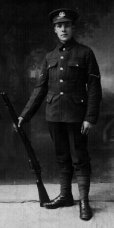

This is the story of my Great Uncle Teddie..Edward James Tuttle...an agricultural labourer's son who drowned at the age of 20 in Gallipoli.CLICK HERE to read about his life before he joined the army.
          Sometime during 1914 Teddie enlisted into the Norfolk
          Regiment, the 3rd (Special Reserve) Battalion (14). He
          enlisted at Great Yarmouth and gave his address as
          Great Yarmouth, I have not found out why unless it was
          because he was at that time living with  his brother
          Ernest William who was then married and living there at
          the time.

          On Saturday 8th August 1914 the 3rd Special Reserve
          were sent to Felixstowe. In addition to taking a
          hand in the defence of the Harwich coastline against a
          possible invasion, the battalion had the duty of
          training and despatching drafts overseas. It was
          practically debarred from going abroad as a battalion
          and the task demanded from it as a special reserve was
          a far more weary and thankless one. It had to accept
          thousands of recruits, equip and train them and as soon
          as the men showed promise to draft them off to other
          regiments. It seems that Teddie wanted to see active
          service and so he and some other Norfolk men
          volunteered to join the Essex Regiment and they were in
          the draft of July 24th 1915. It was a custom in the
          Great War for a soldier to be issued with a different
          number when he changed regiments so Teddie who by this
          time had become Lance Corporal Tuttle No 17596 of the
          Norfolk Regiment, became Lance Corporal Tuttle
          no.20637 of the Essex Regiment. This arrangement was
          altered in 1920 when a soldier was given a regimental
          number on joining and kept it thereafter no matter to
          which other regiment or corps he was posted.

          A postcard with the postmark 'Devonport' and dated 31st
          July 1915, 9.45am and with 1/2d stamp addressed to
          Mrs.E.Tuttle,Norwich Road,Mattishall,
          East Dereham,Norfolk arrived, it read:

         "Dear Father & Mother,
          Am sending a photo of ship have only an hour longer
          here as we sail tonight at 8 o/c Friday,
          Much love Ted
          Don't expect letter just yet.
          Farewell".

          The picture was of the 'Royal Edward' entering
          Avonmouth dock. A passage from the History of Norfolk
          Regiment tells the rest of Teddie's story:

          Colonel Tonge refers to the loss of 300 men, the best
          draft that ever left Felixstowe. These men volunteered
          to join the Essex Regiment and appear to have
          constituted the drafts of June 23 and July 24 1915.
          They were part of the reinforcements carried by the
          transport "Royal Edward" which was torpedoed and sunk
          in the Aegean Sea on August 14th 1915. She sank two and
          a half minutes after the torpedo struck her.Of the
          1,400 men she carried only 600 were saved,and the
          drowned included all but 18 of the 300 Norfolk men. The
          men who had had a route march just before leaving
          Alexandria, were waiting on deck for foot inspection at
          about 9.20 am. Their lifebelts were down below, and
          when the ship was unexpectedly struck most of them ran
          below to fetch the belts. Owing to the ship's sudden
          heeling over and sinking, these never got up again.
          Those who escaped were picked up by a hospital ship
          which responded to the s.o.s. signal. To partly replace
          this sad loss, another draft of 150 men to the Essex
          Regiment was dispatched on September 29, 1915.
                    Addenda   1994
          From: "Men of Gallipoli"(David & Charles,1988) by kind
          permission of the publishers.

          One of the features of the Cape Helles monument is the
          rows of names of men drowned in the torpedoing of the
          Royal Edward,which sank in the Eastern Mediterranean
          on 13th August with a loss of over 850 lives.A.T.Fraser
          in the Border Regiment,was in a deckchair on the
          afterdeck  starboard side when suddenly dozens of men
          ran past him from port to starboard. The explosion came
          before he had time to ask what was the matter."The ship
          had no escort and we had not been ordered to have our
          life-belts with us.The hundreds on deck ran below to
          get their life-belts and hundreds below would have met
          them on their way up.I shared a cabin accessible from
          the deck I was on and I raced there to get my life-belt
          and ran to my life-boat station which was on the star-
          board side.As the men arrived they fell in two ranks.
          Already the ship was listing and this prevented our
          boats from being lowered,so we were ordered to jump
          for it.I saw no panic,but of course one could imagine
          what was happening on the inside stairs. I swam away
          from the ship and turned to see the funnels leaning
          towards me.When they reached the sea,all the soot was
          belched out,there was a loud whoosh and the ship sank.
          No explosion,no surge.So I was alone.The little waves
          were such that in the trough you saw nothing,on the
          crest you saw a few yards.The water was warm.I wondered
          if there were sharks".
          Fraser found some wood to rest on and he was joined by
          a seaman,an older man who had twice previously been
          torpedoed.This brought the young Scot confidence.An up
          turned  Royal Edward lifeboat was to provide 17 of the
          survivors with a little more security though in what
          Fraser calls half-hourly recurring turbulence,the boat
          turned over,offering them conventional but completely
          waterlogged accommodation every alternate half hour
          but at least providing them with something to do.There
          was no singing and little conversation. The first ship
          that passed hailed the scattered men and promised to
          signal for help.It could not stop as it had high
          explosives for Lemnos.Some of the men became depressed
          and showed unwillingness to clamber back in the life   boat when it
          overturned,but on each occasion all were
          persuaded.Finally the hospital ship SOUDAIN arrived to
          pick them up in her life-boats,and at 2 o'clock Fraser
          was safely aboard her after just under five hours in
          the sea. He remembers that"a large number of men lost
          their false teeth as we were constantly sick in the
          sea- and these men were sent back to England.We the
          younger ones,were clothed and kitted and on another
          ship three days later for Gallipoli


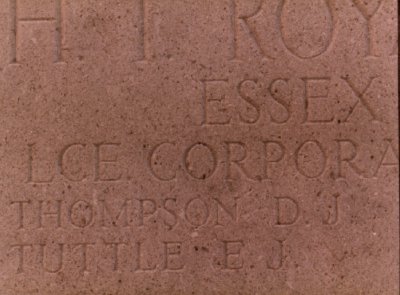
          20637 Lance Corporal Edward James Tuttle, 1st Battalion
          Essex Regiment, died on Friday, August 13th 1915 ( The
          date from 'History of the Norfolk Regiment said 14th
          August and the date on the back of the photograph of
          him, written by his mother, says 15th August, but the
          Essex Museum confirms August 13th as being correct)
          He was aged 20 years and has no known grave. He is
          remembered on Cape Helles Memorial,Gallipoli,Turkey,
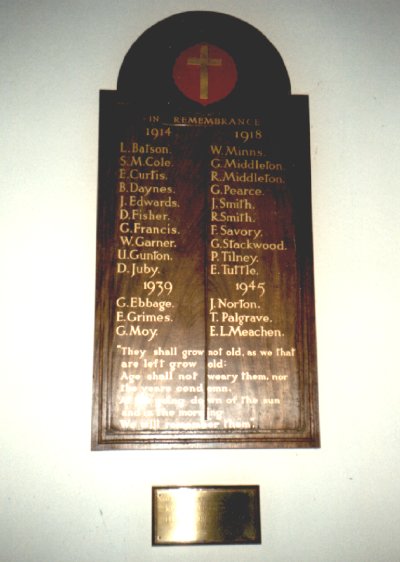
          panel no. 229-233(Royal British Legion) Also in
          Mattishall Church. Special Provisions Act 1957 Death
          Certificate has him listed as Private Tuttle Edward
          James age 20 England 13.8.1915,at sea, drowned. The
          Private is an error.

          On remembrance Sunday 1989, a wreath of poppies was
          placed at the base of the Cape Helles Memorial, the
          message read:
          "In fond remembrance of a brave young soldier.
          It took us three years but we are so pleased we found
          your last resting place Teddie.  Pauline and John."
             (This was from myself, and my brother who had
          helped with the early research)
          Sometime later a request for a photograph of the
          memorial was granted and clearly shows the name of
          Lance Corporal Edward James Tuttle, 1st Battalion Essex
          Regiment.
5th August 1998:
THE LOSS OF THE ROYAL EDWARD - OFFICIAL VERSION
UB14-THE SUBMARINE THAT SANK THE ROYAL EDWARD
ARTICLE IN TIMES NEWSPAPER AUGUST/SEPTEMBER 1915
 |
 |
The above postcard is the one sent to Teddie's parents, dated 31st July 1915, it is of the Royal Edward entering Avonmouth Dock. The message on the postcard reads:
Dear F & M
Am sending photo of ship
have only an hour longer
here as we sail to night
at 8 o/c Fri
Much love from Ted
don't expect letter just yet
farewell
It was the last they ever heard from him.
Two articles appeared in The Times..one on the 18th August 1915 reporting on the torpedo attack on the Royal Edward, the other was the memorial at sea..the service where the Royal Edward Sank..this was on Tuesday September 7th,1915.
Click here to read both the reports
In October 2006 I was given the "Next of Kin memorial Plaque". My cousin Joy had died, Teddie was her uncle and her husband kindly gave it to me, via my father, as the family keeper of records. It is a beautiful object of which I knew nothing, but have found a page on the Internet which explains all.
The plaque bears his name, Edward James Tuttle.

His mother obviously stuck a small picture of him on the plaque and I can't bring myself to remove it. Somehow it makes it even more poignant.
WW1 Memorial Plaque
Further searching came up with a few more details from a gentleman called Iain Kerr:
The "Next of Kin Memorial Plaque" was given to the relatives of the men
and
women (the female version is very rare) who died on active service in the
Great War and various other related actions and engagements up to July
1922. The 120 mm diameter bronze plaque shows the figure of Britannia
bestowing a laurel crown on a rectangular tablet bearing the name of the
deceased in raised lettering. In front stands the British lion. The
inscription round the circumference reads "HE (or SHE) DIED FOR FREEDOM
AND
HONOUR". The plaque was designed by Edward Carter Preston from
Liverpool. If you look, you will see his initials "ECP" alongside the
lion's front right paw. Preston won the Government design competition in
1916.
The plaque was made in an extremely difficult casting process - each one cast with the individual's full name - the whole operation was fraught with difficulties. In fact, an American, Manning Pike, was engaged to oversee operations but progress was so slow that they fired him and appointed some Staff Officers in his stead. Within six months they went back to Manning Pike and persuaded him to return.
The records show that Plaques were issued to the over 1,355,000 next of kin of males and 6000 to next of kin of females who were entitled to them. However, it is possible that only about 80% were actually forwarded to the bereaved before the project limped to a halt.
An illuminated Scroll with the deceased's name and unit together with a message from King George V was also sent to the next of kin.
Research sources:Civil Registration,Newspapers,Kelly's Directories,Local Historian Iris Coe(Mattishall),"Norfolk & Suffolk in the Great War",Ian Hook, Keeper of of the Essex Regiment Museum and Royal Norfolk Regiment Association.Men of Gallipoli by Peter Liddle.
Third February 1990.Researched and written by Pauline Dodd
. An account of the Life of a Norfolk country boy,son of an agricutural labourer, who drowned in the Agean Sea,Gallipoli, fighting for his country.He was the Great Uncle of the writer.
 17 November, 2006



| Page 1 | Summary | Dialect | Gallipoli | The Rows |
 Get your ownFree Home Page