Beyond
Human Senses : describing the indescribable Submitted
in partial fulfilment of ACKNOWLEDGEMENTS
CONTENTS
Preface
H.P.
Lovecraft: 'The Call of Cthulhu'
Lurking
Fears: The Horror Fiction The
life of Howard Phillips Lovecraft has, to many scholars, become inextricable
from his work; as if by properly understanding his fiction and his letters
we will better come to understand the man. Lin Carter's 1972 biographyLovecraft:
A Look Behind the Cthulhu Mythos seems so intended: a reconstitution
of anecdotal 'facts', polarised and refracted through the lens of the
author's own ideas about the man, making Lovecraft and his work operate
in yoked tandem, without ever managing to achieve a theoretical basis
that will allow this 'tandem' to operate. It's almost as if the biographical
details of Lovecraft's life are as fascinating to Carter as his fiction
and thus must be read through, or moderated by, the fiction. The key to
understanding Lovecraft's canon becomes one of a biographically-oriented
search that uses literary criticism as a validator for its findings, not
the other way round.
For
me it was - and is - Lovecraft's works of fiction that must take primacy.
Biographical details are fascinating insights into areas of his texts,
as are author-centred approaches to some of his over-riding themes,
but one must always remain fixed on the core of the Lovecraft phenomenon:
the stories he left behind him after his brief, melancholic life. The
search for biography in the work of a man whose life was composed of elaborate
fictions, is often a search for a glowing but non-existent chimaera, an
attempt to reconstitute already fictional 'facts'. My research is concentrated,
in the main, on the written artifacts Lovecraft left behind him, not the
apocrypha and heresies of his biographers, friends, and detractors.
This
is not to say that the life of Lovecraft hasn't been chronicled with precision
and insight. de Camp's The
weird fiction of Howard Phillips Lovecraft exists as a visible landmark
in the continuum of fantastic fiction. His works are on the very cusp
of the two distinct orders of the genre. On the one hand: the old guard,
where terror is explored primarily in the Gothic manner, heavy with the
accumulated "furniture" of the genre, and running into limitations that
the mere suggestion of horrors cannot break free from; and on the
other: the new guys on the block, the pulp 'hacks', unhampered by any
restrictions and only too happy to deliver sharp, visceral, graphic shocks.
This is exemplified by Stephen King in Danse Macabre when he says:
'I recognize terror as the finest emotion and so I will try to terrorize
the reader. But if I find that I cannot terrify him/her, I will try to
horrify, and if I find that I cannot horrify, I'll go for the gross-out'.
(King, 40).
Today
it is easy to concern ourselves with the very real faults that pepper
Lovecraft's literary legacy. His verbosity, pomposity, intolerance, misogyny,
misanthropy, his xenophobia, his tendency to either over-stress or under-write
his nightmare visions. It may be true that Lovecraft's characters exist
mainly as plot functions or expositors of views. There is no attempt to
flesh out these hollow men, Lovecraft's eye remains cold and analytical.
His first-person narrators are cut from the same cloth, with the same
template: they are all antiquarians and scholars, scientists and dabblers
in ancient lore, intellectual snobs, and it is only in the models of the
past that answers to the problems of present and future are to be solved.
I will be returning to this 'antiquarianism' occasionally, for Lovecraft's
Graeco-Roman affinities and neo-classicist beliefs mean that his fictional
worlds exist in a perpetual state of threat, forever in danger of losing
cohesion or ontological stabilty because of deviations that assail the
classical 'norm'.
That
racial prejudice provides a thematic infrastructure to describe his ontologically
unstable universe is, paradoxically, both Lovecraft's downfall and his
triumph. Much has been written on Lovecraft's prejudices and how they
are moderated through and exaggerated in his fiction until they become
hysterical reflections of his fear of the 'foreign' contamination of Anglo-saxon
blood-stock and the degeneration of racial purity. Stories such as 'The
Lurking Fear' and 'The Dunwich Horror' seem to bear out this hypothesis,
and many of Lovecraft's letters are littered with anti-semitic rhetoric,
anti-black propaganda and even a provisional support for the ethnic cleansing
policies of Adolf Hitler. This is the dark-side of the Lovecraft personality,
and it does make painful reading for a devotee of the dark and eldritch
worlds of Lovecraft's creations. Racial minorities are really only ever
treated as figures of mystery, exoticism, or fear in his stories; in his
letters there was evidence of actual hatred:
Of course they can't let niggers use the beach as a Southern resort-
and
there are many more examples of this kind of infantile racism throughout
his letters. This racial prejudice is petty and ignorance-fueled, but,
when refracted through the lens of his powerful fantasist's imagination,
it creates depictions of alien 'others' that remain largely unrivalled
in the history of the macabre. By exaggerating the immigrant 'others'
he feared, and the social degeneration he believed would result from their
influx (as in 'The Lurking Fear' and 'The Dunwich Horror'), Lovecraft
created a panoply of monstrous beings that moved just outside of the range
of human perception, time, and space. Clive Bloom in 'This Revolting Graveyard
of the Universe' (in Doherty, 64) suggests that racism only forms part
of Lovecraft's stories, that although Lovecraft's horrors are:
a transposition of his social fears about new immigrant
groups into a cosmic battle in which the evil Untermenschen are constantly
defeating the less numerous Ubermenschen ... the majority of Lovecraft's
tales depict Anglo-Saxon degeneracy among the rural white
poor, not the newly arrived passengers of the steerage.
Bloom
uses 'The Dunwich Horror' to illustrate this point, although, as I will
examine in the third chapter, some his ideas are very much open to question.
To
tackle Lovecraft's work, I intend to explore three elements of Lovecraft's
work that can really be grouped together under the general heading: transgressions;
in which I mean a moving past the boundaries of, in Chapter One - human
perceptions; in Chapter Two - human time; and in Chapter Three - human
physicality. I feel these areas give a good general picture of Lovecraft's
overriding themes, while allowing me to home in details that I feel will
offer some insight into Lovecraft's literary legacy, attempting to thematize
Lovecraft's stories, while using his fictional works, his books of letters
and his critical piece 'Supernatural Horror in Literature'. In the conclusion
I will draw together the strands, but more importantly try to follow the
enduring appeal of both his own stories, and the later writers who have
borrowed from or emulated his themes and/or styles.
Beyond
Human Perceptions: Absence and To
create a theoretical basis from which to examine the texts of Howard Phillips
Lovecraft requires a careful consideration of the major issues at play
within the Lovecraft canon. From an epistemological standpoint, modern
literary criticism functions best as an interrogator of unresolved elements
at play within a subject text, and with the works of Lovecraft these unresolved
textual elements are as important as the resolved aspects of narrative.
Stories of otherwordly - or indeed otherdimensional - terrors find easy
resolutions problematised by the sheer otherness of their subject matter;
Lovecraft's stories take this a stage further with their evasive, de-centred
nature.
For
Lovecraft, horrors cannot be contained within a narrativity that is unable
to pronounce their name; subjectivity fails to find labels or descriptions
of the things from beyond, and the whole pattern of linear story-telling
is disrupted by this constant falling short of the narrative truth. Somewhere
in the midst of Lovecraft's overly-ornate, fussily over-worked verbosity
lurks a series of connected discourses that not only seek to explain the
universe in terms of timeless 'Old Ones' whose presence on this planet
sparked the first steps towards human evolution, but also to question
the very nature of subjective reality itself.
Joanne
Russ sees Lovecraft's fictions as symptomatic of what Laing called 'ontological
insecurity'. This suggests that '(I)f one fears that one doesn't exist
securely ... any contact with another becomes potentially catastrophic
' (In her article in Smith, Curtis 463). She offers this as an explanation
for Lovecraft's obsessions with the fragility of human perceptions of
reality, an obsession succinctly revealed by the character of Crawford
Tillinghast in 'From Beyond':
(W)ith five feeble senses we pretend to comprehend the
boundlessly The
'boundlessly complex cosmos' is one of the cornerstones of Lovecraft's
work, it imbues his work with the impossibility of understanding even
the horrors contained within his own tales. Such horrific intrusions 'from
beyond' become harbingers of human insignificance in the face of abyssmal
gulfs of unknowable, incomprehensible space. It is almost as if Lovecraft's
creatures are signifiers - Yog Sothoth, Cthulhu, Shub Niggurath, Azathoth,
Nyarlathotep - without humanly comprehensible signifieds. The narrators
of Lovecraft's stories are never able to satisfactorily describe the monsters
that populate the fictional universe, and instead their attention is turned
towards breaking the monsters down into component parts that human minds
can at least make sense of. This is illustrated in 'The Call of Cthulhu',
where Cthulhu 'cannot be described - there is no language for such
abysms of shrieking and immemorial lunacy, such eldritch contradictions
of all matter, force, and cosmic order ' (The Haunter of the Dark,
72). Instead Cthulhu is reduced to a signifier of an infinite chain
of signifieds; Cthulhu is 'A mountain (that) walked or stumbled
' (ib); Its bas relief shows elements of 'an octopus, a dragon and
a human caricature ' (ib. 49), and that has 'rudimentary wings
'; Cthulhu changes, depending on what part, or facet, of It that the narrator
is observing. Cthulhu is described as 'Polypheme ' and 'a
gelatinous green immensity ', (both ib.) and this instability of coherent
form interrogates the limits of human perception, by posing the mind a
puzzle made up of conflicting images and impressions. Naming has always
been a symbol of ownership, Durkheim tells us, so perhaps a part
of the horror of Cthulhu is the horror of humanity eclipsed by something
we cannot own by naming.
Lovecraft's
mythos, and many of his non-mythos stories, attempt to address and
describe feelings of the sublime, using a new vocabulary of images from
the developing genres of horror and science-fiction to create a new grammar
to examine those feelings. Lovecraft's use of sublimity - an excess of
sensory information of such intensity that it literally causes fear and
wonder - is best summed up in the letter Lovecraft sent to Clark Ashton
Smith in 1930: Strangely,
though, these 'poignant emotional experiences ' are products of the intellect,
and not the senses; they are to do with 'considering' and not 'sensing'
or 'experiencing'. Burke, in his A Philosophical Enquiry into the Origins
of Our ideas of the Sublime and Beautiful, describes this moment when
fictional consideration over-reaches the limits of human sensing in his
discussion of Milton's Paradise Lost: '(T)he mind is hurried
out of itself, by a croud of great and confused images ' (quoted in
Sage, 36) and it is exactly the presence of this crowd of images that
Lovecraft attempts to Layered
throughout each of Lovecraft's stories is an interdependent structure
of binarily-opposed terms and discourses: the discourses of science and
superstition; of past and present; of forces from this world and from
beyond; of humanity and otherness. Lovecraft seems perpetually engaged
in metaphysical debate within his stories, structuring them in such a
way that the opposing terms interrogate each others' difference.
In
'The Colour From Out of Space', for example, the discourses of modern
science and folk-superstition are re-examined by use of an agent from
beyond our narrow grasp of 'reality'. The meteor that hits Nahum Gardner's
well 'was nothing of this earth, but a piece of the great outside;
and as such dowered with outside properties and obedient to outside laws'
(The Haunter of the Dark, 181) and as such it is explicable by neither
science nor superstition, and neither discourse is adequate to describe
or explain what becomes of the Gardner's farm in the collision between
the alien with the commonplace. The meteor, a 'large coloured globule
... it was only by analogy that they called it colour at all Lovecraft
sustains the conflict between the rationality of human science and the
irrationality of the sublime, finally telling us little about either,
but giving us feelings of the latter, which may be the only approach
Lovecraft could find, and it maintains an almost dialectical tension between
the two. That the human cost is, as Joanne Russ identifies (463) engulfment
is an almost irrelevant factor in our understanding of what Lovecraft's
tale tells us about the things that dwell beyond our narrow sphere of
perception, and is only of importance in the quest for understanding of
what the tale tells us about our own feelings of vulnerability and cosmic
insignificance.
To
borrow from Lacan, the world of symbolic order is disrupted by the intrusion
from the brooding 'imaginary' of deep and boundless space. Blaise Pascal's
famous response to infinity, that 'Le silence eternel de ces espaces
infinis m'effraie : 'the terrible silence of these infinite spaces terrifies
me' (PensŒes, iii.206 ) encapulates this sense of sublime terror generated
by man's contemplation of eternity. Ordinarily, we are only able to examine
infinity with the use of science and mathematics, by use of astronomy
and theoretical physics. We tie space and its mysteries down to logical,
taxonomic, mathematically constant structures; structures controlled
by the algebra of relativity. Lovecraft seems to be making the simple
statement that space, with its many mysteries, is really whatever we say
it is. The writer of science-fiction has as much licence to investigate
eternity as the scientist, and that the writer can use elements of science
to back up his fictional schema means that he is in a strong position
to extrapolate without recourse to such annoying inconveniences
of 'proof' or evidence. Lovecraft's universe is huge and threatening,
and can never be measured or quantified. The 'vivid interplays of unknown
and inconceivable influences' underpinning Lovecraft's fiction 'give vast
and fabulous activity to dimensional areas that are not shapes, and to
nuclei of complex rearrangements that are not minds' (Letter to D. Wandrei,
Letters 2, 127). What lies beyond our narrow sphere, then, exists beyond
human science. Lovecraft makes a new universe, and populates it with horrors
that awaken our feelings of awe and terror. Human rationality, and the
limits it imposes upon what it will see, what it will believe, only exists
as a kind of sublime circuit-breaker, something that prevents us from
constant feelings of sublimity. Civilisation, culture and science 'earth'
us against constant sensory exposure to the perpetual wonder of the universe.
Whether we use the discourse of science - imposing rational, symbolic
order upon a universe that may have more facets and twists than we can
ever know or imagine - or the discourse of the local witness in 'The Colour
Out of Space' - from which we learn more but ultimately know as little
- the central concern of the narrative is what we become when a piece
of space stops being 'out there' and moves into our realm. What use is
there for taxonomy, quantification, even religion (... the way it's made
an' the way it works ain't like no way o' God's world' [Haunter, 196])
in the face of the sublime?
no breath from the skies whose motions and dimensions our astronomers
measure or deem too vast Signification
becomes a series of diminishing iterations, winding down into entropy,
both social and physical. The colour brings an end to social order and
physical function; cut free from evolutionary purpose and instinctual
drive, the human soul itself loses its 'colour'. The metaphysical collision
of 'within' (human space) and 'without' (alien space) challenges
physical and moral law. A breakdown on the level of physicality is followed
by a fracturing of moral sense, as if one is wholly reliant on the other.
The natural order - personified by neo-pastoral Nahum - once disrupted
is irrevocably altered. The human soul, once bared before the painful
bliss of the sublime, is forever eclipsed. Newtonian constants, which
Newton himself saw as requiring the hand of god to reset its mechanisms,
are reduced to the same ambiguous, monotonous colour as Nahum's land;
partial signifiers of a universe of existential horror and preternatural
properties.
Beyond
Human Time: Non-Linear Time in "The Shadow Lovecraft's
works are constantly addressing a notion of exceeding human understanding
and perception, of taking his readers beyond all that is known or postulated
within our consensus reality. Working within the confines of the genres
of both horror and science-fiction, Lovecraft devised a detailed mythology
and a pantheon of god-like beings to facilitate some unsettling explorations
into ultra-human forces and ideas; evoking feelings of human limits transgressed.
In his essay 'How to think what no one has ever thought before', William
H. Calvin advises one 'to take a nap and dream about something' (Science,
Mind & Cosmos, 29), and Lovecraft seemed acutely aware of this simple
path to questioning the fundamental principles of human scientific empiricism.
Flights of cosmic fantasy can serve to interrogate accepted modes of human
thought as well as to titillate escapist minds.
(P)arents and friends die; beloved houses and landscapes become
is
something Lovecraft was very much aware of, but the solution was not to
be found by 'drugging oneself with immortality-mythsin order to be tolerably
contented during the brief span one lives.' (ib, 415) Instead Lovecraft
used other myths to examine the uneasy relationship between humans and
time. At
The Mountains of Madness examines an idea of human history and the
taxonomic quest of science to impose retrospective labels to areas of
prehistory. Palaeontology seeks to classify that which it cannot
asense of impatient rebellion against the rigid and eluctable tyranny
of time, space and natural
(M)y conception of time - my ability
to distinguish between Indeed
when the World War breaks out, Peaslee is assailed by 'strange impressions
of remembering some of its far-off consequences - as if I knew how it
was coming out and could lookupon it in the light of future information.'(ib.)
horrible annals of other worlds and other universes ...
strange orders
Beyond
Human Bodies: Lovecraft's Representations of the Lovecraft
moved between the timeless depths of infinite space and the mysteries
of fractured time to evoke sublime reactions. His stories seem to be constantly
posing the question: if our perceptions of time and space are faulty,
then what can we really hold to be true in the universe? Lovecraft
had many devices for bringing the sublime to Earth, to juxtapose
cosmic reality with human perception of reality; whether it was the direct
approach: which brought the alien into immediate human contact (as
in the aerolite from 'The Colour Out of Space', ); the buried:
where the alien is suggested by cyclopean ruins (as in At The Mountains
of Madness, or 'The Temple');visitation : where the alien is
visited by the human (as in 'The Dream Quest of Unknown Kadath'
or 'The Shadow Out of Time'); or fusion: where the alien is mated
with the human, (as in 'The Dunwich Horror' or 'The Shadow Over Innsmouth').
In all of these cases, the 'other' is brought into contact with the human,
and the contact leaves the human changed forever by the experience.
The
Whateleys have had commerce with alien forces, and their house has become
a kind of slum '
lay half-bent on its side in a foetid pool of greenish-yellow ichor
The
unholy product of a union between terrestrial and alien parents, Wilbur
Whateley is a xenogenetic mutation. His twin, who looks more like his
father than Wilbur does is 'all made o' squirming ropes' and there is
'nothin' solid about it - all like jelly '. (ib. 111) Barton Levi St.
Armand sees this kind of description as part of Lovecraft's 'Great
Dread of the Viscous' (The Roots of Horror in the Fiction of H. P. Lovecraft,
63), and this fear of viscosity is ever-present in Lovecraft's descriptions
of monsters and their body fluids, but it is enlightening to compare these
kind of descriptions with the language Lovecraft uses to describe his
visit to a East Side slum, where:
(T)he organic things - Italo-Semitico-Mongoloid - inhabiting that
St.
Armand sees this description as a 'manically excremental raving' (64)
that surpasses anything Dean Swift tried to depict, but I feel that linking
this xenophobic nightmare with Juvenalian satire which
really isn't all that far from the language Lovecraft uses to describe
the slum. If anything the Innsmouth creatures are portrayed as more human
than the urban ethnic minorities. Its tempting to suggest that Lovecraft's
fear of the viscous and of the grotesque is by far exceeded by his fear
of the
(A)ny magazine-cover hack can splash paint around wildly and
and
one feels that Lovecraft is not only talking about painted art here, but
also literature. The ' The
awful ... blasphemous horror ' of the paintings is defined in the narrative
by what it is not: it is not the 'exotic technique ' of Sidney Sime, nor
the 'trans-Saturnian landscapes and lunar fungi ' of Clark Ashton Smith
(all ib. 40) that makes these paintings work, but some other quality that
Thurber struggles to find a label for. This 'Daemoniac portaiture' (ib.)
depicts the encroachment of awful creatures into human society, where
they feed or battle, or teach small children (changelings) how to eat
human flesh. These creatures are 'seldom completely human ... roughly
bipedal, had a forward slumping, and a vaguely canine cast. The texture
of the majority was a kind of unpleasant rubberiness .' (ib.) They exist
in the margins of society, at its darkest edges and its deepest depths.
They prey on humans who stray across their places, and they interact with
humanity in ways that Thurber hardly dares mention; the most chilling
for Thurber being the changeling - where 'weird people leave their spawn
in cradles in exchange for the human babes they steal' (ib. 41). That
the 'dog-things' (ib.) are the results of this practice disturbs Thurber,
although at this point he is still viewing Pickman's works as art. It
is not until the final page that Thurber finds the photograph of the thing
in the cellar that makes him realize that all the rest of Pickman's paintings
are true representations of their subjects too. Pickman is not only
'a thorough, painstaking, and almost scientific realist' (ib. 43), he
is also, possibly, one of the weird
The
Cult of Cthulhu
The
Internet buzzes with information about Lovecraft. Scholars swap messages
with teenagers whose introduction to Howard Phillips was an epigram on
Iron Maiden's 'Live after Death' album. Arguments flare up, ideas are
exchanged, even paranoid Lovecraftian fantasies are aired. One thing is
certain, Lovecraft's monsters have been translated into the information
super-highway's ghosts in the machine. The
cinema has translated his work to varying degrees of success; from the
the bizarrely titled Roger Corman film "Edgar Allan Poe's 'The Haunted
Palace'" [1963] (actually a version of 'The Case of Charles Dexter Ward');
through the eighties 'splatterfests' "Re-Animator" [1986], "From Beyond"
[1986], and "Bride of the Re-Animator" [1989]; to the nineties antecedents
"Necronomicon" (1994), and "From the Mouth of Madness" (1995), cinema
seems to want to show what Lovecraft only hinted at.
(A) large part of Lovecraft's driving force came from the frisson
and
that was almost the exact same sentiment that I had always planned to
end this dissertation with, but the more I have read, the harder it has
become to subscribe to this notion any longer. The only way I can soften
the blow of reading some of Lovecraft's virulent racist statements is
to note that Lovecraft's xenophobia stretched far beyond racism, and was
more a fear of strangers, regardless of skin colour. The
reflected face of the ghoul in the mirror, the moment when the narrator
sees his own monstrousness in the silvered glass, is perhaps Lovecraft's
fear of the most terrifying other of all.
Calvin,
William H. "How to Think What No One Has Ever Thought Before."
Bakhtin,
Mikhail. Cthulhu"





in the fiction of Howard Phillips
Lovecraft
the requirements for the degree of
BACHELOR OF ARTS
Nene College, Northampton, 1996
My thanks are directed mainly at Penny, for humouring me when I used her
as a sounding board for my ideas, and for her eternal patience, belief,
and support. Thanks are also due to Simon Perrill, Nigel Burrell, Russell
for fact-checking, and all the Lovecraftian scholars whose works have
been my guide through the twisting labyrinth that is an undergraduate
thesis.
This work is dedicated to the memory of Andrew Paul Lancaster, who shared
my passion for Lovecraft, and without whom this dissertation would never
have been attempted.
Chapter One: Beyond Human Senses
Chapter Two: Beyond Human Time
Chapter Three: Beyond Human Bodies
Afterword
Works Cited
Selected Bibliography
'The most merciful thing in the world, I
think, is the inability of the human mind to correlate
all its contents. We live on a placid island of ignorance
in the midst of black seas of infinity, and it
was not meant that we should voyage far.'
of Howard Phillips Lovecraft.
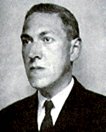
Lovecraft: A Biography is a detailed and human account of the
life of the creator of the Cthulhu Mythos. It served as an invaluable
guide through the labyrinths of contradiction and paradox that litter
the trail to a satisfactory literary critical space in which to examine
the disparate strands that makes up a writer's life and works. I will
occasionally come back to biographical/author-centred approaches because
it is nigh on impossible not to, but the stories, letters, and entries
in his Commonplace Book exist as very real artefacts that we can use to
calibrate his fiction; whereas personal recollections are always subjective
and often rose-tinted, thwarting accurate analysis.
can you imagine sensitive
persons bathing near a pack of greasy
chimpanzees? The only thing that makes
life endurable where blacks
abound is the Jim Crow principle, &
I wish they'd apply it in N.Y. both
to niggers & to the
more Asiatic types of puffy, rat-faced Jew.
Either stow 'em out of sight or kill 'em
off - anything so that a white
man may walk along the streets without
shuddering & nausea
(quoted in de Camp, 249),
Presence in "The Colour Out of Space".
complex cosmos, yet other beings
with a wider, stronger, or different
range of senses might not only see
very differently the things we see,
but might see and study whole worlds of
matter, energy, and life which
lie close at hand yet can never be
detected with the senses we have
... strange, inaccessible worlds
exist at our very elbows.
Dagon and other macabre tales, 58).
The true function of phantasy is
to give the imagination a ground
for limitless expansion, and to satisfy
aesthetically the sincere and
burning curiosity and sense of awe
which a sensitive minority of
mankind feel toward the
alluring and provocative abysses of
unplumbed space and unguessed entity
which press in upon the
known world from unknown infinities and
in unknown relationships
of time, space, matter, force, dimensionality,
and consciousness.
I know that my most poignant
emotional experiences are those
which concern the lure of unplumbed
space, the terror of the
encroaching outer void, and the struggle
to transcend the known
and established order.
(Letters, Volume 3)
in his fiction, to mediate the sublime through the calmly rational
first-person narrators that populate his most famous fictions.
', (ib.) exists as a causal focus for a series of narrative and
philosophical discourses that examine the effects of the unknowable upon
minds that instinctively need to know the nature and structure
of everything. Taxonomy - the human drive to classify and understand -
cannot satisfactorily signify this unworldly other; language fails to
impose order upon this pattern of alien behavior. Not only is it impossible
for us to ever know the colour that this 'other' is, it is equally impossible
for us to divine its intentions or the processes it uses to secure the
success of its goals. The way the alien lives and just what it is that
it does to the Gardner family are things we cannot know; they are a system
of practices and routines that defy our attempts to impose terrestrial
psychopathology upon them.
The three professors from Miskatonic University subject the 'colour'
to all manner of scientific experimentation and Lovecraft describes the
processes in some detail before the element reduces itself - and the beaker
containing it - and literally passes out of the rational gaze of science.
The role of science in this phase of the narrative seems simple, but is
actually quite complex. Initially it appears to be the attempt of modern
science to reduce the 'colour' to a set of laws, rules and dimensions
that will identify the properties of the aerolite. But, while masquerading
as an attempt to quantify, measure, describe and identify just what the
colour is, the scientist's role is simply to show us what the colour is
not. This theoretical aporia, in which contradiction empowers but also
threatens narrative function, reduces the text to a search for signification,
which always falls short of - or indeed negates - that which it attempts
to describe. It is almost as if the human linguistic system is challenged
and found lacking; what are often seen as relatively stable linguistic
units like deixes are subverted into betraying less than the information
they are intended to encode. If situational co-ordinates are open to question
- now/then, here/there, us/them - then more abstract and ambiguous coding
is completely jeopardized. Lovecraft's prose makes it almost impossible
for us to imagine the contents of the aerolite (and the alien behaviour
they impose upon human physiology) because he is more intent on showing
us what the aerolite isn't. 'Us' and 'them' are redundant terms, for the
boundaries between alien and human physicality are blurred; 'here'
and 'there' are fused into a place neither here nor there, Nahum's
farmafter the fact.
Nahum Gardner - a man of the land, innocent of affairs of space and
the paradoxes of infinity - occupies a peculiar narrative position, for
his story and his words are mediated through the more knowledgeable Ammi
Pierce in anecdotal form, embedding authorship of the story firmly in
the control of others. The hierarchy of discourses is structured from
Lovecraft's prose, through the persona of the surveyor, through the narrative
of Pierce, who relates the story of Gardner. This makes the narrative
very difficult to separate into the discourses that structure the story.
The narrator himself is a man of Euclidean geometry, suddenly thrust into
Lovecraft's non-Euclidean universe; he is a surveyor, a man of symbols
and equations, measurements and scale drawings. His world view is altered
by the tale of 'the blasted heath', and his intellect falls short of categorical
signification of this thing which is:
to measure. It was a
colour out of space - a frightful messenger from unformed realms whose
mere
existence stuns the brain
and numbs us with the black extra-cosmic gulfs it throws before our
frenzied eyes (Ib.
202).
The colour's passage from the 'unformed realms' of the unconscious
to the 'motions and dimensions' of symbolic order is facilitated by engulfment,
then destruction. Its hosts - the Gardner family, the local wildlife and
fauna - become reduced (much as the colour reduces itself) until they
are defined more by what they are no longer than what they have become.
Presence yields to absence in an alchemical interation that somehow leaves
less than was present before, without leaving left-over or waste.
The colour's interactions with humanity point to an essential colourlessness
of behavior, as if contact with the sublime dissolves the human soul,
or at least deadens it. If colour is defined as the amount and quality
of light reflected back from a source, then this colour seems more like
an absence of light, a demonstration of an anti-colour. The colour makes
its hosts 'calloused to strange and unpleasant things' and forces people
to act 'listlessly and mechanically' as they perform their 'thankless
and monotonous chores ' (All 'Haunter', 187). The Gardners are shunned
by the local populace, excommunicated from fellow man they can only become
less than human. Social order is broken down by this calamity from elsewhere
and no explicable alien social order rises to fill the vaccuum. The Gardners
are made alien, but they are also alienated from the community by all
but Ammi Pierce.
The 'aerolite' is a harbinger of an alien sign system, and its meeting
with Nahum's simple existence forever redefines the relationship between
absence and presence. That the colour continues to move, 'an inch a year'
is a clear indication that in the battle between order and chaos, the
symbolic and the imaginary, order will always fail because its terms are
so tightly bound to inflexible axioms, its terms are too self-referential
and tied to simplistic rules and relativistic, general laws. The irrational
knows no such limits, it creeps on like cancer through cells, until
reason itself is devoured, made absent, by the presence of the sublime.
Science, rational order, after asking the questions falls short of an
answer. Folk-tale - and modified superstition - also fails. Only that
from outside - an alien grammar imposed on the human structure - can overwrite
human experience and genetics, re-writing humanity in alien sentences
that mean nothing to the characters within the story, for they are unreadable.
The surveyor, the metonymic 'eye' (I) can only survey. There is no evidence
of reciprocity, humanity gives nothing back to the universe in this non-Newtonian
equation. The sublime 'aerolite', characterised by awe and terror, not
only acquaints its hosts with their own mortality and a glimpse of their
own extinction, but also consumes the sense of self-preservation that
Burke found at the heart of the sublime.
out of Time" and At The Mountains of Madness.

In the previous chapter I examined the manner in which Lovecraft used
elements of a modified idea of the sublime to exceed human feelings and
understanding; in this chapter I will pay close attention to the way Lovecraft
used time, and a sense of time beyond a human perception of
time, to add force to the devices and concerns described in the first
chapter. Time - its passing; history; prehistory; lineage; the
'sense of pageantry' of one's ancestry (Letters 4, 416) - is central
to Lovecraft's works. Not just the time we count off on clocks and watches
- although it is this idea of time that fuels Lovecraft's musings - but
rather a philosophical consideration of time that is not tied to a human
measurement of time, but rather a system freed up from linear human restraints
in which our perception may only be one of many.
Where his search for a scientific sublime is a fantasist's quest for
truth in a universe in which God has been philosophically pronounced dead
and other things must fill the void left by his passing, the examination
of non-human time-frames gives rise to other interesting lines of enquiry
and criticism. To human perception, the arrow of time has a straight
and true shaft and transports us all from birth through to death, remaining
oblivious to how attached an individual becomes to their own, personal
synchronic span of diachronic eternity. Human life is ephemeral, a tiny
part of a massive continuum, and where some chose religion to ease the
perpetual truth of our mortality, Lovecraft's atheism offered him no such
comfort. That:
hopelessly altered or
destroyed; social millieux and other
environmental supports decay
and become metamorphosed; and
one's own self grows
old, exiled from the beauty, vividness &
adventurous expectancy of youth
(Letters 4, 416)
Within Lovecraft's stories time moves in increasingly mysterious ways,
and its passage is constantly disrupted - or even reversed - by forces
beyond human ken. Ted Hughes, in 'Moon Clock', wrote about a kind of time
that was 'somehow, somehow never now' (Moon Whales, 80) and there is a
sense of this odd paradox contained within Lovecraft's fantasies: that
the thing we call the present is only a nexus or meeting place for all
times ; that each era can influence not only the future ( which it
does second by second ), but the past also, as if time is divisible, that
creatures beyond our knowledge may view what we see as an immutable journey
forward - from the past into the future - as merely a system of
operations that can be reduced, reshuffled, reversed.
but only hypothesize about. The aim of the Miskatonic University
Expedition is to learn about prehistory, but their methodology is really
only directed at confirming existing ideas about that prehistory. Science
carries with it its own hegemony, rewriting the world with its theories.
It seems always to be seeking to consolidate its theoretical grasp with
a necessarily blinkered view, a view that humansare capable of having.
This realisation feeds back into one of the dilemmas of scientific philosophy:
how we, with limited powers of reason and understanding, can ever hope
to understand the complex, possibly limitless principles that govern eternity.
It really comes back to the 'five feeble senses' idea addressed in the
previous chapter, and Lovecraft is, in many ways, declaring war on science's
hegemony.
In a letter to Harold S. Farnese in 1932, Lovecraft discussed his fascination
with that which is unknown, outside scientific classification, declaring
it a 'virtually permanent ... part of the human personality '. (Letters
4, 70-71) Although contemporary science 'destroys' human belief in the
supernatural, Howard Phillips Lovecraft saw his work as:
law - a sense which drives
our imaginations to devise all sorts of plausible hypothetical defeats
of
that tyranny -and
second a burning curiosity concerning the vast
reaches of unplumbed and
unplumbable cosmic
space which press down tantalisingly on all
sides of our pitifully tiny
sphere of the known.
Between these two ... factors I believe
the field of the weird must
necessarily continue
to have a reason for existence, and that the nature
of man must necessarily
still seek occasional
expression ... in symbols and phantasies involving the
hypothetical
frustration of
physical law, and the imaginative extrusion of knowledge and adventure
beyond the
bounds imposed by reality.
Lovecraft's phantasies, then, invent new forms of answer to the eternal
question 'Why are we here?' and reinterpret the universe in the shape
of narratives that resist the rigorous scrutiny of science. Lovecraft's
message seems to be that if science's Grail-quest is right and there is
a 'Grand Unified Theory' that can interpret and explain the universe around
us, then its message is one we should fear rather than embrace. Totality
of vision and understanding will only seek to undermine our imagined position
at the centre of things, and show us instead that our search for a universal
truth and order to the universe is as hollow as our theological dreams.
Dawkinian evolutionism shows us a vision of a godless world no less marvellous
or miraculous for this absence, but this was a message that had been telegraphed
in advance by the discoveries that Darwin had softened somewhat to fit
in with his wife's strong religious beliefs. Lovecraft's stories take
a different path to atheism, telling us that there may well be forces
out there that we could feasibly label 'god-like', but this pantheon is
unlike anything we ever expected to be out there. The truth of the human
'Book of Genesis' is nothing to do with the fall from Paradise, indeed
the true story is but a brief entry in some incalculably complex laboratory
journey, we are little more than an experiment that escaped from the test-tubes
of the Great Old Ones somewhere in the 'that nameless geologic past' of
The Mountains of Madness (76).
The 'pageantry of history' is recorded on the labyrinthine walls of
the Antarctic city of the Old Ones, a series of carvings, arabesques and
cartouches that show the 'abnormal historic-mindedness of the primal race'
(ib. 79). Human time is dwarfed, and ultimately eclipsed by this 'monstrous
dead city' (ib) that is a thousand million years old; and it's bas-reliefs
record the myths and legends of that time, myths that stretch back unimaginable
lengths of time, establishing an unknowable gulf of time, perhaps a thousand
million times a thousand million years, the 'preterrestrial life of the
star-headed beings on other planets, in other galaxies, and in other universes.'
(ib. 82). Human time, or more accurately human perception of history,
is reduced to the tiniest subset in a master set of boundless aeons; time
becomes something immeasurable to human taxonomy. The discoveries of the
Old Ones' historical record reminds us that in our need to classify
we have created synchronic labels for areas of Earth history - Eocence,
Cretaceous, Mesozoic, pre-Cambrian, Jurassic - but these are not the vast
epochs we imagine them to be, but rather ephemeral periods in a much larger
scale than we are really capable of grasping. Where time becomes something
that dwarfs human perception, the 'much-discussed couplet' from 'The Call
Of Cthulhu' comes readily to mind:"That is not dead which can eternal
lie / And with strange eons even death may die" and with it the realisation
that eternity, whatever that may be, will be filled with the risings and
fallings of species such as ours, and the permanency of that deathis a
matter of the strangeness of time. In the caverns of Antarctica,
the narrator and his companion are offered a glimpse of thesestrange eons.
The narrator's knowledge of the forbidden books of the Miskatonic University
library prepares him, in part, for the revelations of prehistory; Danforth's
breakdown at the further revelations of the other mountain range and city
destroys his mind. His mad ravings - 'the windowless solids with five
dimensions ... the original, the eternal, the undying ' (ib. 138) - are
partly rationalised by the narrator as conceptions drawn from Danforth's
earlier researches into theNecronomicon, that were not formed until 'his
memory had had a chance to draw on his bygone reading ... He could never
have seen so much in one instantaneous glance ' (139); but time itself
is so compressed and distorted in this terrifying tomb of 'primal white
jelly' that maybe the narrator's denial is symptomatic of his reticence
to believe what his senses and researches are telling him. Perhaps one
of the subtexts of Lovecraft's use of the elongated time-scale of At
The Mountains Of Madness is that we, as a race, are hopelessly locked
onto a scientific course that believes it will explain all the mysteries
of time and space if we ourselves are given enough time; and that we really
cannot - or will not - grasp or accept the idea of a cosmic
bigger picture that doesn't contain us at the very centre. Just as
occidental geographers placed Europe at the centre of the Mercator Projection,
so terrestrial conceit wishes us to appear as a bright, shimmering jewel
in the middle of the beautiful crown of the heavens; we wish to be evolution's
highest achievement and our planet to be the ultimate reflection of the
distance we have travelled down the evolutionary path, something we shape
to reflect our needs and whims, but not a battlefield, an experimental
farm or a cosmic laboratory. We want to see ourselves at the very top
of the food chain,
not as a food-source, not fodder, not the vivisected, and certainly
not cattle.
The aforementioned 'strange eons' form the heart of Lovecraft's 'The
Shadow out of Time' where, like the narrator, the story is concerned
with unearthing the 'fragments of unknown, primordial masonry' that make
up human prehistory.
'The Shadow out of Time' asks many of the same questions as At the
Mountains of Madness. It is an odd, but powerful tale in which the
narrator, Nathaniel Wingate Peaslee, seeks to piece together an account
of the times in which a 'secondary personality' overwrites his own. This
new personality is an
'utter alien' usurping Peaslee's body for its own purposes over a sustained
period of five years (The Lurking Fear, 159). After regaining control
of his own body and mind, Peaslee discovers that:
consecutiveness
and simultaneousness - seemed subtly disordered;
so that
I formed chimerical notions about living in one
age and
casting one's mind
all over eternity for knowledge of past and future
ages. (162)
Just as 'The Colour Out of Space' opened a discourse between science
and folk-tale, 'The Shadow Out of Time' uses myth to fill in the
spaces left by the theoretical musings of science. Although the 'new developments
in those theories of relativity ' of Einstein who reduces time 'to the
status of a mere dimension ' (162), it is myth - 'the persistent legends
of immemorial antiquity' (164) - that allows Peaslee to put together a
reasonable account of the 'curious knowledge and strange conduct of (his)
body's late tenant' (162). 'Stupifying gulfs of time' (ib) yawn
under Peaslee, and the deeper he digs into myth and folklore, the more
he discovers about the creatures that had 'delved into every secret of
nature before the amphibian forebears of man had crawled out of a hot
sea three hundred million years ago' (169).
Some of these creatures 'were as old as the cosmos itself ... Spans
of thousands of millions of years, and linkages of other galaxies and
universes were spoken of .... there was no such thingas time in the humanly
accepted sense' (ib). Indeed the Great Race of Yith can project themselves
through time, across millions of years, to 'study the lore of every age'
(ib). Moving forward and backward through time, it is from this race that
'arose all legends of prophets, including those in human mythology' (ib),
and, although the Great Race find it harder to travel back in time than
they do forwards, they seem to be in control of time and its mysteries.
Peaslee, in dreams, remembers his missing years, recalling the:
of beings which had peopled the world in
forgotten pasts, and frightful
chronicles of grotesque-bodied
intelligences which would people it
millions of years after the death of the
last human being.
Lovecraft shows us the races that bracket human existence, showing
us to be just a parenthesised clause in an unknowably alien sentence.
The human race's life-span is nothing in comparison to the planet's age;
just as the individual human's life-span is insignificant next to the
Great Race of Yith's four or five thousand years. It seems that we have
nothing in common with these incredibly ancient, mind-projecting aliens.
Nothing except taxonomy; for the Great Race are a race of historians and
archivists using the bodies of other races, forwards or backwards in time,
as their history books. The minds of the selected creatures are transported
into the bodies of the Great Race, and it is here that Peaslee meets the
minds of people from every age of human history, as well as minds from
other times. Some 'would live in incalculable epochs to come ', while
others are from 'six million years in the past(179). Just like the Old
Ones in At The Mountains of Madness, the Great Race are historically-minded,
indeed there are Old Ones amongst the assembled minds in the past that
Peaslee meets, for what else could 'the winged, star-headed, half-vegetable
race of paleogean Antarctica' (ib.) be?
That the Great Race are technologically well in advance of us, but
still remains interested in
history, one of ther first casualties of modernity, if Post-Modernism
is to be believed - is perhaps one of the most fascinating things about
them; for it shows, perhaps, a dissatisfaction with their present, in
favour of chronicling both distant past and far-flung future. The Utopian
'fascistic socialism' (ib. 180) of the Great Race's society seems to retain
stability through historical researches, which provide the ten foot rugose
cones with a collective interest that also acts as a kind of societal
glue. Myth and legend threaten the Great Race, but they remain fixed on
their chronicling and archiving.
In many ways this interest in history reflects Lovecraft's own antiquarian
sensibilities. Lovecraft's letters reveal him as a man who yearned for
the past, a scholar who longed to live in a simpler, less confusing
age. He saw himself as an eighteenth century gentleman born out of time.
Lovecraft affected an 'eighteenth century pose', de Camp notes (22), although
'(F)ew outside of mental institutions ... have carried out the charade
with Lovecraft's rigor'. (ib.) This vigor for the eighteenth century translated
itself into a hatred of using post-colonial words and phrases, and of
dating some correspondences and self-portraits two hundred years before
the actual calendar date; but it also manifested itself in a keen interest
in the history of bygone ages. This is reflected in much of his fiction,
but 'The Shadow Out of Time' seems a specific examination of Lovecraft's
idea of the ultimate in historians. Though the
otherness of the Great Race serves to add dramatic weight and cosmic
horror to the tale, Lovecraft's working-through of his philosophical considerations
of time gives 'The Shadow Out of Time' a power and resonance that reflects
its writer's preoccupations, and turns time itself into a traversable
geography. In a multi-dimensional universe, the Albert Einsteins and Stephen
Hawkings of our world are only capable of theorizing about the particular
effects that humans are capable of considering. The archivists of the
Great Race know no such bounds, and neither, in his own way, did Lovecraft
himself.
'Foreign' as 'other ' in "The Dunwich Horror" and "Pickman's
Model".
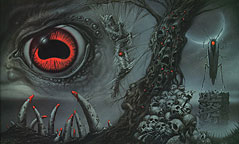
There is a long tradition of depictions of the monstrous and the grotesque,
and Lovecraft draws from a large pool of precedents in the construction
of his eldritch horrors. Working within a genre, already bound by rules
and conventions, Lovecraft was keenly aware of the essential ingredients
it took to produce fiction that would bring the fantastic into sharp,
horrific focus. He was a fan and critic of horror tales, and many of his
main influences are chronicled in his critical work 'Supernatural Horror
in Literature'. Although, some may argue, much of Lovecraft's work seems
to be contradicted by his theoretical assertions, there is still the sense
that the effects his horrific creations achieve make such contradictions
almost irrelevant.
'The Dunwich Horror' is, as I mentioned in the preface, used by Bloom
as a partial defence of Lovecraft's racism. He believes that the story
shows that social degeneration comes from within
instead of the xenophobe's idea of without. For me this seems
like hedging; and I'm not sure it stands up to scrutiny. The threat in
the story comes from Old Whateley's commerce with things from very
much without, proving that contact with alien others is ultimately more
destructive than the 'path of retrogression so common in many New-England
backwaters ... (who have) come to form a race by themselves, with the
well-defined mental and physical stigmata of degeneracy and inbreeding'
(The Haunter of the Dark, 77). Far from off-setting Lovecraft's racism,
Bloom's example just seems to suggest that Lovecraft's hatred of degenerates
was not restricted to those from overseas. In many of his stories,
these back-woods communities suffer from a moral and physical collapse
that is eclipsed
by degeneration that reaches in from without.
from which all standards of order and cleanliness had long since disappeared'
(ib. 79). The condition of the Whateley's house is perhaps a metaphor
for, or a result of, the human degeneration after contact with the alien
Yog-Sothoth; a creature summoned using theNecronomicon of the mad Arab
Abdul Alhazred. The exotic (Alhazred) facilitates contact with the alien,
(Yog-Sothoth) causing degeneration. This degeneration is perhaps best
illustrated in the description of the thing that is Wilbur Whateley, which:
and tarry stickiness
... its chest had the leathery, reticulated
of a crocodile
or alligator. The back was piebald with yellow and
black ...
from the abdomen a score of long greenish-grey
tentacles
with red sucking
mouths protruded limply ... of genuine
blood there was
none; only the foetid greenish-yellow ichor
which had trickled along
the painted floor (ib.93).
awful cesspool
could not by any stretch of the imagination be
call'd human. They
were monstrous and nebulous adumbrations
of the pithecanthropoid
and amoebal; vaguely moulded from
some stinking
viscous slime of earth's corruption,
and
slithering and
oozing in and on the filthy streets or in or out of
windows and doorways
in a fashion suggestive of nothing but
infesting worms
or deep-sea unnamabilities. They - or the
degenerate
gelatinous fermentation of which they
were
composed - seem'd
to ooze, seep and trickle
(Letters 1, 333-334).
detracts from the real insight this passage gives us into the formation
of monsters within Lovecraft's stories. The foreign and the other are
intrinsically linked in 'The Dunwich Horror', and Lovecraft's disgust
at the East Side slum is echoed in many of his other works. The horror
that constitutes 'The Shadow Over Innsmouth' -intercourse with deep
ones from the sea - is described as:
a limitless stream - flopping, hopping,
croaking, bleating - surging
inhumanly ... in a grotesque,
malignant saraband of fantastic
nightmare ... I think their predominant
colour was a greyish-green,
though they had white bellies.
They were mostly shiny and
slippery, but the ridges of
their backs were scaly. Their forms
vaguely suggested the anthropoid,
while their heads were the
heads of fish (The Lurking Fear, 150)
foreign.
'The Dunwich Horror', then, goes beyond human physicality, but is forever
dependent upon human frames of reference to delineate its form. Although
the creature(s) it describes are composed of the same kinds of fragments
as Cthulhu in the preface, the fusion of human and alien blurs the distinction
between those fragments. Where Cthulhu was utterly alien - a chain of
signifiers that will not fit into a humanly comprehensible whole - the
Whateley twins' humanity is shackled to the alien elements of Yog-Sothoth.
The progeny of this alien and human mating are, paradoxically, both lessened
for us as
aliens, and empowered for us as grotesques.
The offspring of Yog-Sothoth are acting as a spearhead for an invasion
of the Earth, a
'plan for the extirpation of the entire human race' (The Haunter of
the Dark, 103). That the
others gain a foothold in this world by mating with the Whateleys is
surely evidence of Lovecraft's loathing of the 'contamination' of Anglo-Saxon
blood-stock by what he saw as inferior immigrants. By the alchemy of the
imagination, this corrupted blood is transmuted into viscous ichor, a
pollution that can only be cleared by extermination. I find this subtext
is too strong to ignore, whatever Bloom might say. The human is engulfed
by the alien, then destroyed by it.
In 'Pickman's Model', although the objects of awe and terror
are still very much 'others', this time they are from the all-too-near
edges of this world, rather than the vastness of space. Richard Upton
Pickman, a painter, specialises in capturing images that distress and
disturb the members of the Boston Art Club where he exhibits. The story's
narrator, Thurber, is a friend of Pickman, who begins his narrative
following the painter's mysterious disappearance. He is in possession
of more information regarding the disappearance than anyone else, but
not at all interested in where his erstwhile friend has gone; indeed the
story is only used as an explanation for why Thurber will no longer use
the subway. This 'queer prejudice' (The Haunter of the Dark, 34)
is a direct result of his association with Pickman, whose morbid art is,
Thurber believes, profound and possessed of genius. Offering a sideways
dig at the pulp magazines that were the only market he had for his own
work, Lovecraft notes:
call it a Witches' Sabbath or a portrait
of the devil, but only a
great painter can make such a thing really
scary or ring true.
That's because only a real artist knows
the actual anatomy of
of the terrible or the physiology
of fear - the exact sort of
lines and proportions that connect up with
latent instincts or
hereditary memories of fright, and the
proper colour contrasts
and lighting effects to stir the
dormant sense of strangeness.
(ib. 35).
magazine-cover hacks' can just as easily be the 'magazine-story hacks'
that abounded during Lovecraft's day, and the 'physiology of fear' is
something Lovecraft himself investigated in 'Supernatural Horror in Literature'.
The story itself is oddly constructed, building up as it does to a
big punch-line: that Pickman's horrific, nightmarish visions are actually
copied from life-models. The monsters and ghouls of the story, then, are
only shown to us through the windows of Pickman's painture, moderated
through the eyes - and then the narrative - of Thurber. What gives
the story its power, and earns it its place in this chapter, is the way
the depictions of the monstrous - of the others - is given extra weight
through their disguise as works of art. This strategy is one of concealment;
it conceals the 'reality' of the monsters beneath the illusion of artifice,
and herein lies the strength of the device. An artist's works can exceed
the bounds of reality, can depict exterior or interior landscapes and
images that are limited only by imagination. When Pickman's paintings
exist as art their shocking power is off-set by their artifice:
art exaggerates nature, and cannot be trusted to accurately reflect real
things. But when Pickman's art is revealed as nature, the monsters are
revealed as more than just products of some crazed fevre dream; indeed
these are creatures painted from life, they exist in larger and more menacing
forms than the ones depicted in Pickman's works. The effect of this is
to exponentially increase the power of the subjects of the paintings.
children substituted for a human baby. The monstrous can be concealed
by the illusion of art, but also by the individual monster's guile. It
is almost as if the 1920's Harlem concern of 'passing' - the black peoples'
attempts to pass as white - is being given a contemporaneous twist within
Lovecraft's tale; except here the 'blasphemous shapes' of Pickman's possible
kin are 'passed' as human. The behaviour of the creatures can be seen
as the stereotypical behaviour of the black 'savage': cannibalism, violence,
tribal behaviour. Also, and perhaps most tellingly, Pickman lives in an
exotic part of the city which few but the 'foreigners that swarm'
its streets (ib. 38) know about. Perhaps, once more, Lovecraft's visions
owe their roots to his fear of the non-Caucasian, rather than the viscous.
While I am not trying to suggest that all of Lovecraft's monsters are
based on his fear of his society being swamped by the flood of immigrants,
I do find it interesting that his monsters echo the concerns of the time
in such a neat, but hysterical, form.
'The Dunwich Horror' and 'Pickman's Model' are by no means the only
tales to feature such concerns, it is only space that prevents me from
citing many more examples. Maybe Lovecraft's monsters, the things from
outside human physicality, are often just distorted reflections of things
from within.
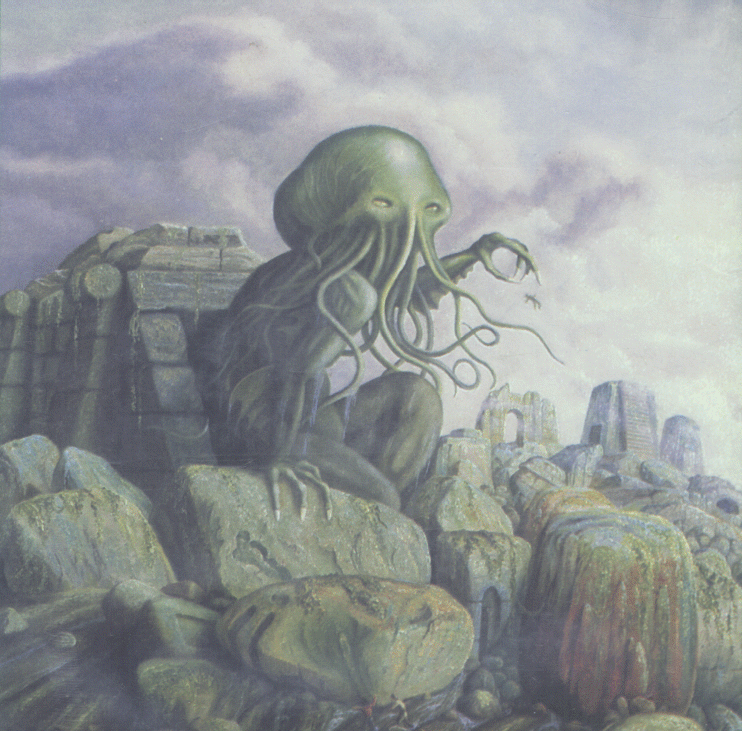
In the world of 'hard copy', Lovecraft is the subject of a regular
journal -Lovecraft Studies; and anthology publications such as "The Starry
Wisdom". New imprints of his works see the light every year, and writers
as diverse as Stephen King, Ramsey Campbell, William Burroughs and J.
G. Ballard have worked in the Lovecraftian manner.
Lovecraftian creatures, ideas and stylistics permeate the horror genre
still. It is hard to overstate Lovecraft's contribution to the genre,
just as it is hard to ignore some of his intolerant views. There is a
balance to be struck somewhere between the author and his works, but it
is sometimes hard to locate. The force of Lovecraft's prose makes this
so, and the critic ends up with a mass of contradictions to try to unravel,
often unsatisfactorily.
In his introduction to The Starry Wisdom , David M. Mitchell
wrote:
he experienced between the patriarchal
vision of order, logic
and reason to which
he adhered, and the intruding chaotic,
female forces from 'outside' -
forced both destructive and
redeeming. This paradox was, for him, never
resolved and I am
of the opinion that his occasional misogyny
and ill-considered
racism both sprang from this gulf
between these antagonistic
sides of his personality
(ed. D. M. Mitchell, 10)
The Poe-esque story "The Outsider" shows us that maybe this fear stretched
further, that Lovecraft also feared a much more personal other.
Science, Mind and Cosmos
. ed. John Brockman & Katinka Matson.
London: Phoenix, 1996.
Campbell, Ramsey. "The Call to Cthulhu". Printed in
magazine, issue n¼
22. Pages 23-27 London: Newsfield Publications, October 1990.
Carrol, NoŽl.
The Philosophy of Horror
. London: Routledge, 1990.
Carter, Lin.
Lovecraft: a look behind the Cthulhu Mythos
. London: Panther,
1975.
de Camp, Le Sprague.
Lovecraft: A Biography
. London: New English Library,
1976.
Doherty, Brian. ed.
American Horror Fiction: From Brockden Brown to
Stephen King
. London: MacMillan, 1990.
Hughes, Ted.
Moon Whales
. London: Faber & Faber: 1995.
Jackson, Rosemary.
Fantasy: The Literature of Subversion
. London:
Routledge, 1995.
King, Stephen.
Danse Macabre
. London: Futura, 1986.
Lovecraft, H. P.
At the Mountains of Madness & other novels of terror
London: Panther, 1968.
Lovecraft, H. P.
The Colour out of Space & others
. New York: Lancer, 1963.
Lovecraft, H. P.
Dagon & other macabre tales
. London: Panther, 1969.
Lovecraft, H. P.
The Haunter of the Dark & other tales of terror
. London:
Panther, 1963.
Lovecraft, H. P.
The Lurking Fear & other stories
. London: Panther, 1970.
Lovecraft, H. P.
Omnibus 1: At the Mountains of Madness
. London: Panther,
1985.
Lovecraft, H. P.
Selected Letters, Volumes 1-5
. ed. August Derleth and
Donald Wandrei. Wisconsin: Arkham House, 1968.
Lovecraft, H. P.
The Tomb & other tales
. London: Panther, 1967.
Mitchell, D. M. ed.
The Starry Wisdom
. London: Creation, 1994.
Nicholls, Peter. ed.
The Encyclopedia of Science Fiction
. London: Granada,
1979.
St. Armand, Barton Levi.
The Roots of Horror In The Fiction of H. P.
Lovecraft
. New York: Dragon Press, 1977.
Wolf, Leonard.
Horror: A Connoisseur's Guide to Literature and Film
. USA:
?????, 1989.
Rabelais and his World
. Indiana: Indiana Univesity Press,
1984.
Campbell, Ramsey. "The Call to Cthulhu". Printed in
magazine, issue n¼
22. Pages 23-27 London: Newsfield Publications, October 1990.
Campbell, Ramsey.
Cold Print
. London: Grafton, 1987.
Campbell, Ramsey. ed.
New Tales of the Cthulhu Mythos
. London: Grafton,
1988.
Carrol, NoŽl.
The Philosophy of Horror
. London: Routledge, 1990.
Carter, Lin.
Lovecraft: a look behind the Cthulhu Mythos
. London: Panther,
1975.
Cawthorn, James and Michael Moorcock.
Fantasy: The Best 100 Books
London: Xanadu, 1988.
de Camp, Le Sprague.
Lovecraft: A Biography
. London: New English Library,
1976.
Doherty, Brian. ed.
American Horror Fiction: From Brockden Brown to
Stephen King
. London: MacMillan, 1990.
Jackson, Rosemary.
Fantasy: The Literature of Subversion
. London:
Routledge, 1995.
Jones, Stephen and Kim Newman. eds.
Horror: 100 Best Books
. London:
N.E.L., 1992.
King, Stephen.
Danse Macabre
. London: Futura, 1986.
King, Stephen.
Night Shift
. New York: Signet, 1979.
Klein, T.E.D.
The Ceremonies
. London: Pan, 1985
Klein, T.E.D.
Dark Gods
. London: Pan, 1987.
Laing, R.D.
The Divided Self
. London: Penguin, 1985.
Lovecraft, H. P.
At the Mountains of Madness & other novels of terror
London: Panther, 1968.
Lovecraft, H. P.
The Colour out of Space & others
. New York: Lancer, 1963.
Lovecraft, H. P.
Dagon & other macabre tales
. London: Panther, 1969.
Lovecraft, H. P.
The Haunter of the Dark & other tales of terror
. London:
Panther, 1963.
Lovecraft, H. P. and others.
The Horror in the Burying Ground
. London:
Panther, 1975.
Lovecraft, H. P. and others.
The Horror in the Museum
. London: Panther,
1975.
Lovecraft, H. P. & August Derleth.
The Lurker at the Threshold
. London:
Panther, 1970.
Lovecraft, H. P.
The Lurking Fear & other stories
. London: Panther, 1970.
Lovecraft, H. P.
Omnibus 1: At the Mountains of Madness
. London: Panther,
1985.
Lovecraft, H. P.
Selected Letters, Volumes 1-5
. ed. August Derleth and
Donald Wandrei. Wisconsin: Arkham House, 1968.
Lovecraft, H. P. & others, ed. August Derleth.
Tales of the Cthulhu Mythos
London: Panther, 1975.
Lovecraft, H. P.
The Tomb & other tales
. London: Panther, 1967.
Lumley, Brian.
The House Of Cthulhu
. London: Headline, 1991.
Nicholls, Peter. ed.
The Encyclopedia of Science Fiction
. London: Granada,
1979.
Price, Robert M. ed.
Black Forbidden Things: Cryptical Secrets from the
"Crypt of Cthulhu"
. Washington: Starmont Studies in Literary Criticism
#44, 1992.
Price, Robert M. ed.
The Horror of it All: Encrusted Gems from the "Crypt of
. Washington: Starmont Studies in Literary Criticism #31, 1990.
St. Armand, Barton Levi.
The Roots of Horror In The Fiction of H. P.
Lovecraft
. New York: Dragon Press, 1977.
Smith, Clark Ashton.
The Abominations of Yondo
. London: Panther, 1974.
Smith, Clark Ashton.
Genius Loci and other tales
. London: Panther, 1974.
Smith, Clark Ashton.
Lost Worlds: Volume One
. London: Panther, 1975.
Smith, Clark Ashton.
Lost Worlds: Volume Two
. London: Panther, 1975.
Smith, Clark Ashton.
Other Dimensions: Volume Two
. London: Panther, 1977.
Smith, Clark Ashton.
Out of Space & Time: Volume One
. London: Panther,
1974.
Smith, Clark Ashton.
Out of Space & Time: Volume Two
. London: Panther,
1974.
Smith, Clark Ashton.
Tales of Science and Sorcery
. London: Panther, 1976
Smith, Curtis C. ed.
Century Science-Fiction Writers
. London: St.
James Press, 1986.
Van Doren, Charles. ed.
Webster's American Biographies
. US: G&C Merriam
co., 1974.
Wolf, Leonard.
Horror: A Connoisseur's Guide to Literature and Film
. USA:
?????, 1989.