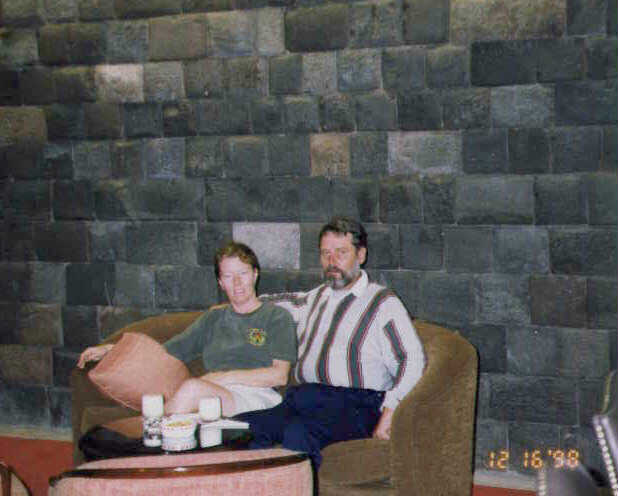
Pisco Sour in der Hotel Bar / Pisco Sours in the hotel bar
(not sure if the pink and tired eyes is due to the camera or the pisco sour ?/
ich weiß nicht ob die trüben Äugelchen vom Blitzlicht oder
vom Pisco Sour sind?)
|
Vorheriges Kapitel |
|
Cuzco
Die alte Inkahauptstadt
The old Capital of the Inca
Empire
Das 5-Sterne-Hotel Liberador war früher einmal die hoch-herrschaftliche Villa von Pizarros' Bruder Gonzalo (wie sein berühmter Bruder Francisco war auch er von Beruf "Conquistador" oder Eroberer), und dieser Bau hat auch heute noch viele original Inka Bestandteile. Und wenn man im Hotel in die Bar geht dann ist die gesammte Außenwand aus den typischen, und so fugengenau zusammengesetzen Inka Quadern. Man fühlt man trinkt hier die Geschichte richtig in sich hinein, besonders wenn man beim Kellner noch etwas Inkafeuer in den Augen zu erkennen glaubt. Solche Erinnerungen vergißt man nicht leicht wieder. - Und an dieser Stelle will ich endlich auch etwas mehr von diesem Pisco Sour berichten den wir jetzt schon so oft geschlürft haben, ihr wundert euch sicher was denn das wohl ist? Die Zutaten sind: Eiweiß, Zitronensaft, etwas Pisco (ein weisser Brandwein), naja, ne ganze Menge von diesem Pisco Brandy, gestoßenes Eis, und dann ein Spritzer einer sauren Zutat - wahrscheinlich Angostura Bitter. Dieses Rezept macht einen sehr schönen kühlen (und alkoholreichen) Trunk, und sehr schön süffig ist es auch.
Pisco Sour in der Hotel Bar / Pisco Sours in the hotel bar
(not sure if the pink and tired eyes is due to the camera or the pisco sour ?/
ich weiß nicht ob die trüben Äugelchen vom Blitzlicht oder
vom Pisco Sour sind?)
The 5-star-hotel Liberador was once the splendid and stately residence of Pizarros' brother Gonzalo (like his famous brother Francisco, Gonzalo was also by profession a "Conquistador" or conqueror), and to this day his mansion has considerable Inca masonry in its walls. When we went to the hotel bar the entire outside wall was of Inca origin with its typical masonry, the stones put together so tightly that not even a razorblade would fit into the cracks. And in such ancient ambiance one very keenly feels the special history of this place; and when one looks into the eyes of the waiter and finds a spark of Inca blood in there, then this whole experience becomes a very special memory that we will treasure for a long long time. - And this is a good segue to finally tell you what this Pisco Sour drink is all about, I am sure you were wondering for a while now. Well, the ingredient are as follows: egg whites, some lemon juice, some Pisco white brandy (make that a lot of brandy), some shaved ice, and finally a dash of Angostura Bitters). This concoction makes for a smooth and very cool (though potent) drink, - delicious indeed I must say.
Eigentlich ist dieses Nationalgetränk der Peruaner ein großer Fehlschlag gewesen, denn als die Spanier hier in der peruanischen Hafenstadt Pisco ein Weingut betreiben wollten, waren die Resultate (wegen des rauen Klimas) nicht gerade berauschend, und so um die Lage zu retten haben sie ihre bitteren Trauben in Brandy verbrannt und dann etwas rumgepanscht und dieses potentes Getränk erfunden.
Actually this national drink of Peru started off as a big failure, because when the Spaniards in the Peruvian port city of Pisco wanted to start a wine industry, the results (because of the rough climate) were less than what they expected, and to salvage their investment they distilled brandy out of the grapes, and then mixed up a few things and came up with this very potent beverage.
Hier von Cuzco aus (die Inkas nannten die Stadt Qosqo) wurde das große Inkareich befehligt und regiert. Hier war der fabelhafte Palast des Inkafürsten (von dem leider heute, wiedermal dank der spanischen Conquistadores, nichts mehr übrig geblieben ist). Aber vom herrlichen und heiligsten aller Tempel ist noch was da (weil man einige Mauern in die Klosterkirche Santo Domingo eingebaut hatte). Wie schon in Machu Picchu ist dieser Zentraltempel der mächtigen Sonne geweiht. Auf dem weiten Vorplatz zum Tempel sollen damals lebensgroße purgoldene Figuren von charmanten und exotische Inkaprinzessinnen und allerlei einheimische Tiere wie Llama und Alpacas gestanden habe, selbst lebensgroße Bäume aus solidem Gold (sogar mit richtigen kleinen Schmetterlingen drauf) sollen damals Schatten gespendet haben. (Natürlich haben die Spanier auch von diesen Herrlichkeiten nichts übrig gelassen - Schade).
From here in Cuzco (or "Qosqo" as the Inca called the city) the mighty empire was governed and ruled. The fabulous palace of the Inca king was here(sadly, again thanks to the Spanish Conquistadores, nothing is left of that building). But of the main and holiest, and splendid, temple of the sun, there is luckily quite a bit left (mainly because they made the building part of the monastery of Santo Domingo). As in Machu Picchu the central temple here in Cuzco also has curved walls and is dedicated to the sun god. On its wide plaza in front, it is said, there used to be life-sized statues of charming and alluring Inca princesses and local animals like llama or alpaca. All of them made of solid gold. And to give some shade they even had golden life-size trees on this fabulous plaza, even with little butterflies sitting on the leaves. (Of course the Spaniards did leave a single trace of these wonderful treasures for prosperity. What a pity)
Der Sonnentempel in Cuzco ist jetzt ein Museum und man hat die spanischen Erweiterungen wieder abgetragen und die originalen Mauern wieder freigelegt. So kann man auch hier wieder die gebogenen Mauern des Sonnentempels und die solide Maurerfertigkeiten der alten Inkas bewundern. Neben dem Sonnentempel gab es auch noch Räume die dem Mondgott geweiht waren, oder wo dem Regenbogen gehuldigt wurde. Im Sonnentempel sollen die Wände mit Goldtafeln ausgeschlagen worden sein, im Mondtempel waren es Silbertafeln, und der Regenbogen hatte vielleicht bunte Webwaren als Wandschmuck; aber heute sieht man nur fein verarbeitetes Mauerwerk mit genau ausgerichteten Fenstern.
Now the sun temple of Cuzco is a museum and the additions that the Spanish added over time have been removed and the original walls are being displayed again. And the craftsmanship of the masonry is of the very best one can find. Next to the sun temple there are rooms dedicated to the moon god, and another one dedicated to the rainbow god. At one time the sun temple walls were adorned with golden sheeting, the moon temple had silver wall coverings, and the rainbow temple perhaps was adorned by spendid samples of the colorful weavings that this area is still famous for; - but nowadays one only sees the naked (though splendidly built) walls and the precisely aligned window openings.
Heute versuchen einige Leute die alten Inka Straßennamen wieder einzuführen, was das Navigieren und Kartenlesen recht interessant werden läßt, denn diese neuen, alten Namen sind in den Stadtplänen nicht verzeichnet. Und wenn man dann nach dem Weg fragen will, muß man sich die Zunge ganz schön verrenken um diese mittelalterlichen Namen auszusprechen. Man will wohl den Teil der Bevölkerung etwas verwirren der nur Spanisch und kein Indianisch spricht. - Cuzco war damals schon eine Großstadt mit etwa 150,000 Einwohners, das war im 15. Jahrhundert fast so viel wie Rom oder London. Alle Straßen in Tahuantinsuyo (das Inkareich) führten hier nach Qosqo (Cuzco), von hier aus ging es tausenden Kilometer weit bis runter nach Chile, oder nach Norden bis Kolumbien, und man reiste diese Entfernungen meist auf Schusters Rappen. Fracht wurde auf den Rücken der Llamas getragen, und eilige Nachrichten wurden im Dauerlauf von Kurieren von einer Relais-stations zur anderen getrabt. Kein Wunder daß die Inka's damals dachten Cuzco läge am Bauchnabel der Welt, denn so eine tolle und glanzvolle Stadt gab es damals nirgendwo anders auf diesem großen amerikanischen Kontinent.
Some people like to show their feelings for independence by replacing Spanish street signs with the ancient Inca names; that makes navigating and card reading quite interesting, because the new (old) names are not listed on most maps. And when in desperation, one asks for direction one has to squeeze and bend one's tongue tortuously to pronounce the medieval names. Maybe they want to confuse that part of the population that only speaks Spanish but does not speak the old Quechua indian tongue. - Cuzco was a very large city of 150,000 inhabitants during the Inca period, that in the 15th century was as large as London or Rome. All roads in the Tahuantinsuyo (that is the Inca name for their empire) led to Qosqo (Cuzco), from here trails thousands of miles long led all the way north to Columbia, and south as far as the southern tip of Chile; and all this was traveled by foot. Freight was hauled by llama, and important news traveled via swift runners in relay from outpost to outpost. No wonder the Incans thought of Cuzco as the naval of the entire world, because nowhere else in the Americas existed a city as splendid as this one.
Nachdem wir von unserer Reise nach Machu Picchu erst einmal eine Nacht in dieser feinen Nobelherberge verbracht haben, ging es am nächsten Morgen zu einer kleinen Stadtrundfahrt los: Da gab es die schöne und barocke Kathedrale zu besichtigen, herrlich verschnörkelter Altar mit viel, viel gehämmerten Silber, und einige sehr interessante Gemählde. - Diese Bilder stammen aus der 'Cuzco-Mal-Schule' in der die Spanier damals den Einheimischen das Malen beibrachten, und die dann ihre Phantasie und Liebe für starke und grelle Farben in den Dienst der katholischen Kirche stellten und herrliche, wenn auch zuweilen etwas naïve, Bilder produzierten.
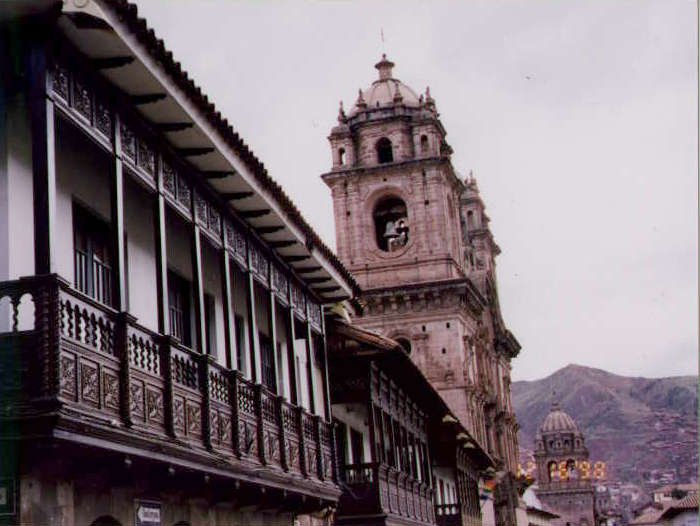
Cuzco Kathedrale / Cathedral
After our trip back from Machu
Picchu we rested for a night in our fancy hotel, and on the next morning
we took a sightseeing trip through town by bus: Here was the nice
and very baroque cathedral to view, with wonderfully ornate silver decorations,
and some very interesting oil paintings. - These pictures are of the 'Cuzco
painting school' in which the Spaniards taught the locals their techniques
of painting, the Peruvians then used their fantasy and their love for strong
and stark colors to pour their new found (and at time a little naïve)
talents into the services of the catholic church.
"Sexy Woman" Festung / Fortress
Am Nachmittag ging es dann mit unserem kleinen Bus auf einen Hügel gleich außerhalb der Stadt. Von hier oben hatte man einen wunderschönen Blick auf die Stadt Cuzco mit ihrer schachbrett-artigen Straßenanordung. Da unten lag der große Platz vor der Kathedrale, und wir konnten andere Sehenswürdigkeiten gut von hier aus ausmachen. - Aber außer dem schönen Blick gab es hier auf der Anhöhe noch eine riesengroße Inkafesting. Wie schon in den Tempeln hatten die Inkas hier die Steine schon gerade abgehobelt und ausgerichtet, nur handelte es sich hier um riesige Quader die teilweise bis zu 17000 kg schwer waren.
In the afternoon we went by bus
up a hill just outside of town. Here on a little plateau we had a great
view of the city of Cuzco with its rectangular ordered street system.
There was the large plaza in front of the cathedral, and we could spot
the other points of interest in this place. - But besides the magnificent
view, there was also an enormous Inca fortress up here. As we had
seen so many times already, all the stones here were smoothed and formed
by hand and fit perfectly into each other, only here some of the shaped
boulders are huge and weight up to 17,000 kg (which is well over 125 tons).
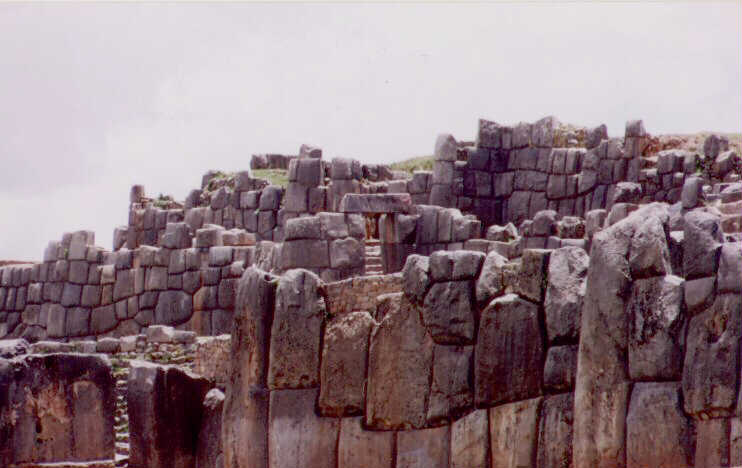
Inca Festung / Fortress
"Sacsayhuaman"
Wie kommt diese Festung zu dem komischen Namen? - Naja, das war ein Scherz der Reiseleitung, denn der Inkaname dieser Befestigungsanlage ist "Sacsayhuaman"; was, wenn ausgesprochen wie "sexy woman" (woman=Frau) auf Englisch klingt. So vergißt man den Namen bestimmt nicht so leicht.
And how does this place come to its unusual name? - Well, that was a bit of humor by our guides in order to make the pronunciation of the old Inca name of "Sacsayhuaman" a little easier for us western tourists. Well a name like that one does not forget easily.
Also hier oben waren damals so um die 5000 Inkasoldaten stationiert, und zu besonderen Gelegenheiten da nahm der Inkafürst hier von seinem mächtigen steinernen Thron aus, die Parade der Truppen ab, und zu diesem Zweck hatte man einen riesigen Exerzierplatz angelegt. - Und manchmal gab es auch etwas grausamere Veranstaltungen; wenn das Wetter für eine Weile nicht so besonders war und deshalb zur Linderung eine Prinzessin den Göttern hingeopfert wurde (auf die Einzelheiten verzichte ich hier, die können im Geschichtsbuch nachgelesen werden). - Aber auch heute noch (500 Jahre später) zieht es die Bewohner von Cuzco hierhin zu großen Festivals (so zum Beispiel zur Sonnenwende im Dezember). Dann sitzen die Peruaner in ihren bunten Kostümen auf den gleichen Steinen wo damals schon ihre Vorfahren die Inkas ihren Soldaten beim üben und paradieren zuschauten. Heute allerdings geht es nicht mehr so brutrünstig zu wie damals (mal von etwas Nasenbluten abgesehen was westliche Touristen hier schon mal wegen der Höhe haben).
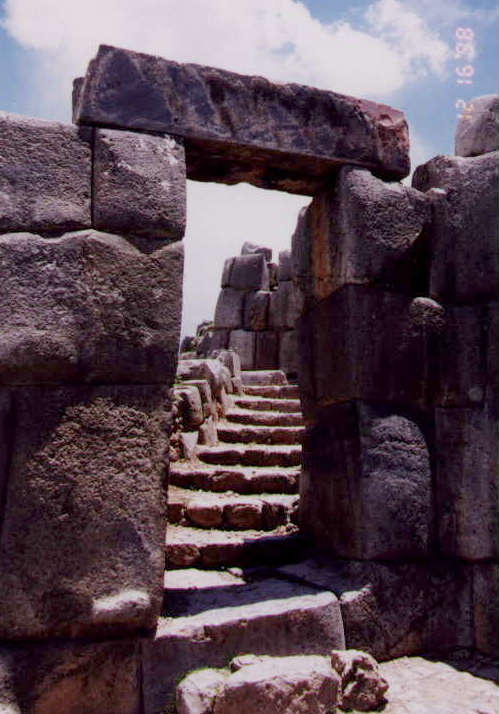
Up here in this massive fortress the Inca kings had a garrison of about 5000 soldiers, and on special occasions they marched across the vast parade ground in front of his majesty as he sat on a large stone throne. - And sometimes there were rather more sinister spectacles to observe up here; when the weather was not cooperating for a time, then sometimes a young princess was sacrificed to remedy such inclement conditions (well, I won't go into all the details of this here, - look it up in history books for yourself). - But even today, more than 500 years later, the local folks of Cuzco still come to this great place to celebrate their local festivals (like the solar equinox in December). Then the modern Peruvians sit on those marvelous boulders, like their Inca forebearers, and enjoy a good and colorful show. Must say though, that the offerings nowadays are far less gruesome than in the ancient times (maybe aside from a bleeding nose that a western tourist might get from the extreme elevation here).
Die Inkas waren auch großartige Ingenieure, denn sie legten (wie auch die alten Römer) eine unterirdische Wasserleitung von hier bis runter nach Cuzco an. So hatte die Stadt nicht nur frisches leckeres Bergwasser, sondern auch eine geheimen und versteckte Wasserversorgung (was im Konfliktfall natürlich sehr nützlich ist). - Von hier oben aus konnte man auch eine andere Besonderheit dieser Gegend sehen, denn rings um die Stadt gab es Felder auf den Quinoa wuchs. Das ist ein bei uns fast unbekanntes Getreide (aus der Amaranth-Familie) und es hat eine ganz markante purpurne Farbe. Überhaupt ist ja diese Gegend hier sehr Artenreich und viele unserer heutigen Getreide- und besonders Maisarten stammen aus dieser Gegend.
The Incan were also very skilled engineers, they built(like the old Romans) an underground water supply line from the hills into the city of Cuzco. That way the city had fresh and sweet water anytime, and it was hidden and covered (which came in handy in times of conflicts). - From up here one could also see another interesting feature of this area; fields of Quinoa. That is an almost unknown type of grain for us Westerners, coming from the family of Amaranth plants, it sports a very unique purple color. Besides, the region here is known for many different types and subspecies of plants, grains and especially maize, but also tomatoes, that originate from this area of the world.
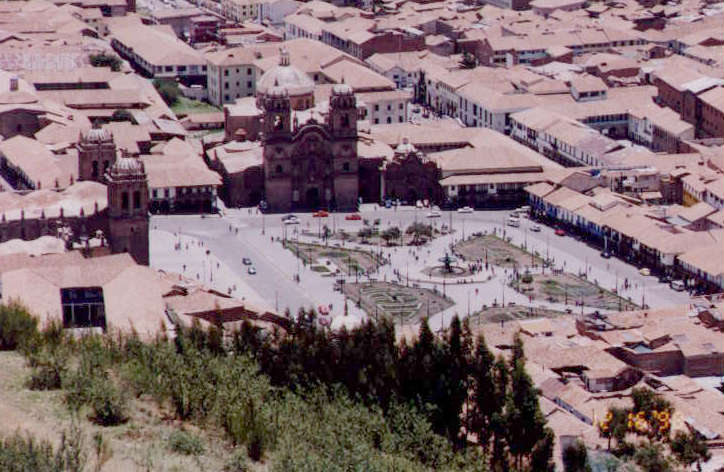
Market Square of / Markplatz von Cuzco
Zum Abschluß der Besichtigung von "Sexy Woman" gab es noch eine kleine Überraschung für uns zahlende Touristen. Wir bekamen ein Konzert das eine Gruppe junger Leute auf alten Inkainstrumenten spielten. Die berühmte Querflöte die man heute so oft mit Peru verbindet, gab es damals zur Inkazeit noch nicht, aber Flöten waren schon sehr üblich damals, und zuweilen wurden schon mal zwei dieser Instrumente zusammen von einem Bläser gespielt. Es dauerte dann nicht lang bis andere Besucher dieses Konzert für uns auch hörten und es bildete sich schnell eine Menschentraube um die Musikanten, auch eine Gruppe junger Peruanerinnen fing an zur Musik zu tanzen (die haben ja alle so viel Rhythmus im Blut), und dann holten sie sich Männer aus den Zuschauern heraus und forderten sie auch mit zu tanzen. So wurde ich auch ausgeguckt und in die Mitte gezerrt, und schon schwang ich meine Hüften im Takt zu alter Inkamusik. Caramba.
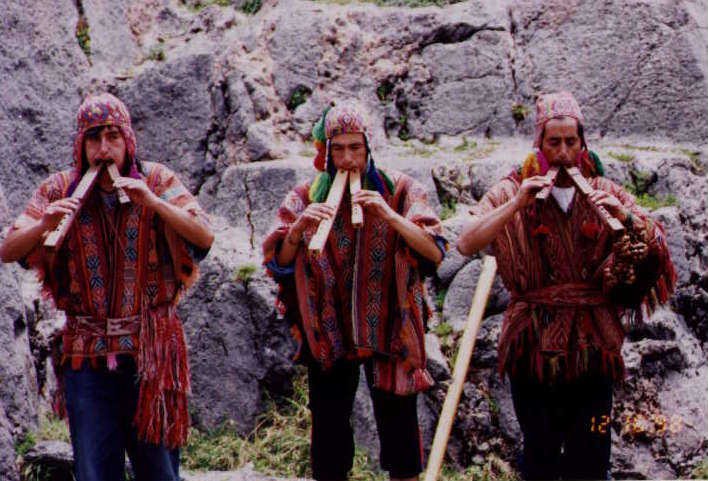
Traditional Inca Instruments / Traditionelle Inkamusikinstrumente
At the conclusion of our visit to "Sexy Woman" we received a little surprise for us paying tourists. A group of young Peruvians gave us a little concert performed on ancient Inca instruments. The famous panpipe that today is so much associated with music from Peru, was unknown during the Inca period; - though they did have numerous other types of flutes then, and sometimes a person played two flutes at the same time. And it did not take long until the lovely music caught the ears of other visitors to the ruins, and soon a bunch gathered around us and listened. Among them was a group of young Peruvian women who started to dance (they all have so much music and rhythm in their blood they couldn't help it), and then they started to pull men out of the crowd to dance with them. So it happened that I too was gently prodded into the open space before the musicians, and soon I too was swinging my hips to the beat of ancient Incan music. Caramba.
Auf der Rückfahrt in die Stadt hielten wir mal wieder an so einem Souvenirmarkt an (wo sich die Herren Busfahrer eine kleine Bestechung in die Tasche steckten, weil sie ihre Ladung Touristen hier auf die Toilletten ließen). Aber draußen vor der Türe parkte eine alte Indianerin 3 Llamas am Straßenrand. Und eines davon hatte so einen herrlichen Bubikopf-Haarschnitt, daß wir es uns nicht verkneifen konnten den feschen Kerl und sein Konterfei auf die Fotoplatte zu bannen.
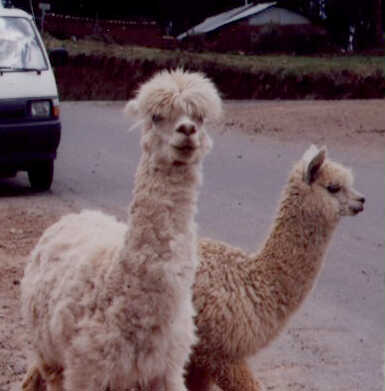
Was für ein feiner Llama Kerl ... / What a handsome llama fellow he is....
On the way back to town, our
bus stopped at one of the souvenir markets (where our guides undoubtedly
received a little kickback for allowing the tourist load to use the bathrooms
just here and nowhere else). But outside the shops, an old indian woman
had parked her three llamas at the edge of the road; and one of them had
such a cute pageboy hairdo, that we could not help but to memorialize his
lovely face and fashionable hairstyle in a picture.
Spaziergang durch Cuzco /
Walk through Cuzco
Nach den Besichtigungen hatten wir den Rest des Nachmittages zur freien Verfügung, und wir sind losgezogen diese Stadt etwas alleine zu erkunden. Cuzco ist schön kompakt und übersichtlich, und wenn einer mit einer Karte ausgerüstet ist, kann man sich eigentlich nicht sehr verlaufen (obwohl uns von einigen Gegenden abgeraten wurde, wegen Taschendieben und allgemeiner Kriminalität). - Wir bekamen auch eine Touristen-Karte ausgehändigt wo viele der Museen und Kirchen der Stadt drauf abgebildet waren, nicht nur das, die Karte war auch gleichzeitig Eintrittskarte in diese Stätten und jedesmal wurde, wie früher bei der Straßenbahn, abgeknipst. Ganz schön praktisch und pfiffig diese Cuzco-sianer.
After the official round of sightseeing was over, we had some time in the afternoon to explore the city on our own. So off we went. Cuzco is a nice and compactly laid out city, and with a map it is not too hard to navigate the place (though we were warned to stay away from certain areas of town where pickpockets might be and the crime rate might be higher). We also received a map which depicted the major museums and churches in town, but besides telling us about them, the map also served as the admission ticket to these places of interest. And every time we entered one of these places, they punched a hole into the map, quite like a conductor of a railway. We thought that was a very nice idea, quite clever these Cuzco-sians.
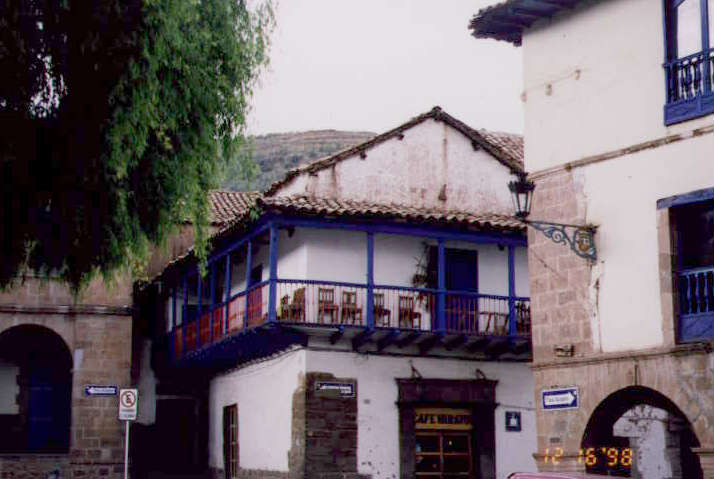
Cuzco Street Impression / Cuzco Straßenansicht
In Peru muß man gutes Schuhwerk haben, denn die Bürgersteige sind ziemlich durchlöchert. - wir hatten das schon in Lima gemerkt, hier braucht man Schuhe mit Allradantrieb. (Und einmal habe ich mir auch den Fuß umgeknickt, aber gottlob ohne bleibenden Folgen). Also wanderten wir los, - und wir waren erstaunt wieviel altes Inkamauerwerk hier in Cuzco doch noch übrig war. Meist waren es die Mauern im Parterre, oben gab es dan spanische Adobe-Architektur. Die Spanier konnten so viel "heidnische" Inka-Steine garnicht ausmerzen (deshalb haben die dann meisten nur Putz drüber geschmiert, und der ist durch die Jahrhunderte natürlich längst wieder abgebröckelt.) Auch haben wir uns hier in Cuzco wieder an den schönen hölzernen Balkonen erfreut, und herrlich geschnitzte Eingangstüren bewundert. Es gab immer etwas zu sehen und zu entdecken. Und bald sind wir auch ein wenig abseits vom touristischen Pfad gewandelt und haben uns in Gegenden getraut wo die alltäglichen Peruaner wohnen und arbeiten. Das war auch sehr interessant.
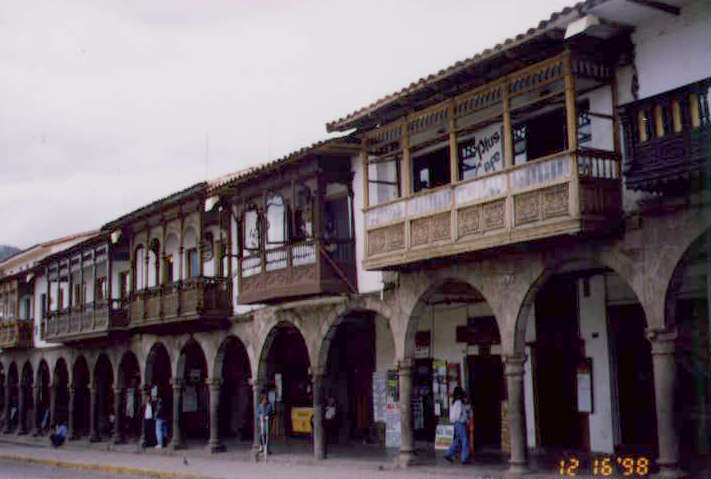
exquisite Balconies / herrliche Balkons in Cuzco
To walk and sightsee in Peru one needs rather sturdy shoes, because the sidewalks are in ill repair and littered with pot holes. - We already noticed that in Lima, and here too one needed shoes with all-wheel-drive. (Once I twisted my ankle, but luckily without lasting effects). So we wandered off, and we were surprised how many of the buildings still had Inca masonry as part of their construction, usually it was only the ground floor walls that showed the characteristic Inca stonework, the upper floors were in Spanish adobe style. Of course the Spanish did everything they could to eradicate the "heathen" Inca architecture, and plastered the Inca walls over, but through the years that plaster crumbled and now tourists like us could see many of the original foundation walls in all their glory again. - And from the Spanish architectural period we again marveled at the wonderful balconies the houses had here, or the lovely carved entrance doors. There was always something to discover and to explore. And sometimes we wandered off the beaten tourist tracks a bit and discovered neighborhoods where the Peruvians live and work. That too was very interesting and educational for us.
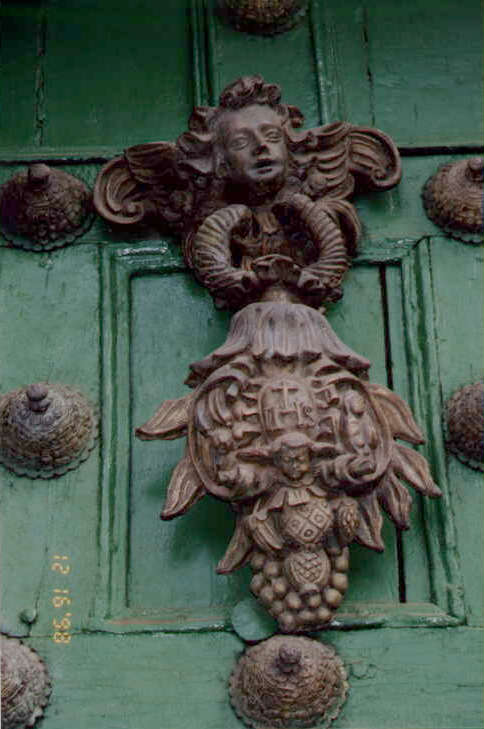
Doorknocker / Türklopfer
Nach so viel Stadtwandern taten uns dann die Füße etwas weh, und wir haben dann wohl die einzige Künstlerkneipe, oder vielleicht kann man das besser als eine Hippie-Kneipe bezeichnen, in der ganzen Stadt gefunden. Da hingen selbstgemachte Ölgemälde an der Wand, zum Teil wurde eine Pflanze mit langen smalen Blättern auf den Bildern verehrt (die Cannabispflanze = Marjuana Rauschgift). Aber das Bier war kühl, und wurde fachmännisch und stolz mit meinen bescheidenen Spanischkenntnissen bestellt. Die Pause tat richtig gut, besonders den Sohlen.
After all that city hiking our feet started to send signals to the brain, so we found a place to sit down and to rest, - it was probably the only artist or hippy pub in town, with homemade oil paintings on the walls, some of the depicting a plant with narrow slender leaves (also known as Cannabis or Marijuana plant). But the beer was cold, and was properly and proudly ordered by me in broken Spanish. Ahhh, the rest felt good, both for the soul and the soles.
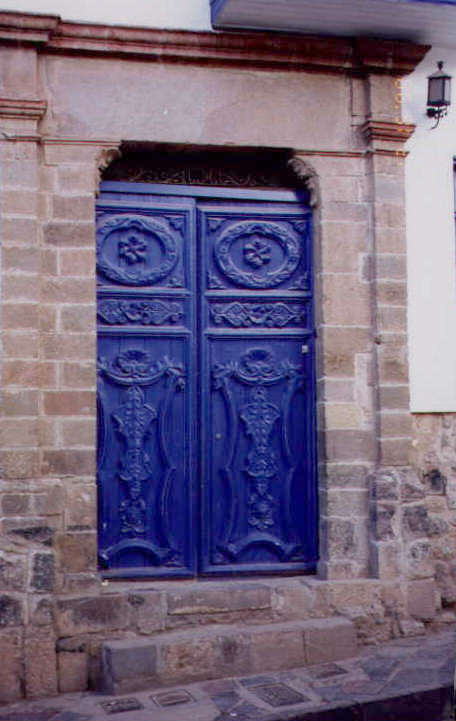
Fancy Side-Entrance / Barockes Seiten-Portal
Abends beim Essen habe ich dann noch ein wenig über dieses tolle Land nachgedacht. Die alten Inkas waren ganz schön fortgeschritten, man sagt zwar die hätten das Rad nicht gekannt, aber das stimmt nicht ganz, denn obwohl die das Rad als Transportmittel nicht kannten, so hatten sie doch die Töpferscheibe, und man hat auch kleine Räder (oder Scheiben) als Kinderspielzeug gefunden. Und rädriger Verkehr hätte bei den Inkaautobahnen sowieso nicht viel genutzt, denn die hatten da ja stellenweise Stufen und Treppen drin. Obwohl die damals schon Tunnel für Ihre Strassen gebaut haben - Auch ist es nicht wahr daß erst die Spanier Krankheiten wie Syphillis oder die Pocken in die Neue Welt eingeschleppt hätten, heute weiß man von Leichenöffnungen an Mumien, daß die Leute hier schon lange vor dem weißen Mann an diesen Krankheiten litten.
That night during dinner was
time to reflect a little on this country. The old Inca were rather
advanced in their development; though one says they did not know the wheel,
this is only partially true, because the pottery wheel was well know by
them, and archeologists also found round disks as part of toys for kids.
But the wheel in transportation was indeed not used by the Inca, and it
would not have made much sense since their famous Inca trails had steps
and stairs in them. Though they already did carve tunnels for their trails.
- It is also a myth that it was the Spaniards who introduced syphilis and
smallpox to the New World; newly conducted autopsies on mummies found that
the people here suffered from these diseases well before the white man
came here.
Heimflug / Going Home
Jetzt war es Zeit Cuzco zu verlassen, auf dem einstündigen Flug nach Lima hatten wir wieder einmal herrliche Blicke auf die richtig hohen (über 6000m) Andengipfel, und dann landeten wir auch schon wieder in der dunstige Metropole von Lima. Da wir noch einen Tag in Lima drangehängt hatten, holte uns eine Führerin vom Flugzeug ab und wir fuhren in einem Privatwagen in abenteuerlicher Weise (jeglicher Autoverkehr in Lima ist ein Abenteuer) zu unserem Hotel. - Wir sind dann noch einmal kurz durch diese interessante Stadt geschlendert, haben uns den Platz vor dem Präsidentpalais noch mal etwas länger betrachtet; -- aber eigentlich hatten wir jetzt keine richtige Touristen-Lust mehr, und haben uns in's Hotel zu einem Nachmittagsschläfchen zurück gezogen. Es kommt dann irgendwann der Punkt wo man alles ausklingen lassen will, wo sich die ganzen vielen Eindrücke im Gehirn setzen müssen, und da will man dann einfach keine neue Sachen mehr erleben.
Now it was time to leave Cuzco and a one hour flight brought us again some spectacular views of the really high Andes mountains (over 20,000 ft), and soon we descended back into the hazy metropolis of Lima. We added an extra day in Lima to our stay, so we were greeted at the airport by a guide who in a private car transferred us to the hotel in a nerve tingling trip (but then all driving in Lima is nerve wracking). - After freshening up, we took another stroll downtown to the presidential palace, -- but we were worn out, our touristy curiosity had faded, so we retired back to the hotel for a good afternoon nap. Sometimes there comes a point on a trip when one needs to unwind and where all the many impressions need to be digested, and where the brain just cannot cope with any more inputs.
Wir hätten noch einige Museen unsicher machen können, oder uns den Park ansehen können wo die Peruaner von den Chilenen einen auf die Nase bekommen haben. -- Ja, die haben sich hier ziemlich gewaltig gekloppt, damals 1883 hat Peru eine ganze Provinz an Chile verloren, und Bolivien hat sogar seinen Zugang zum Pazifik gänzlich eingebüßt. Und die letzte Schlacht dieses "Krieges des Pazifik" wurde in einem Vorort von Lima geschlagen (und verloren). Als Europäer oder Amerikaner weiß man garnicht so viel von der südamerikanischen Geschichte, und dass sich die Staaten hier schon einige Male kräftig in der Wolle hatten. - Aber wie gesagt, wir waren etwas aus-geurlaubt und haben uns anstatt geschichtsträchtiger Gedanken zu schwingen lieber gemächlich das Verkehrsgewühle von Fenster unseres Hotelzimmers aus besehen.
Sure, we could have visited a few more museums, or looked at the park where the Peruvians got their nose bloodied by the Chileans. Actually that was a rather nasty fight, back in 1883, Peru lost an entire province to Chile, and Bolivia lost even their precious access to the Pacific. The last battle of this "War of the Pacific" was fought (and lost by Peru) here in a suburb of Lima. - As a European or American we didn't know very much about South American history, and that there were quite a few wars among the nations here. - But as I said, we were tired from having vacation and preferred to watch the traffic crawling along from the perch of our hotel room.
Uns ist aufgefallen daß es hier in Peru ausgesprochen viele chinesische Restaurants gibt, und als wir nachfragten, wurde uns erzählt daß ähnlich wie in Kalifornien die Chinesen zum Eisenbahnbau in's Land geholt wurden. Als die Transkontinentale Eisenbahn in den USA fertig war, sind viele von dort hierher gekommen und haben hier weitergebaut. Später sind dann sehr viele im Land geblieben und die wollten natürlich auch ihre gute Küche nicht verzichten, und auch die Peruaner haben das chinesische Essen schätzen gelernt und jetzt gibt es viele, viele dieser "Chifa" Restaurants (Chifa ist die chinesische Wort Aussprache für "Chef" (=Koch)).
We noticed that there were a large number of Chinese restaurants here in Peru, and when we asked, we were told that, like in California, the Chinese were instrumental in building the railroads. Actually when the transcontinental railroad through the U.S. was completed many Chinese migrated from Northamerica to Peru. And after the Peruvian railroads were finished, they stayed in the country, and of course they did not want to miss their own cooking. Later the other Peruvians also learned to love the Chinese cuisine and now a trip to a so called "Chifa" restaurant (Chifa is the Chinese pronounciation of the French "chef" or "cook") is very common in today's Peru.
Abends sind wir dann noch zu einem nicht untypisch peruanisch Essen gegangen - im japanischen Restaurant, -- denn außer den vielen Chinesen haben die Peruaner auch sehr viele Japaner in ihr Land geholt. -- Also habe ich neben meinen spanischen Sätzen auch noch meine japanischen Sprachbrocken dem Sushi-Chef über die Theke geredet. (Der hat ganz schön geguckt, zumal wir dann untereinander auch noch Deutsch oder Englisch geplaudert haben). Da Lima gleich am Meer liegt erwartet man natürlich ganz herrlich frischen Fisch hier, und wir wurden bei unserem Sushi (rohe Fisch Häppchen auf Reis) auch nicht enttäuscht. -- Später haben wir dann noch ein wenig mit einem der japanischen Gäste geschwätzt der auch wie wir an der Sushi-Theke saß. Es stellte sich heraus daß er einer der Gäste in der Residenz der japanischen Botschaft war die vor etwa 5 Jahren von peruanischen Guerillas für über 20 Tage besetzt worden war. Die peruanische Regierung hat dann ziemlich brutal die Residenz gestürmt, so daß keiner der Terroristen überlebten (obwohl man sagt daß sich einige vorher den Truppen ergeben hätten). Es war eine höchst interessante Unterhaltung die wir da beim Fischessen hatten.
In the evening we had a not very unusual dinner, we went to a Japanese restaurant, - besides the large Chinese population, Peru attracted also a rather sizable Japanese contingent. - So I was able to parley with not only my Spanish knowledge but also with my meager Japanese language skills (and the Sushi Chef behind the counter looked really puzzled when Una and I started to speak either English or German with each other). Since Lima is located right on the ocean, we figured the seafood here must be extremely fresh, and our sushi (raw fish on rice) expectations were not at all disappointed. - Later we engaged in a conversation with one of the Japanese guests who joined us at the sushi counter. He had been one of the hostages that was held for 20 days at the residence of the Japanese ambassador by Peruvian guerillas (that was about 5 years ago). The Peruvian government decided to storm the building and all guerillas were killed (though it was said that some of them surrendered before they were shot). Well, that was a most interesting talk during our fish dinner.
Zum Schluß dann noch schnell ein letzter Pisco Sour von der Hotelbar, dann ab in's Bettchen, morgen fliegen wir wieder nach Hause. -- Nach einem guten (internationalen Buffet)Frühstück holte uns unsere peruanische Führerin vom Hotel ab. Wieder ging es per Auto, diesmal mitten durch den Berufsverkehr, (teilweise sogar über Schleichwege) in Richtung Flughafen. Da wurde wie wild die Spur gewechselt, gehupt, und auf Spanisch geschimpft, aber wir kamen wohlbehalten an. Unsere Führerin verdiente sich ein Zubrot und erledigte alle Formalitäten für uns. Sie wusste an welchem Schalter wir anstellen mussten, wo wir unser Lösegeld (Flughafengebühr) bezahlten, wir brauchten uns um nichts zu kümmern. Und damit wir auch ja ihr Trinkgeld nicht vergessen, hatte sie die ganze Zeit unsere Flugtickets in ihrem Besitz. - Aber es war gut so, denn sie hat uns doch viel Arbeit abgenommen, obwohl wir als trainierte und versierte Reisende das auch alleine hingekriegt hätten. -- Und dann waren wir in den Luft und schwebten wieder den U.S.A entgegen. Zwischenlandung in Miami, eine Nacht im Hotel, dann via Chicago (wo es leicht am schneien war) wieder in Richtung San José. Home, sweet Home.
To conclude this vacation, let's have a last Pisco Sour at the hotel bar, then a good nights rest, tomorrow we will fly back home. -- The next morning we had a good (international) buffet breakfast, then our Peruvian guide and a driver picked us up to take us to the airport (this time even with some shortcuts through residential areas to avoid the rush hour traffic). The lanes were changed frequently, the car horn got frequent use, and the avalanche of rapid Spanish was probably rather raw cursing. - But our guide had everything firmly under control (and she also held our tickets - just in case we might forget the tip for her). Anyway she knew exactly at what counter to check in, where to arrange for the airport tax (the ransom they charge here to let you leave), and where the waiting areas were; and for that help we gladly rewarded her with a good tip (Though we probably could have managed on our own, after all we are seasoned and skilled travelers). -- And soon we were in the air flying north towards the U.S.A. and home. Stop over (and a night) in Miami, then via Chicago (it was snowing lightly there) back to San José. Home sweet home.
Wowww!
Was ein Urlaub das war !!!
What a Vacation that was !!!
|
Vorheriges Kapitel |
|