Karamjeet Singh's Himalayan Home

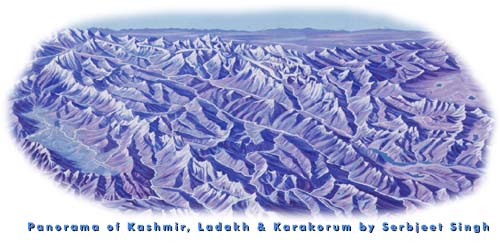 " In a hundred ages of the gods, I could not tell thee of the glories of the Himalaya"....
Thus does tradition call down to us from the Puranas. The Himalaya, is a spectacle of awesome
dimensions... ranges upon ranges, tiers of rock, sharp sky piercing peaks and canyons,
deep beyond measure.......how did this come about,
whence rose these citadels of ice...how did this three thousand kilometer long mountain
range come into existence?, for the Himalaya is not only the most impressive of all the
mountain chains, but also the youngest.
" In a hundred ages of the gods, I could not tell thee of the glories of the Himalaya"....
Thus does tradition call down to us from the Puranas. The Himalaya, is a spectacle of awesome
dimensions... ranges upon ranges, tiers of rock, sharp sky piercing peaks and canyons,
deep beyond measure.......how did this come about,
whence rose these citadels of ice...how did this three thousand kilometer long mountain
range come into existence?, for the Himalaya is not only the most impressive of all the
mountain chains, but also the youngest.
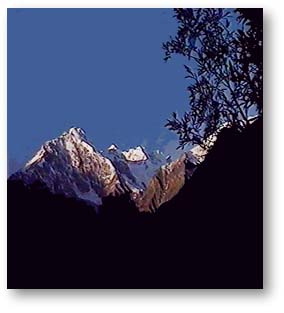 You have to stretch your imagination a bit to comprehend the cataclysmic
events that led to the formation of the Himalayan ranges.
You have to stretch your imagination a bit to comprehend the cataclysmic
events that led to the formation of the Himalayan ranges.
According to the most accepted geological theories, India once belonged to an Island
continent called Gondwanaland and was separated from the Eurasian continent by the
primordial Tethyan ocean. One billion years ago, the Aravallis, whose eroded remnants
are visible around Delhi, formed a chain higher than the Himalayas today. Over millions of
years these mountains suffered the forces of erosion and their sediments were deposited in
the Tethyan ocean. Then 140 million years ago, India began it's northward movement, on a
collision course with the Eurasian continent.
The point where the two continents were joined is known, appropriately, as the
Indus- Yarlung Suture zone, marked by the courses of these two greatest rivers of the
Kailash. After 60 million years, the Indian and Asian plates became closely welded along
this suture zone. The northward movement of India continued but at a slower rate - 2-3
centimeters per year.
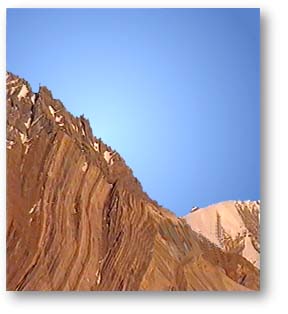 And what birth pangs.... as a result of the collision itself, and the related contraction of the
Tethyan ocean, all the rocks of this area, from the mountains of then northern India to the
oceanic crust, and the deep sea sediments of the Jurassic and Cretaceous ages, joined in
the formation of the Himalayas.
And what birth pangs.... as a result of the collision itself, and the related contraction of the
Tethyan ocean, all the rocks of this area, from the mountains of then northern India to the
oceanic crust, and the deep sea sediments of the Jurassic and Cretaceous ages, joined in
the formation of the Himalayas.
This then is the result of those ancient events ..... each layer tells the story of the
play of millions of years of brute force by nature.
The Himalayas as we see them today went through some distinct epochs of
uplift. First came the Trans. Himalaya. South of this is the high Himalayan region, where
the range reaches it's highest points. Here we find old crystalline rock, the oldest core
material in the entire Himalayas, almost 2 billion years old, the bottom layers of the
compacted Tethyan sediments. This is known as the main central thrust.
As the Himalayas rose the forces of erosion kept pace, leading to the formation
of a contiguous lower range of hills known as the Shivaliks. Made of erosion material 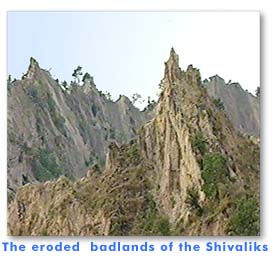 from the still rising Himalayas, their sediments reflect the history of the up thrust of the
emergent Himalayas. Numerous fossil finds allow the Shivaliks to be dated with accuracy
and provide evidence of the comparative youth of the Himalayas.
from the still rising Himalayas, their sediments reflect the history of the up thrust of the
emergent Himalayas. Numerous fossil finds allow the Shivaliks to be dated with accuracy
and provide evidence of the comparative youth of the Himalayas.
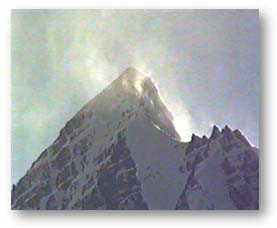
In the second phase of upheaval, further uplift of the central axis took place. It
was now that the great peaks of the Garhwal himalaya..Nanda devi etc achieved their
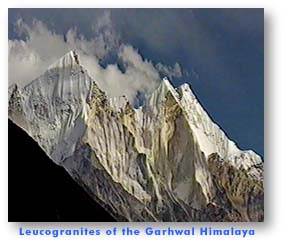
present eminences. In this period, intrusions of young granites, known as leucogranites
because of their whitish colour, took place in the highest peaks.. such as the Bhagirathi
sisters and Shivling.
The last up thrust affected not only the Himalayas, Transhimalaya and the
Karakorum, but also the whole of the Tibetan region. With an area of 2.5 million square
kilometers, this region is the highest land mass on earth and in the last 1 million years it
has risen by nearly 5,000 meters, an average of 4-5 millimeters per year.
The uplift continues even today at a measurable 10 meters
every hundred years. Mount Everest has itself risen 8.2 meters in the last 100 years.
 Very little is known about the start, duration and extent of the Ice ages in the
Himalayas. Geologists have however determined that the second last was the most severe.
The period after this major ice age saw a marked retreat of the glaciers and this was also
the period that most Himalayan lakes came into being, amidst the ice polished rock
landscape. The Pangong and the Chandratal are classic examples of such glacial remnants.
Very little is known about the start, duration and extent of the Ice ages in the
Himalayas. Geologists have however determined that the second last was the most severe.
The period after this major ice age saw a marked retreat of the glaciers and this was also
the period that most Himalayan lakes came into being, amidst the ice polished rock
landscape. The Pangong and the Chandratal are classic examples of such glacial remnants.
Large lakes were also formed as rising rivers were blocked by the emergent
ranges. As the rising Pir panjal blocked the Jhelum it turned, what we know as The Vale
of Kashmir, into a lake. This primeaval lake, called the Karewa, drained, and from it's
 sediments, pieces of primitive tools have been recovered - our only evidence of a pre ice-
age culture in the Himalayas.
sediments, pieces of primitive tools have been recovered - our only evidence of a pre ice-
age culture in the Himalayas.
All the major rivers of the Himalayas have their source in the holy Kailash
region. The Indus to the north, the Yarlung -Brahmaputra in the east, the Sutluj in the west
and the Ganga, Karnali streams to the south and southwest. This amazing situation,
making Mt. Kailash the literal lynchpin of the Himalaya, is the result of a 30 million year
old upthrust of the Kailash range at a time when the Himalayas were in the slow, initial
phase of their formation.
Two of these great rivers, the Indus and the Yarlung-Brahmaputra, were forced 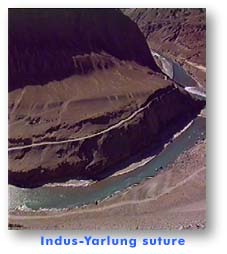 to flow along the lines of the suture zone in an east west direction, only penetrating the
range at it's eastern and western extremities.
to flow along the lines of the suture zone in an east west direction, only penetrating the
range at it's eastern and western extremities.
To further confound matters, this penetration takes place at points of highest uplift, Nanga
Parbat in the west and Namche Barwa in the east. The cutting action of the other rivers
kept pace with the rising Himalaya and they come right through the range at some of the
highest points.
In the East, the Yarlung Tsangpo parallels the Himalaya till it comes to the great axial
bend at Namche Barwa. Then, cutting one of the deepest gorges on earth, three times as
deep as the Grand canyon, it enters the plains of Assam.
The sources of all major Himalayan rivers lie, therefore, on the north side of the
great range and besides the Kailash group, include most larger Himalayan rivers.
These rivers are the principal architects of the Himalayan landscape and each river system
has created it's own unique geomorphology. The Indus and it's tributaries like the Zanskar
and the Suru in the transhimalaya. It's major Himalayan tributaries which are river systems
in their own right ... the Chenab, Ravi, Beas and the Sutlej. Further east the Garwhal
 himalaya is the domain of the Ganga and it's feeder streams while the Teesta drains the
Sikkimese himalaya. Beyond, in Arunachal is the true lower catchement of the great
Brahmaputra river system.
himalaya is the domain of the Ganga and it's feeder streams while the Teesta drains the
Sikkimese himalaya. Beyond, in Arunachal is the true lower catchement of the great
Brahmaputra river system.
The gradual rise of the Himalaya took place in a series of long, curvilinear,
parallel folds, and in this stupendous upthrust of the earth's crust, was created a mountain
range that contains all the worlds mountains over 7,000 meters in height, and constitutes
the line of demarcation between two of the world's great faunal realms - the Oriental to the
south and the Palearctic to the north. Here we find compressed into a few tens of
kilometers, the most abrupt environmental changes in the terrestrial world.
Geographically the range has been traditionally divided into :-
- The Punjab Himalaya....... consisting of the catchement basins of the Indus, Jhelum,
Chenab, Ravi, Beas and Sutluj.
- The Garhwal Himalaya ...... consisting of the catchement basins of the the Yamuna and the
Ganga.
- The Kumaon Himalaya
- The Nepal Himalaya
- Sikkim ..... the basin of the teesta
&
- The Eastern Himalaya.... the Brahmaputra and it's left bank tributaries.
Broadly they are classified into western, central and eastern Himalaya.
The Western Himalaya, from Himachal Pradesh onwards, has a much greater
depth or width, than the Eastern Himalaya. A transverse section drawn from the plains of
Punjab, through Kashmir, onto the Karakorums is three times longer than anywhere in the
Eastern Himalaya.
The Eastern Himalaya is also climatically very different. High rainfall and
gentler conditions make the eastern Himalaya a recognised haven for biodiversity.
 Although we tend to talk of the Himalaya as a monolith, nevertheless the fact
remains that in their 3000 kilometer length, they present endless variation in terms of
climate, geomorphology, flora and fauna. From the tropical jungles of Arunachal to the
cold desert of the Nubra.. ..primulas and rare orchids to the equally rare edelweiss...
frozen waterfalls and verdant forest ......bare rock and glacial wastes ...the Himalaya have
it all.....
Although we tend to talk of the Himalaya as a monolith, nevertheless the fact
remains that in their 3000 kilometer length, they present endless variation in terms of
climate, geomorphology, flora and fauna. From the tropical jungles of Arunachal to the
cold desert of the Nubra.. ..primulas and rare orchids to the equally rare edelweiss...
frozen waterfalls and verdant forest ......bare rock and glacial wastes ...the Himalaya have
it all.....
 Index
Suru
Index
Suru
|
This page hosted by
 Get your own Free Home Page
Web Page Design and Images Copyright©: Karamjeet Singh