Karamjeet Singh's Himalayan Home
 Garhwal is the birthing ground of the holy Ganga, it's two feeder streams, the Alaknanda and the Bhagirathi,
wending their way from west and east, to join at Devprayag - the confluence of the Gods.
Garhwal is the birthing ground of the holy Ganga, it's two feeder streams, the Alaknanda and the Bhagirathi,
wending their way from west and east, to join at Devprayag - the confluence of the Gods.
Here, is a great 40
mile long conglomeration of peaks and glaciers that give rise to the various source streams of the holy
Ganga. While from the east the Bhagat kharak and Satopanth glaciers feed the Alaknanda, towards the west
is the Great Gangotri glacier, a 40 km long river of ice, which gives birth to the other source stream-the
Bhagirathi.
For millions of Hindus, the Ganga is the holiest river on earth, for besides being the harbinger of life for
millions along it's banks, it is also a potent purifier - a dip in it's waters at the source, cleanses a man of all
sins, past and present.
The goddess Ganga was sent to earth by Lord Shiva to succor mankind. It is at Gangotri that she descended to earth and such was the impact of her descent from the heavens that the earth would have been destroyed
had not lord Shiva cushioned the impact with his matted tresses. The actual spot is located at a fall, where
the infant river takes a plunge through a sheer cut granite gorge.
to earth and such was the impact of her descent from the heavens that the earth would have been destroyed
had not lord Shiva cushioned the impact with his matted tresses. The actual spot is located at a fall, where
the infant river takes a plunge through a sheer cut granite gorge.
Gangotri is thus a major pilgrimage for the devout Hindu, and has been so through the centuries. Road
access in modern times has only increased the pilgrim traffic raising pollution concerns.
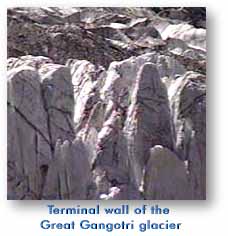 The actual source of the river is a further 18 kilometer trek, to the mouth of the Great Gangotri glacier, a
stupendous 40 km long river of ice. Over the main Himalayan axial ridge from Chaukhamba, are the other
giants, the Bhagat Kharak and the Kedarnath glacier, also adding their waters to the Ganga through the
Alaknanda and the Mandakini.
The actual source of the river is a further 18 kilometer trek, to the mouth of the Great Gangotri glacier, a
stupendous 40 km long river of ice. Over the main Himalayan axial ridge from Chaukhamba, are the other
giants, the Bhagat Kharak and the Kedarnath glacier, also adding their waters to the Ganga through the
Alaknanda and the Mandakini.
The Himalayan Glaciers are an ever renewing source of water. In summer and autumn, billions of cusecs of
water melt from glacial ice and sustain the rivers. An idea of the huge quantities of water held imprisoned in  the glaciers can be had from the fact that a single giant glacier like the Gangotri glacier has a total volume of
almost 20 cubic kilometers of ice. Compare this to the total reservoir capacity of a large dam like the Bhakra
and the Gobind Sagar lake, which is less than 8 cubic kilometers.
the glaciers can be had from the fact that a single giant glacier like the Gangotri glacier has a total volume of
almost 20 cubic kilometers of ice. Compare this to the total reservoir capacity of a large dam like the Bhakra
and the Gobind Sagar lake, which is less than 8 cubic kilometers.
Gaumukh, the source of the Ganga, is so called because the glacier's mouth is said to resemble a cow's
mouth. Here, at the meeting place of heaven and earth, we are witness to the actual birth of the Ganga as it emerges from the glacier, it's bitterly cold waters like
soothing balm to the delirious pilgrims.
The melting of a glacier owes less to the sun's rays than it does to pressure. Pressure equals temperature and
the massive pressures generated by millions of tons of ice create substantial heat in the bottom layers. This
is increased due to friction as the glacier travels. A few kilometers before the actual mouth, a subterranean
tunnel forms, through which the melt rushes, gradually increasing in size.
 Along the glacier is a high altitude wonderland. The Bhagirathi sisters are an irrestible lure for those into vertical climbing.
Another prominent mountain is Shivling, probably one of the most graceful and perfectly shaped mountains in the entire
Himalaya. It's near vertical white granite walls and summit cap of black slate, make Shivling an object of awe and wonderment
for pilgrim and mountaineer alike.
Along the glacier is a high altitude wonderland. The Bhagirathi sisters are an irrestible lure for those into vertical climbing.
Another prominent mountain is Shivling, probably one of the most graceful and perfectly shaped mountains in the entire
Himalaya. It's near vertical white granite walls and summit cap of black slate, make Shivling an object of awe and wonderment
for pilgrim and mountaineer alike.
A recent study by the Indian Mountaineering Foundation came up with the astonishing
conclusion that Gangotri is the most polluted area in the Himalayas today. The yearly
influx of over two hundred and fifty thousand pilgrims, fifteen to twenty thousand trekkers
and over a hundred expeditions attempting the nearby peaks, have severely strained the
resources of this tiny hamlet at an altitude of 10,000 feet. The effect of this influx on a tiny
place like Gangotri is mind boggling. Tonnes of rubbish, garbage and solid waste are
regularly dumped into the very source of the Ganga. The
destruction of the high altitude juniper and silver birch(bhojpatra) forests is a natural
consequence to the fuel and heat needs of so many visitors.
 The Himalayan lands between 10 and 15 thousand feet are extremely fragile. The rocks
and soil are under the constant assault of the elements and at these heights, the only binder
are scrub grasses, juniper bushes and groves of silver birch, Bhojpatra, the parchment on
which most of our ancient texts were written. It is this level which is under extreme assault
in the Gangotri region. It has been estimated that the daily consumption of Gangotri town
is 4700 kg's of wood, which works out to a staggering 850 tonnes over a 6 month season.
Actual consumption may be more yet. Till 1994, all lodges and eating houses in Gangotri
were totally dependent on firewood for their heating and cooking needs. The Gangotri Conservation Project, a non-governmental initiative, with the
cooperation of Indian Oil Corporation, was responsible for bringing Liquified Petroleum Gas to the area. 274
LPG connections were issued in 1994 itself, and a hundred more in 1996. The expense
involved in LPG however keeps clandestine cutting active.
The Himalayan lands between 10 and 15 thousand feet are extremely fragile. The rocks
and soil are under the constant assault of the elements and at these heights, the only binder
are scrub grasses, juniper bushes and groves of silver birch, Bhojpatra, the parchment on
which most of our ancient texts were written. It is this level which is under extreme assault
in the Gangotri region. It has been estimated that the daily consumption of Gangotri town
is 4700 kg's of wood, which works out to a staggering 850 tonnes over a 6 month season.
Actual consumption may be more yet. Till 1994, all lodges and eating houses in Gangotri
were totally dependent on firewood for their heating and cooking needs. The Gangotri Conservation Project, a non-governmental initiative, with the
cooperation of Indian Oil Corporation, was responsible for bringing Liquified Petroleum Gas to the area. 274
LPG connections were issued in 1994 itself, and a hundred more in 1996. The expense
involved in LPG however keeps clandestine cutting active.
 Both the Alaknanda and Bhagirathi valleys are rich in wildlife - perhaps because it is a sacred region. The Kedarnath
area, for example, is known for the comparatively large numbers of the dog like Moschus Moschiferus or, the
Musk Deer. The Musk deer is believed to occupy a position somewhere between deer and antelope. What distinguishes
it are the dog like canines extending outside the mouth of the male. An elusive, reclusive species they generally hang
out in solitary pairs, keeping to the dense undergrowth. This elusivness has however not helped them survive in any
considerable numbers. The main reason for the slaughter of an entire species is the musk gland situated below the
abdomen of the male. At Chopta, near the temple of Tungnath, the State Forest Department has underway a fairly successful
experiment in captive breeding of Musk deer.
Both the Alaknanda and Bhagirathi valleys are rich in wildlife - perhaps because it is a sacred region. The Kedarnath
area, for example, is known for the comparatively large numbers of the dog like Moschus Moschiferus or, the
Musk Deer. The Musk deer is believed to occupy a position somewhere between deer and antelope. What distinguishes
it are the dog like canines extending outside the mouth of the male. An elusive, reclusive species they generally hang
out in solitary pairs, keeping to the dense undergrowth. This elusivness has however not helped them survive in any
considerable numbers. The main reason for the slaughter of an entire species is the musk gland situated below the
abdomen of the male. At Chopta, near the temple of Tungnath, the State Forest Department has underway a fairly successful
experiment in captive breeding of Musk deer.
 Index
Shivaliks
Index
Shivaliks
|
This page hosted by
 Get your own Free Home Page
Web Page Design and Images Copyright©: Karamjeet Singh
