Karamjeet Singh's Himalayan Home

 Kumaon, like neighbouring Garhwal, lies right on the main axis of the Great Himalaya range. From the eastern ramparts
of Nanda Devi, 25,645 feet, on through Nanda Kot and the Panchchuli group, both twenty two thousanders, finally meeting
up with the Nepalese Api group along the gorge of the Mahakali, the Great Himalaya rises in a gentle sweep from the
plains of Uttar Pradesh.
Kumaon, like neighbouring Garhwal, lies right on the main axis of the Great Himalaya range. From the eastern ramparts
of Nanda Devi, 25,645 feet, on through Nanda Kot and the Panchchuli group, both twenty two thousanders, finally meeting
up with the Nepalese Api group along the gorge of the Mahakali, the Great Himalaya rises in a gentle sweep from the
plains of Uttar Pradesh.
Kumaon is the land of the Mahakali and it's major right bank tributaries, the Goriganga, the Dhauliganga and the Ramganga.
Like the other major source rivers of the Ganga, the Mahakali too, originates north of the Great Himalayan crest zone
and forces a passage through the main range, to merge with the Ganga in the distant plains.
Munsiary, or the place of snows, overlooks the Goriganga, the main tributary of the Kali, and the river which drains the melt
of the Milam glacier as well as the eastern approaches of Nanda Devi. The left bank tributaries of the Goriganga emerge
from the Balati glaciers and the vast snowfields of the Panchchuli group. Legend has it that the setting sun reflecting off these peaks, as viewed from Munsiary, represents the last meal cooked by the Pandavas, heroes of the Indian epic-Mahabharata,
before they ascended to heaven. The five peaks of the group represent their Chulas or cooking hearths, hence the name Panchchuli.
off these peaks, as viewed from Munsiary, represents the last meal cooked by the Pandavas, heroes of the Indian epic-Mahabharata,
before they ascended to heaven. The five peaks of the group represent their Chulas or cooking hearths, hence the name Panchchuli.
The turbulent and aptly named Goriganga originates from the Milam glacier , at the head of the valley of the same name.
Here at an altitude of 11,200 feet, is located Milam village, at one time one of the most important staging posts on a significant trade
route with Tibet. Milam in those days was a very large village, a bustling high altitude encampement. Nowadays, the
village size is greatly reduced and continuing migrations to the plains of the young leave it a very sleepy shadow of it's former
self. But Milam has another claim to fame. It was home to the Pandit brothers, two intrepid explorers of the 19th century.
 By 1864, though the Indian Himalayas were being surveyed and mapped, the areas north of the border, ie Tibet, were more
or less a complete blank. Even the position of Lhasa on the map was largely conjectural. The situation was not easily remedied though.
Tibet in those days was a completely closed system with no ingress allowed beyond the borders. White men were especially taboo.
By 1864, though the Indian Himalayas were being surveyed and mapped, the areas north of the border, ie Tibet, were more
or less a complete blank. Even the position of Lhasa on the map was largely conjectural. The situation was not easily remedied though.
Tibet in those days was a completely closed system with no ingress allowed beyond the borders. White men were especially taboo.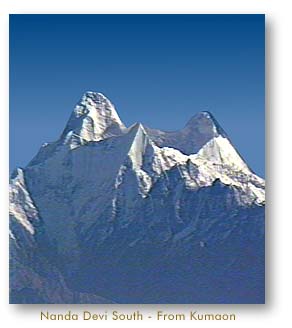 This is when Nain Singh and his cousins entered the picture. Being of hardy Bhotia stock and living not far from the Tibetan
border, they could easily pass for Tibetan as far as appearance, speech and manners went. These men were trained by the
Great Trignometrical Survey of India in practical reconnaisance and route survey, taught the use of the pocket
compass and the sextant to take star sightings, to fix altitude by taking the temperature of boiling water(the boiling point of water changes with atmospheric
pressure), and to keep accurate records of the details of their routes.
This is when Nain Singh and his cousins entered the picture. Being of hardy Bhotia stock and living not far from the Tibetan
border, they could easily pass for Tibetan as far as appearance, speech and manners went. These men were trained by the
Great Trignometrical Survey of India in practical reconnaisance and route survey, taught the use of the pocket
compass and the sextant to take star sightings, to fix altitude by taking the temperature of boiling water(the boiling point of water changes with atmospheric
pressure), and to keep accurate records of the details of their routes.
Nain Singh's journeys read like the stuff of adventure fiction. Disguised alternately as a lama or a trader, beset by brigands,
officialdom and the general rigours of such a journey in those times, he made an epic 1200 mile trip, crossing numerous
high passes, to return with complete details of a map of the southern trade route of Tibet, as well as a detailed charting
of the Brahmaputras's course for 600 miles, along with sundries like the first position fix of Lhasa, all concealed within his
prayer wheel. His cousin and pupil Kishen Singh, surpassed his mentor by disappearing into Tibet for 4 years. One of his goals
was to establish whether the Yarlung Tsangpo in Tibet and the Brahmaputra in India were the same river (this fact was unknown then).
When all hope was given up he returned, a physical wreck, but with a complete record of all his travels which included
a sojourn as a slave. He succeeded in solving the mystery of the Brahmaputra by throwing marked pieces of wood into
the Yarlung Tsangpo which were later recovered in Assam in India, proving conclusivly that it was indeed the same river.
Nain Singh and Kishen Singh were both honoured in their lifetime with titles and generous land endowements as well as
salutations and medals from Geographic societies of Europe and England.
The Gori valley is great trekking country though low on infrastructure of any sort. The road, such as it is, terminates at Munsiary and from
here to Milam village is a four day trek. The recent relaxation of Inner line restrictions in the area now permit the trekker to branch into
a number of unexplored and unreferenced valleys. Foreigners may face a few extra restrictions, especially near the Indo-Tibetan
border.
Further down, towards Almora the landscape turns benign with large pine forests and toy like villages. Wildlife abounds in these areas
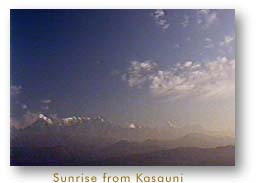
and a drive through these areas in November can be sheer delight. One of the best views of the range can be had from Kasauni, with Trisul especially prominent. Viewed from here, it's upper ridge is
molded like a trident - hence the name. Another great viewpoint is Binsar, and here Nanda Devi dominates the landscape, the
southern walls of the inner sanctuary clearly visible. Binsar is also home to a wildlife park abounding in Pheasants and Black bear.
Mankind has been around in Kumaon for a very long time. Evidences of stone age settlements have been found in Kumaon, particularly the rock shelter at Lakhu Udyar. The paintings
here date back to the mesolithic-chacolithic period.
The early medieval history of Kumaon, is the history of the Katyuri dynasty. The Katyuri kings ruled from the 7th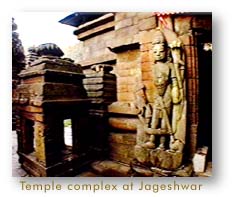 to the 11th century, holding sway at the peak of their powers over large areas of Kumaon, Garhwal and western Nepal.
The town of Baijnath near Almora was the capital of this dynasty and a center of the arts. Temple building flourished under
the Katyuris and the main architectural innovation introduced by them was the replacement of bricks with hewn stone. Large
blocks were quarried and transported, somehow, over hilly terrain, and iron clamps used to hold the blocks together.
to the 11th century, holding sway at the peak of their powers over large areas of Kumaon, Garhwal and western Nepal.
The town of Baijnath near Almora was the capital of this dynasty and a center of the arts. Temple building flourished under
the Katyuris and the main architectural innovation introduced by them was the replacement of bricks with hewn stone. Large
blocks were quarried and transported, somehow, over hilly terrain, and iron clamps used to hold the blocks together.
 On a hilltop facing east, opposite Almora, is the temple of Katarmal. This 900 year old sun temple was built during the
declining years of the Katyuri dynasty. The intricately carved doors and panels have been removed to the National Museum
in Delhi as a protective measure after the 10th century idol of the presiding deity was stolen.
On a hilltop facing east, opposite Almora, is the temple of Katarmal. This 900 year old sun temple was built during the
declining years of the Katyuri dynasty. The intricately carved doors and panels have been removed to the National Museum
in Delhi as a protective measure after the 10th century idol of the presiding deity was stolen.
After an interregnum of a couple of centuries, the Chands of Pithoragarh became the dominant dynasty. The magnificient
temple complex at Jageshwar with it's cluster of a hundred and sixty four temples, was built by the Chand rulers over a space
of two centuries. Dedicated to Lord Shiva, the evocative carvings are complemented by the beautiful cedar forest around it.
 The lower Kumaon hills have a large number of tals or lakes, mostly formed as a result of the active tectonics in the region. Nainital
is of course famous, more so nowadays as a vivid example of environmental degradation. Others like Bhimtal and Sattal are
in much better shape due to the absence of a major town on their periphery.
The lower Kumaon hills have a large number of tals or lakes, mostly formed as a result of the active tectonics in the region. Nainital
is of course famous, more so nowadays as a vivid example of environmental degradation. Others like Bhimtal and Sattal are
in much better shape due to the absence of a major town on their periphery.
Kumaon, or more specifically the areas around Nainital, are also one of the last known habitats of the enigmatic Himalayan mountain
Quail, last sighted over a hundred years ago. Therafter the bird has vanished and is probably extinct. Dr. Salim Ali's excellent
handbook describes it's habits as " reluctant to fly, almost when trampled upon, heavily and for short distances". Like the
famous Dodo, the Mountain Quail too, seems too naive for co-existence with humanity. As with other endangered Himalayan species, the Quails natural habitat was the dense understory on steep, wooded hillsides. Unfortunately it has been this middle altitude
low scrub and brush that has suffered most at the hands of human beings. No wonder the quails and pheasants are fast disappearing.
 Kumaon is, or rather was, classic tiger country. Throughout known history, tigers ranged all over Kumaon's lower
districts. For centuries the balance was maintained till the early years of this century when the first man eaters made their
appearance, indicating a disruption in the natural order due to rising human and cattle populations. Maneaters made Kumaon famous. In the
first decade of the century the Champawat tiger and the Panar leopard, known after the areas they frequented, killed eight
Kumaon is, or rather was, classic tiger country. Throughout known history, tigers ranged all over Kumaon's lower
districts. For centuries the balance was maintained till the early years of this century when the first man eaters made their
appearance, indicating a disruption in the natural order due to rising human and cattle populations. Maneaters made Kumaon famous. In the
first decade of the century the Champawat tiger and the Panar leopard, known after the areas they frequented, killed eight hundred and thirty six human beings. Jim Corbett relates the hunting down of these two scourges in the Temple Tiger, and it
makes for fascinating reading. By the ninteen thirties the balance had turned inoxerably against the tiger and their numbers started declining
rapidly due to the onslaught of macho white sportsmen and Indian princelings. The rampage continued well into the sixties, with
even the English royal family coming over on a tiger shoot. The situation became critical by the end of the decade when finally,
in 1971, the Indian government banned the killing of tigers. Project Tiger started about then and inspite of it's much touted
success in earlier years, gradually got mired in beauracratic inertia. The rising Chinese demand for tiger bones used in some
Chinese voodoo medicine formulations, led to increased poaching in India. How much so has become apparent only recently
when over a 100 kilos of bones were seized from a dealer. Non-partisan experts now estimate India's tiger population as not more
than 3,000 in the wild. At this rate the Tiger will be extinct in another ten years.
hundred and thirty six human beings. Jim Corbett relates the hunting down of these two scourges in the Temple Tiger, and it
makes for fascinating reading. By the ninteen thirties the balance had turned inoxerably against the tiger and their numbers started declining
rapidly due to the onslaught of macho white sportsmen and Indian princelings. The rampage continued well into the sixties, with
even the English royal family coming over on a tiger shoot. The situation became critical by the end of the decade when finally,
in 1971, the Indian government banned the killing of tigers. Project Tiger started about then and inspite of it's much touted
success in earlier years, gradually got mired in beauracratic inertia. The rising Chinese demand for tiger bones used in some
Chinese voodoo medicine formulations, led to increased poaching in India. How much so has become apparent only recently
when over a 100 kilos of bones were seized from a dealer. Non-partisan experts now estimate India's tiger population as not more
than 3,000 in the wild. At this rate the Tiger will be extinct in another ten years.
Most of Kumaon's remaining Tigers are resident in the Jim Corbett National Park, India's first, and some say most successful,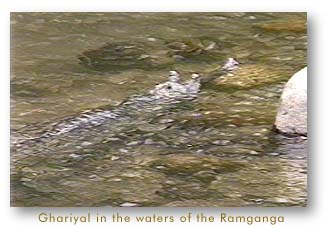 National Park. Situated in the lower Kumaon hills, the park encompasses a typical doon valley, sandwiched between
the low Shivaliks and the foothills of the lesser Himalaya. A primeaval landscape of dense Sal forests and tall grasses, it
is also famous for it's biodiversity, home as it is for species ranging from the Asian elephant, elephas maximus, to the Ganges Ghariyal, garialis gangeticus,
a crocodile species with a long thin snout.
National Park. Situated in the lower Kumaon hills, the park encompasses a typical doon valley, sandwiched between
the low Shivaliks and the foothills of the lesser Himalaya. A primeaval landscape of dense Sal forests and tall grasses, it
is also famous for it's biodiversity, home as it is for species ranging from the Asian elephant, elephas maximus, to the Ganges Ghariyal, garialis gangeticus,
a crocodile species with a long thin snout.
The Asian elephant once roamed the continent from Syria to northern China. Again, at the beginning
of the century they numbered in the millions, now reduced to an estimated 55,000 in the wild, in isolated pockets. India
with nearly 20,000 wild elephants and at least 2000 captive ones, is home to 35% of Asia's elephants and is a genuine
success story as far as conservation efforts are concerned.
 Index
Kulu
Index
Kulu
|
This page hosted by
 Get your own Free Home Page
Web Page Design and Images Copyright©: Karamjeet Singh