Karamjeet Singh's Himalayan Home

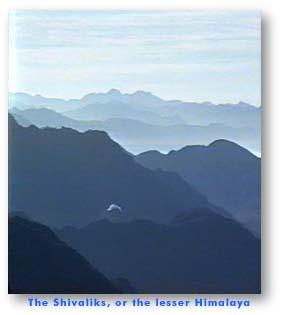 As the Himalayas rose, the forces of erosion kept pace. Detritus and sediment from the
rising Himalaya were deposited in a skirt at the base of the growing chain. These sediments
were themselves up thrust in the last major folding event as the Indian plate pushed and
ground against the Eurasian continent. This narrow strip, which is nonetheless 2,000
kilometers long, and forms a continuous chain, is known as the Shivaliks. Structurally,
their sediments reflect the history of the up thrust of the emergent Himalayas and
numerous mammalian fossil finds testify to the youthfulness of the Himalaya.
As the Himalayas rose, the forces of erosion kept pace. Detritus and sediment from the
rising Himalaya were deposited in a skirt at the base of the growing chain. These sediments
were themselves up thrust in the last major folding event as the Indian plate pushed and
ground against the Eurasian continent. This narrow strip, which is nonetheless 2,000
kilometers long, and forms a continuous chain, is known as the Shivaliks. Structurally,
their sediments reflect the history of the up thrust of the emergent Himalayas and
numerous mammalian fossil finds testify to the youthfulness of the Himalaya.
The Shivaliks ,also known as the sub-Himalaya or the foothills, run in a
continuous belt from Jammu, through the Kangra valley and then on through the Sirmaur
district to Dehradun and further on the Bhabbar tracts of Garhwal and Kumaon.
Continuing through Nepal, the only break comes at Sikkim, and then on again through
Arunachal. Their width varies from a few kilometers to around 40 kilometers at different
places.
 Longitudinal valleys lying between the Shivaliks and the main range to the
north, are known as Dun valleys. The best known example is of course Dehradun. In these
cases the general slope is towards the middle of the valley and sediments brought down
from streams from both north and south are called Dun gravels. Dense growths of Sal and
riverine forest have been cleared over the years from the Dun valley, to make way for
cultivation.etc
Longitudinal valleys lying between the Shivaliks and the main range to the
north, are known as Dun valleys. The best known example is of course Dehradun. In these
cases the general slope is towards the middle of the valley and sediments brought down
from streams from both north and south are called Dun gravels. Dense growths of Sal and
riverine forest have been cleared over the years from the Dun valley, to make way for
cultivation.etc
The Shivalik hills are well developed along the southern edge of Himachal
Pradesh, from the Kangra valley, in a broad belt, to the Sirmaur region on the border with
U.P.
The landscape is typically, low rolling hills, bisected by innumerable gullies, seasonal
streams, known as choes, which drain this region.
 Once peppered with small principalities and kingdoms, straddling major trade routes in and
out of the interior Himalayan regions, they prospered, till their eventual eclipse
commenced during the British raj.
Once peppered with small principalities and kingdoms, straddling major trade routes in and
out of the interior Himalayan regions, they prospered, till their eventual eclipse
commenced during the British raj.
The archetypically romantic landscape, as immortalised by the Kangra and Basholi school of miniature
painting, the Shivalik countryside can be enchanting.
Sirmaur is one of the lesser known areas of Himachal, and at the time I visited, in November, one of it's
most beautiful. Traveling through this unspoilt backwater is
a real treat and an opportunity to familiarize with the peoples, culture, flora and fauna of
the Shivalik region.
As is the case with most hill states, the history of Sirmaur is a tapestry of valour, deceit
and romance. Perpetually at war with their neighbours, these states came under the
eventual domination of first the Mughals and later, the Sikh raj.
In Sirmaur, the ruling dynasty first ascended the throne in the 10th century A.D
at Sirmur near Paonta Sahib. Sirmur town was destroyed by floods, and as the local
legend has it, this happened due to the curse of a dancing girl whom the Raja cheated.
Later, the dynasty caused to be built, the hill town of Nahan, which served as  the seat of Princely administration for the next few centuries.
Nahan has the distinction of having one of the first elected municipalities in the country as well as a century old underground
sewage system.
Built like an Austrian hill town with it's cobbled streets and orderly air, it remains a
beautiful town, inspite of the usual modern day problems of overconstruction.
The havelis and palaces of Nahan are steeped in an aura of lost grandeur. The elaborate
drawing rooms and reception areas ,... hearken back to an era of Shikar, grand balls and
receptions of state.
For the exteriors of their palaces the rulers preferred to go back to their Rajasthani origins,
This applied to their personal living areas as well. One room is wall to wall lined with
murals done in the rajasthani style and the family's inner courtyard contrasts sharply with
 drawing rooms straight from the Paris of the last century.
The town itself reflects this eclectic mix of architectural styles so typical of British India.
Nahan is surprisingly, home to a century old clock, which still works the way it did the day
it was commissioned. Mechanical arts flourished under the Rajahs and this tradition is still
alive, passed down through the generations by the keepers of the clock or as by the 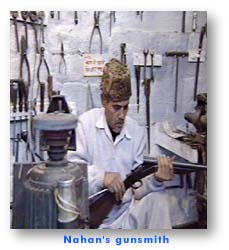 gunsmith in the main marketplace, who takes an inordinate pride in his work.
Nahan has another claim to fame. Gobind Singh, the tenth and last Guru of the Sikhs, spent a few years here. A period, he
later described as one of the pleasantest interludes in his life. While the other hill states like Nalagarh had ranged against him
alongside the Moghuls, the Rajah of Sirmaur was one of his most loyal supporters. Sirmaurs later survival as a state under the Sikh
raj, perhaps hinged on this fact.
Dehradun is of course one of the best known towns of the Shivalik regions, as
well as the largest. In recent years the character of Dehradun has changed much, to the
eternal lament of old time residents.
The people of the Shivaliks today have experienced a slide in the quality of the
environment during their lifetimes. In fact, speeded up erosion has made the hills
themselves volatile. But their ancestors came to a very different land. While some people
moved up from the plains, people in Sirmaur side are an interesting mix of plains people
and the high altitude settlers moving down the Yamuna valley.
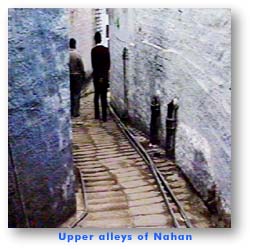 Like people everywhere, they have their complaints and the citizens of Nahan weren't any too
impressed with Nahan's track record viz an underground drainage system and an elected
municipality..... and they had a valid point. Booming populations have routed to the dustbin
civic services catering to the demand loads of the last century.
Like people everywhere, they have their complaints and the citizens of Nahan weren't any too
impressed with Nahan's track record viz an underground drainage system and an elected
municipality..... and they had a valid point. Booming populations have routed to the dustbin
civic services catering to the demand loads of the last century.
The prime cause for the backwardness of the Shivalik belt is a reduction in soil fertility
and productivity, due to massive soil erosion. Ecologically, the Shivaliks have an interesting
history. Prior to the middle of the last century, the hills were covered with thick acacia and
pine forests, the forest floor being covered in a lush tangle of undergrowth. Pheasant
species, deer and the like flourished amidst crystal clear perennial streams. But in less than
two generations after the Anglo-Sikh wars of 1845 and 1849, the entire scene changed.
The Sardars and Rajahs who owned the hunting land in the Shivaliks were evicted and the
forests handed over to the villagers.

While an admirable notion in itself, it completely lacked any sort of regulatory
mechanism. Thus, while tree cutting and overgrazing stripped the area, heavy rains did the
rest. The loosely cemented molasse soils of the Shivalik were washed away, and in most
areas lush rolling hills gave way to a badlands topography of knife edge ridges.
The Shivaliks are a part of the Himalayan mountain chain that have been neglected for a
long time, though the problems and the conservation measures required were identified as
early as 1895. The Shivalik mountain system which covers over 20,000 sq. km area in the
states of Himachal, Punjab and Haryana, is now under a constant threat of erosion and
floods.
Today, most of the Shivalik regions are a scene of dusty, rolling topography,
devoid of vegetative cover. Monsoon torrents, known as choes, are quite common in the
area. Numbering in the hundreds, these choes play havoc during the monsoons. They cut
across fertile fields and spread sheets of sand over the flooded areas. The width of some of
these choes is more than a kilometer, and a flash flood can bring enormous boulders
tumbling down. Productivity of soils is thus on a declining trend in the entire Shivaliks.
Also to be toted up is the annual loss of life and property due to flash floods that disgorge
from steep, rough, highly erodable catchements.

There are many such streams in the Dehradun region too.With unfailing
regularity they swell each year with the monsoon rains, destroying fields and forests along
their banks, and convert fertile land to waste land by spreading their gravel and sand.
Jakhan Rao, over the last 60 years , has enlarged it's bed from 50m to 500 meters and it is
no longer a perennial stream. The Khair and Shishum trees on the flood plains have also
disappeared.
Field studies in the Bhabbar belt of the U.P hills show that river beds in this tract too, have
widened about one and a half times, and even the perennially flowing rivers have dried up.
All this has happened within the last single decade or so.
Which brings us to the question - can the Shivaliks still be saved?
Apparently so, if the efforts of Central Soil and Water Conservation Research Institute are
any indication. The Sukhomajri model of conservation is today known internationally for
the concept of "social fencing" pioneered by it.
Basically people protect the land against grazing and water harvesting structures controlled
the gully erosion. Three check dams could bring life back into the 100 hectares of farm
land in village Sukhomajri.

These experiments have shown that a combination of complete protection and
integrated structural and vegetative measures are the answer to the problem. Grazing
should be substituted with stall feeding. These hills are essentially quite productive and can
be restored to their past glory within a period of 25-50 years, promoting wildlife and
increasing avenues for recreation.
Some distance away from Nahan is the Renuka lake, these days being promoted as a
tourism destination. Set amidst the low hills, clothed in verdant foliage, the lake is the stuff
an average city dweller's romantic dream of a lake is made of. Hopefully the Renuka lake
will not go the way of other accessible Himalayan lakes, like the Naini and Dal lakes.
 Another dun valley, the Patli dun, forms part of the Corbett National park. Thus this is one
of the only regions of the Shivaliks to retain it's forest cover and diversity of wildlife
species. Here in the valley of the Ramganga, we have a chance to observe species which
were once fairly prevalent across the entire Shivalik belt. Thick grass lands clothe the valley
floor, while the slopes bear verdant Sal forests. Ungulates like the barking deer and the
spotted deer thrive, tigers are plenty and the rivers are flush with Mahseer and the
occasional waiting Ghariyal.
Another dun valley, the Patli dun, forms part of the Corbett National park. Thus this is one
of the only regions of the Shivaliks to retain it's forest cover and diversity of wildlife
species. Here in the valley of the Ramganga, we have a chance to observe species which
were once fairly prevalent across the entire Shivalik belt. Thick grass lands clothe the valley
floor, while the slopes bear verdant Sal forests. Ungulates like the barking deer and the
spotted deer thrive, tigers are plenty and the rivers are flush with Mahseer and the
occasional waiting Ghariyal.
 Index
Biography
Index
Biography
|
This page hosted by
 Get your own Free Home Page
Web Page Design and Images Copyright©: Karamjeet Singh