 |
|
|
|
|
|
|
|
|
|
|
|
|
 |
 |
|
||||||||||
|
||||||||||||
|
||||||||||||
|
||||||||||||
 |
 |
 |
 |
 |
 |
 |
 |
 |
 |
 |
|
|
 |
|
|||||||||||
 |
 |
|
||||||||||
 |
|
|||||||||||
 |
|
|||||||||||
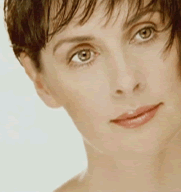
Enya
& Spirit
This year, Enya celebrates the 10th anniversary of Orinoco Flow, a UK
No 1 hit single that effectively came out of nowhere, introducing a young
woman whom few outside of Ireland knew about, and who was playing music
that had nothing to do with pop or rock. Ten years of producing emollient,
albeit often elegiac, music that has sold over 40m albums world wide and
last week won her an Ivor Novello award for international achievement
has done little to resolve the enigma that is Enya.
Here is a woman who, as a young girl, departed her family band, Clannad,
amid a flurry of ccusations and ultimatums, choosing to team up with the
band's ousted manager and sound engineer, Nicky Ryan, and his wife Roma
- a decision that remains as secretive and unfathomable now as it was
virtually destructive to all concerned then. A woman who thereafter hid
herself away in the Ryans' tiny studio in Artane, north Dublin, composing
melodies ad infinitum, which were picked up firstly by the BBC and then
by one of the biggest record companies in the world, Warners. A woman
who has received from that record company guarantees of artistic freedom
that George Michael and Prince
could only dream of. And who, 10 years into her career, is the 62nd richest
woman in Ireland, with a fortune estimated at IR£30m, living near
Nicky and Roma Ryan in her own castle - a 19th century fortress overlooking
Dublin Bay and named Ayesha after the ageless queen in She, H Rider Haggard's
adventure yarn.
Enya knew she wanted it the moment she walked through the doors: "I've
always loved castles," she explained, sounding for all the world
like a little girl who has grown up into a lovelorn woman with millions
of punts to spare, "and now I have one of my own."
It was far from castles she was raised, of course. Born on 17 May 1961,
in Gweedore, Co Donegal, Enya was steeped in Irish music, performing on
stage from the age of three.
Her father, Leo Brennan, a band leader in the 1950s and 1960s, now runsa
pub called Leo's Tavern, a reputable Irish music venue. Her mother teaches
music. Donegal is where Enya keeps coming back to, and referring to, in
her mind and music. "Flying back home to Donegal from Dublin over
the mountains before the plane comes down," she said last year, "I
realise that the landscape is always with me.
I don't get home as often as I would like but the beauty is very powerful.
I don't think it ever leaves you." Leo's Tavern was the breeding
ground for the musical nucleus of the family.
Clannad (Gaelic for family) was formed here in 1970, making an initially
unsteady vehicle for Maire, Paul, and Ciaran Brennan, and their uncles
Padraig and Noel Duggan. The band was managed at this time by Fachtna
O'Kelly, and Nicky Ryan was approached to oversee their live sound engineering
and production.
"They were different," contends Ryan, who had previously been
involved with the Bothy Band and Planxty. "There was a double bass
and a guitar, but no drums. It was acoustically oriented, and it taxed
me to the limit as sound engineer.
I decided to take it on, and did some tours with Fachtna there. Then he
surprised us all one day when he told us he was going to manage the Boomtown
Rats. A total shock. That's how myself and Roma began to manage Clannad."
After a couple of years of touring, Nicky came to realise that, musically,
the group - then run on a co op basis - was treading water. By the late
1970s, Enya had left boarding school at Milford
College, where she had been studying piano and classical music. A choice
of place at either Trinity College or University College Dublin was unwittingly
lost to her through misdirected letters. Enya, in Nicky Ryan's words,
was "between the devil and the deep blue sea, but definitely knowing
it was music she was into. And there I had a band that, as far as I was
concerned, were kind of stale at
this stage. I knew Enya could sing, and that she had a broader range than
Maire. So I brought her into the group. It was my suggestion, not Clannad's.
Reluctantly, she said she'd join us. From that moment on, I felt responsible
for her future."
This is where the Clannad/Enya story becomes, according to Ryan, "not
happy". It immediately became apparent to him that Enya was more
than just a minor figure in the band set-up. Her influence on Clannad
was, he claims, immense. "She never suggested anything," he
says, "it was just
that what she did came naturally to her, to sit down and play these wonderful
chords. It was the first time keyboards were introduced to Clannad, and
in that way she had a huge influence on what went after that in the group."
In the meantime, matters were taking a turn for the worse between Ryan
and the other band members, leading to gauntlets being thrown down by
both parties. He says an
ultimatum was given to him by the band that he would not agree to, so
he left. "They then turned to Enya," Ryan recalls, and said
-"these are the very words that were said - 'Enya, if you want to
be a star, you stay with us. If you want to be nobody, you go with the
Ryans'. The split happened
and Enya chose us. She felt she could see that for her personally, regardless
of what happened afterwards, it was a dead end. So she entrusted the whole
thing, her future, to us."
"These things happen," says Enya's sister Maire. "She left
school in 1979, and we had already been a nucleus, so it was probably
difficult for her. She wanted to go off and do her own thing.
"Tensions
were created because we never answered any of the [media's] questions.
If you're going to
answer questions, people aren't going to believe you anyway. The proof
of the pudding is that Enya is my sister, and I love her dearly, and we
get on really, really well. There's no way you'd get away with it
in our family, anyway. She's a wonderful aunt to my kids. We all go through
troubled times, on and off,
but you get on with life, don't you?"
The
public perception of Enya - a porcelain figure in a moonlit night, beautiful,
but almost too fragile
to touch - is bolstered by her steadfast reluctance to tour, which, considering
her record sales over the
past decade, is unusual, if not unique. Years spent crafting in the studio,
she says, gives her no time
to tour. The recording process is as solitary as one can imagine: no tape
operators, coffee makers, gophers, games, or hangers-on. As Enya once
said: "Great musicians, in spite of their talent and willingness,
never seemed to come to the right wavelength, so we had to invent, record,
sing, everything ourselves. Enya is in fact a sort of trinity."
Melody,
the core of any Enya piece, and her strongest creative point, is worked
on by Nicky for weeks
at a time. And despite what various critics have maintained, sampling,
asserts Ryan, is "simply
unthinkable".
At 37, Enya is unmarried, has no children, and has achieved fame and fortune
without recourse to public outrage or gimmicks. Her desire for privacy
is renowned and mostly respected (although the approaches of a UK-based
stalker have become so serious that the CID is now involved in attempting
to track him down). She has had boyfriends, but their identities have
remained
a secret. Enya currently has a boyfriend of Spanish origin, who is not
allowed to set foot in the studio.
"I've
always tried to make it clear that my work comes first," she explained
recently, "that I need my
space. Finding a man who can adapt to me? I haven't met one. There could
be an element of fear, knowing that no one has yet understood my strong
will, my need. You see, music is something I've got to do. The idea of
coming back home and having to talk to someone after hours in the studio
when I'm spent, exhausted - I can't imagine being able to do that, being
able to cut myself in two, switching from one role to another. As for
children, I've enough nieces and nephews to fill that gap."
Although
the initial absence of musical rivalry facilitated a reconciliation between
her and Clannad,
the irony is that the sound of Enya has eclipsed that of her family.
"There
aren't an awful lot of similarities," contends Maire, who has just
released her third solo album,
Perfect Time. "It's the same influences, the same family, the same
mum and dad, the same geographical area. When people say Clannad or my
solo work sounds like Enya, well,
this kind of music didn't exist before Clannad and Enya. Harry's Game
was done before Enya did the layering of voices, and created what they
call [an] 'ethereal' and 'haunting' [sound]." There is one big difference,
she adds: "I write the words, Enya doesn't."
"Enya knew nothing about recording, about production or arrangements," says Ryan. "Originally, we were stock-piling music and just letting her get on with it. There was no name on the music she was writing. All I knew was that hard work succeeded."
Soundtrack work for David Puttnam on The Frog Prince led to a BBC series called The Celts, which in turn - by a circuitous route involving botched seating arrangements at an Irish awards event where Enya and the Ryans ended up sitting at a table with WEA boss Rob Dickens - led to Watermark, Enya's 1988 debut album.
The
Enya trinity may seem bizarre. The image of this beautiful, talented young
woman spending years in the studio with the Ryans is a perplexing one
for outsiders, perhaps even for her own family. "I have
worked for months with the same two people between the same four walls,"
she has said. "Ultimately it makes you become a social zombie. Your
friends don't call you anymore, you don't know what happens in the outside
world or what people think of your music."
So why does she keep it up?
"Our
force is our peculiarity," she has concluded. "And we have to
keep it at any cost."
"Enya is great fun," insists Ryan. "She's not a dowdy person
by any means. It sounds like she's
aloof because she's just not available. She's a private individual. I
respect that, and that's the
end of it."
Outside
the narrow focus of her work, Enya's life is characterised by exclusion:
there is little room
for other people, no interest in the music of others, no tolerance of
the normal clamour of life,
especially life in a large family. As she has observed, "The music
I like best is silence. I
grew up in a large and noisy family - continual hustle and bustle and
crying and chaos - but the
day that everybody went off and left me on my own was such a treat."
Om Place Alternative Newsroom
Sunday
London Times Newspaper, July 2003
 |
|
|
 |
|
|
 |
 |
|
 |
|
|
 |
|
|
 |
|
|
 |
|
|
 |
|
|
 |
|
|
 |
|
|
 |
|
|
 |
|
|
 |
|
|