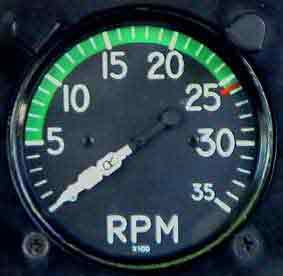
The RPM gauge indicates - unsurprisingly - the speed of the each propellers. The desired prop RPM is set using the Blue levers and corresponding adjustments are automatically made to the the blade pitch angle by the Constant Speed Unit. Max Prop Speed (red line) is shown as 2575, and a quick check in the Check List will confirm that there are three basic settings which cover all phases of flight.
These are also shown in the explanation of the Engine Controls
There is no automatic prop synchronization, and the Aircraft has a tendency to produce a really rather unpleasant "beat" when the props are not synchronized. This can be very uncomfortable to backseat passengers who hear it more easily that the Pilot especially where Pilot and Co-Pilot may be wearing Noise Reduction Headsets.
To resolve the problem adjust the Power Settings so that they are the same, and then carefully adjust the prop speed of one or other engine to (a) eliminate the beat and (b) give the correct rpm for the phase of flight in question.
NOTE the Check List procedure for Over speeding Props.
FEATHERING AND CONSTANT SPEED CHECKS
If the prop speed falls below about 800 rpm, the props will fully feather - which may of course be desired. Or it may not be. (see notes on Oil Temperature on CHT page)
On Power Checks, the Propeller Checks should be effected ensuring that
(a) On the Lower power settings (1500 rpm) neither Prop Speed is allowed to fall below 1000 rpm
(b) At the Higher power setting, a period of at least three seconds elapses between coarsening both the blades (to give 2000 rpm) and fining them again (to restore 2200 rpm). The purpose of this delay (which should be observed on each of the three tests) is to ensure that the Prop Speeds do stabilize after the pitch has been adjusted in each case, and that the constant speed mechanism is functioning correctly.