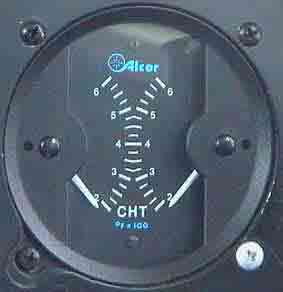
Cylinder Head Temperature gauges are calibrated in Degrees Fahrenheit. They should be monitored at all stages of the flight and on the ground. Normal operating temperatures will be between 200 degrees and 400 degrees (where the needles are horizontal) In the event that the temperature rises above 400 degrees, then cowl flaps should be opened.
Oil Temperatures and Pressures will of course be being monitored as well as Exhaust Gas Temperatures but the Oil Temperature Gauges are less easy to read (due to the shadow and also parallax) and both are a less reliable gauge of engine temperature. They should be showing "in the green" at all stages of flight, but use the CHT gauges as a more reliable indicator of engine temperature.
Use Cowl flaps to regulate temperature especially during taxying during warm conditions, since if the oil temperature is allowed to rise to an unacceptable level, the props have a habit of automatically feathering. Check fuel flow meters also to ensure that the Mixture is at least as rich for the phase of flight in question as is stated in he Checklist.
NOTE also that Cowl flaps should be operated as required during all approaches. (see Checklist).
If landing, then they will probably be open in any case, but if going around, and in particular if training involves a number of go-arounds, Cowl Flaps MUST be open.
In a descent beware of shock cooling of the engines, monitor the temperatures, and use cowl flaps accordingly to preserve engine heat.