|
Biogardener Homepage with links to my other websites
Getting Started Organically
Environmental Issues
Edible Garden
Trees & Shrubs
Traute Klein, biogardener
More on Weeds
Variety Salads Free for the Picking
Delcious Weeds
 "Poppies in the Wheatfield" Original watercolor on rice paper © Traute Klein
Amazon BooksComplete Guide to Growing Fruits, Vegetables, Herbs, Flowers
Edible & Medicinal Weed & Herb Books Getting Started Organically Books Environmental Gardening Books at Amazon
| Chamomile instead of Herbicide and Pesticideby Traute Klein, biogardener
This article grew out of a workshop which I gave at the Manitoba Herb Society September 13, 2001 on the topic of "Herbs as Companion Plants." I really wanted to call it "Herbs yes, Herb Gardens no," but I did not want to offend my listeners. The Herb Society maintains a beautiful herb garden in the beside the Conservatory in Assiniboine Park where the meetings take place.
Herbs in Nature
Herbs in Fields
 My favorite herbs and wildflowers, however, have disappeared from the German landscape. All through my childhood, I enjoyed the brilliant primary colors of the countryside. Every grain field was liberally sprinkled with 4 flowers. Three of them I used to pick into bouquets of flowers: red poppy, blue cornflower (bachelor button), and white and yellow daisies. I drew them and my mother embroidered some of my designs onto our dresses. My favorite herbs and wildflowers, however, have disappeared from the German landscape. All through my childhood, I enjoyed the brilliant primary colors of the countryside. Every grain field was liberally sprinkled with 4 flowers. Three of them I used to pick into bouquets of flowers: red poppy, blue cornflower (bachelor button), and white and yellow daisies. I drew them and my mother embroidered some of my designs onto our dresses.Of the fourth one, we picked enough flower heads for tea to last us all winter, and that was chamomile. It was our everyday supper beverage. The sweet tea made from basswood blossoms, "Lindenblüten," was reserved for Sunday, and that one we picked off the trees which lined the streets of our city.
Herbs Naturally
The Disaster of a Weed-free Field
 After World War II, the American occupation introduced herbicides into German farming to eliminate what they called "weeds." Soon, the fields sported a monoculture, just one grain. Gone were the companion plants: poppies, cornflowers, daisies, and chamomile. After World War II, the American occupation introduced herbicides into German farming to eliminate what they called "weeds." Soon, the fields sported a monoculture, just one grain. Gone were the companion plants: poppies, cornflowers, daisies, and chamomile.The disastrous results of this so-called improvement soon became apparent. Instead of being increased, grain yields were reduced. When I visited Germany in 1968, farmers were desperately trying to return to what Europeans call "biological" methods. They reintroduced chamomile into grain fields, and the yield increased. This companion herb has a function to fulfill. Besides stimulating the grain to be healthy, it repels insects which would otherwise damage the crops, thus it eliminates the need for pesticide. The chamomile seeds are no problem. By the time the grain is harvested, the flowers have matured, and the seeds have fallen to the ground to sprout next year. If any of the tiny seeds do get harvested, they just blow away with the wind. What about the cornflowers, poppies, and daisies? Well, I like to think that God had planted those as a feast for our eyes and as a subject for my paintings.
|
The material on this site may be reproduced or republished only by special arrangement with the webmaster.
You are, however, welcome to pass on or link the URL.


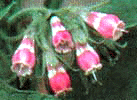 In Germany, the pungent aromas of herbs still wafted through the air when I hike there. Country roads are lined with sweet wild thyme, wet ditches filled with refreshing peppermint, and sandy spots overgrown with naturalized comfrey.