Russia and the Coming Age of the Spirit
One cannot rationally fathom Russia. One
cannot measure it with a measuring stick. It has a special nature. One can
only believe in it.
— Fyodor Tyutchev
In
his famous “Letter to Soviet Leaders” penned close to twenty five years
ago, Alexander Solzhenitsyn observed that the Russian nation has suffered
more than any other in the twentieth century. Indeed, this century could be
said to be the time of Russia’s ‘Golgotha’. A hundred years of
incredible human suffering and national sacrifice claimed millions of
Russian lives. Within the first five decades of this century the Apocalyptic
Horseman of Famine and War ravaged the vast Russian land. Archaic landmarks
swept aside and old values overturned only to be replaced by radical new
ways which themselves were soon found wanting. Spectacular material triumphs
accomplished at the cost of freedom and paid for in human blood.
The
collapse of the Soviet super power did not deliver Russia from her agonies.
The end of communist rule subjected Russia to the worst excesses of the
capitalist market. Financial chaos, mafia banditry and the corruption of
political life quickly replaced the stagnation and certainties of a once
great authoritarian state.
Back in the nineteenth century the Russian
political thinker Alexander Herzen concluded “disorder saves Russia.”
For despite all the external turmoil and pain, the unchanging, eternal
essence of the Russian national soul remains. This essence or Idea, which
owes nothing to politicians or earthly power, is preserved by humility, a
craving for Truth, centuries of God-seeking and suffering.
The chief festival of Russian Orthodoxy is
the Festival of Easter. Christianity is interpreted as above all the
religion of Resurrection. Suffering is redemptive. Jesus suffered on the
Cross before being resurrected. According to Ancient Wisdom long trials and
suffering are inevitable for the pilgrim on the path of spiritual
enlightenment, since they lead to purification. On the national level
suffering can be said to cleanse society in preparation for collective
renewal. There is a purpose, a transcendent meaning in all the trials and
tragedies of earthly existence.
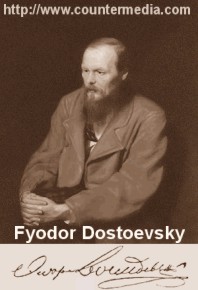
Dostoyevsky, Golden Age Prophet
 God took seeds from other
worlds and sowed them on this earth…and they germinated….But that
which grows lives and enjoys vitality only through its sense of contact
with other mysterious worlds….Much on earth is hidden from us, but in
exchange we have been given a secret and hidden sense of our living bond
with another world.…
God took seeds from other
worlds and sowed them on this earth…and they germinated….But that
which grows lives and enjoys vitality only through its sense of contact
with other mysterious worlds….Much on earth is hidden from us, but in
exchange we have been given a secret and hidden sense of our living bond
with another world.…
— Fyodor Dostoyevsky1
The “theme of redemption through
suffering,” observes the American scholar Tim McDaniel, “is absolutely
fundamental to Russian culture, and central to a great many views of Russian
distinctiveness.”2 For
the Russian writer Fyodor Dostoyevsky (1821-1881), “the main and most
fundamental spiritual quest of the Russian people is their craving for
suffering.” Dostoyevsky called the Russian nation an “extraordinary
phenomenon,” with a unique national character unlike any European people.
“The character of the Russian people,” said Dostoyevsky, is:
so different from that of
all other contemporary European nations, that up until now the Europeans
have not succeeded in understanding it – on the contrary, they have
completely misunderstood it. Europe is losing her universality and the
Christian links between people are losing their power. Contrary to Europe,
the highly synthetic ability of panreconciliation, of panhumanism, is more
and more strong among the Russians. A Russian does not have European
awkwardness, impenetrability, inflexibility. He can come to terms with
everybody…he has an instinct of panhumanism.
Panhumanism arrived at through love and
suffering is the only antidote to Western egoism and materialism. In the
West, Dostoyevsky noted, “all is now strife and logic,” driven on by
“the dream of Rothschild,” the soulless pursuit of “money as the
highest virtue and human obligation.”
By contrast “the Russian vocation,”
Dostoyevsky believed, “is to wait until European civilization expires in
order to take its ideals and goals and to elevate them to a panhuman meaning.”
Shortly before his death, he prophesied, “A new Russia will arise which in
due time will regenerate and resurrect the old one and will show the latter
the road which she has to follow.” “To be a real Russian,” he told a
breathless Moscow audience in 1880, “means to become the brother of
everyone, to become All-Man….It means finding an outlet for the anguish of
Europe in the All-Human and All-Uniting Russian soul.” Russian panhumanism
is a new world idea heralding the way toward a higher stage of civilisation,
in which conflicts would be resolved by creating a “concert of all nations
in the Gospel of Christ.” Dostoyevsky wrote:
The sun appeared in the
East, and it is from the East that the new day begins for mankind. When
the sun is shining in its full glory, then it will be understood what the
real ‘interests of civilization’ are.
Fyodor Dostoyevsky is a true prophet of the
return of the lost Golden Age. His writings take us “from the real to the
more real,” as he searches for the meaning of life in the depths of human
experience. He placed his hope for the future not in the ‘anthills’ of
the capitalist West, but in a new Golden Age of “brotherly communality….
the voluntary, totally conscious sacrifice of oneself in the interests of
all made under no sort of compulsion.” This is Russia’s destiny. Her
world mission. “Nations are moved”, we read in Dostoyevsky’s The
Possessed, “by a force whose origin is unknown and inexplicable. This…is
what philosophers call the aesthetic or moral principle; I call it simply
the quest for God.”
European occultists esteemed
Dostoyevsky as an initiate of esoteric wisdom and some modern authors
speculate about his membership in a secret brotherhood. His writings display
the deep influence of a Christian mysticism infused by Gnosticism and we
know through out his life he communicated with Russian religious dissidents
such as the Old Believers. “The creative work of Dostoyevsky is
eschatological through and through,” said the Russian philosopher Nikolai
Berdyaev. “It is interested only in the ultimate, only in what is
orientated to the end…His prophetic art consists in the fact that he
revealed the volcanic ground of the spirit; he described the inner
revolution of the spirit…It is precisely in Dostoyevsky that the Russian
messianic consciousness makes itself most keenly felt….It is to him that
the words ‘The Russian people is a God-bearing people’ belong.”3
The Third Kingdom
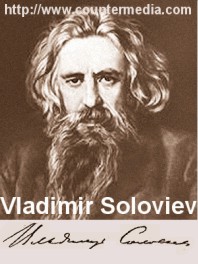 Everything visible to us
Is only a flash, only a shadow
From what cannot be seen
by the eye.
— Vladimir Soloviev (1853-1900)
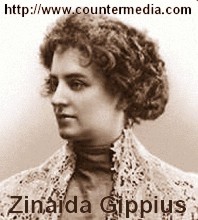
Like Dostoyevsky the gifted Russian poetess
Zinaida Gippius (1869-1945) longed for the dawn of the Golden Age when the
earth would unite with Heaven into one blissful Kingdom. And like
Dostoyevsky Gippius saw the tragedy of human existence in man’s alienation
from the spiritual world and the superficiality of his mere faith in God.
Much of her writings express the trial of the spirit in its attempts to free
itself from material reality and to fly heavenward.
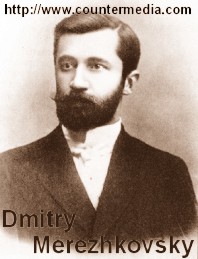
Gippius and her husband the celebrated
Russian novelist and critic Dmitry Merezhkovsky (1866-1941) distinguish
three phases in the history of humanity and its future. These phases
represent three different realms: the realm of God the Father, the Creator
– the realm of the Old Testament; the realm of God the Son, Jesus Christ
– the realm of the New Testament, the present phase which is now closing;
and the realm of the Holy Spirit, Divine Sophia (Wisdom) – the era of the
Third Testament, which is now dawning, gradually disclosing its message to
humanity. The Kingdom of the Old Testament revealed divine power and
authority as truth; the Kingdom of the New Testament reveals truth as love;
and the Kingdom of the Third Testament will reveal love as inner freedom.
 Just as the previous Kingdoms symbolise a
change in human consciousness, so the final Kingdom of the Third Testament
is to be ushered in by a new religious consciousness, the genesis of a New
Humanity. The Third Testament will resolve all present antitheses – sex
and asceticism, individualism and society, slavery and freedom, atheism and
religiosity, hatred and love. The enigma of Earth and Heaven, the flesh and
the spirit, will be solved in the Holy Spirit. The Holy Spirit will redeem
the world, giving humanity a new life in peace, harmony, and love. The Three
in One will be realised, and Spiritual Christianity – long ago driven
underground – will be brought into the open. God the Father and God the
Son will be synthesised by the Holy Spirit, Divine Wisdom. The emphasis the
Merezhkovsky’s placed on the Holy Spirit, reminds us of Dostoyevsky’s
thought:
Just as the previous Kingdoms symbolise a
change in human consciousness, so the final Kingdom of the Third Testament
is to be ushered in by a new religious consciousness, the genesis of a New
Humanity. The Third Testament will resolve all present antitheses – sex
and asceticism, individualism and society, slavery and freedom, atheism and
religiosity, hatred and love. The enigma of Earth and Heaven, the flesh and
the spirit, will be solved in the Holy Spirit. The Holy Spirit will redeem
the world, giving humanity a new life in peace, harmony, and love. The Three
in One will be realised, and Spiritual Christianity – long ago driven
underground – will be brought into the open. God the Father and God the
Son will be synthesised by the Holy Spirit, Divine Wisdom. The emphasis the
Merezhkovsky’s placed on the Holy Spirit, reminds us of Dostoyevsky’s
thought:
The Holy Spirit is a direct
conception of beauty, a prophetic consciousness of harmony and hence a
steadfast striving toward it.
In propagating their ‘Cause of the Three in
One’ Gippius and Merezhkovsky hoped for a religious revolution, a
spiritual metamorphosis of man to prepare him for the Third Kingdom.
According to Gippius the aim of all universal-historical development is the
end of humanity and the world in their present forms through the Apocalypse.
Only the coming of Christ will unite humanity in brotherly love and harmony
as one living family. At this point in the spiritual evolution of mankind
the apocalyptical Church will be established, not as a temple, but as a new
experience of God in human consciousness and in the human soul.
 Gippius and Merezhkovsky gave expression to
the messianic idea at the heart of Russian life. In the process they drew on
the eschatological doctrines popular among Russian Gnostics and religious
sectarians. From earliest times Russian thought was saturated with a
particular Gnostic dualism characterised by a constant struggle between the
evil powers which organise the earth (and earthly life), and the forces of
good which seek for the City of Truth and Justice to come. Gippius and
Merezhkovsky travelled deep into Russia beyond the Volga river, to visit
Russian mystics in their secluded monasteries. On the road to Kerzhenets,
near the legendary invisible city of Kitezh, they met with representatives
of diverse mystical sects. Merezhkovsky maintained a correspondence with
some of these Russian Gnostics and Gippius penned a story describing, with a
great deal of inside knowledge, the secret rites of the Gnostic Khlysty
community.
Gippius and Merezhkovsky gave expression to
the messianic idea at the heart of Russian life. In the process they drew on
the eschatological doctrines popular among Russian Gnostics and religious
sectarians. From earliest times Russian thought was saturated with a
particular Gnostic dualism characterised by a constant struggle between the
evil powers which organise the earth (and earthly life), and the forces of
good which seek for the City of Truth and Justice to come. Gippius and
Merezhkovsky travelled deep into Russia beyond the Volga river, to visit
Russian mystics in their secluded monasteries. On the road to Kerzhenets,
near the legendary invisible city of Kitezh, they met with representatives
of diverse mystical sects. Merezhkovsky maintained a correspondence with
some of these Russian Gnostics and Gippius penned a story describing, with a
great deal of inside knowledge, the secret rites of the Gnostic Khlysty
community.
The Khlysty, know as “God’s people,”
were heirs of the Bogomils and early Gnostic Christians. Savagely persecuted
by the official Orthodox Church they preserved their teachings in secret.
They met not in a church but in an isolated meeting place usually known as
“Jerusalem” or “Mount Zion.” They conducted not a solemn service but
a “rejoicing.” They comprised not a congregation but an “Ark,” and
were led not by a priest but by a “pilot” for the voyage from the
material to the spiritual world – into the seventh heaven where men could
rediscover their lost divinity. The means of ascent lay partly in the
“alchemy of speech” – spiritual songs and chants which produced a
state of ecstasy, a sense of liberation from the material world. The Khlysty
were just one of numerous Spiritual Christian communities owing their
allegiance, not to the Russian Empire or official Church, but to the Third
Kingdom. The most important of their commandments being “Believe in the
Holy Spirit.”
In seeking the freedom of the spirit, the
divine spark within, the Khlysty rejected all earthly laws and institutions.
A Spiritual Christian guided by the Holy Spirit did not need to obey any
external law. The official report of the Holy Synod of the Russian Orthodox
Church in 1900 recognised the Khlysty as the most influential of all sects.
A prominent church missionary reported in 1915 that Khlysty had invaded all
Russia and that there was no province where the sect did not exist in one
form or another.
Spiritual Revolution
After the Bolshevic
Revolution, many people who once had vested their hopes in religion and
magic turned to science and technology instead. The Bolsheviks adapted
occult ideas, symbols, and techniques to political propaganda. Occult and
quasi-occult ideas nourished early Soviet utopianism, pervaded literature
and the arts, and contributed to the Lenin cult.4
Zinaida Gippius and Dmitry Merezhkovsky
believed the Bolshevic Revolution to be a diabolical perversion of the
spiritual influences of the incoming Third Age. A monstrous and catastrophic
parody of the Kingdom of the Spirit. After fleeing Russia Merezhkovsky
explored the links between the Russian people and the so-called lost tribes
of Israel. He saw Russia’s catastrophic plight foreshadowed in the
Biblical prophecies of the dispersed Israelites and condemned Bolshevism as
Antichrist.
Other Russian mystics and religious
dissidents welcomed the Bolshevic Revolution as a necessary part in
Russia’s fulfilment of the divine plan. The very fact that the Revolution
had taken place in Russia was a striking demonstration of Russia’s unique
historical mission. Prior to the First World War the “holy fool” Marfa
Medvensky, whose prophetic utterances enjoyed wide popular support, had
passed a “verdict of death on all external manifestations of religion, all
sacraments, all ritual, all human institutions.” The October 1917
communist takeover brought an end to the cruel institutions of Church and
Empire that had long persecuted Russia’s Spiritual Christians.
Nikolai
The republic is for the
mind, Mother Russia is for the heart….The republic is for the mind,
Kitezh-city is for the heart.
 Alexander Blok (1880-1921), the greatest
Russian poet at the beginning of the twentieth century and contemporary of
the Merezhkovskys, wrote in 1918, “I see before me Russia, that Russia
which great writers saw in their terrifying prophetic dreams. I see that
Petersburg which Dostoyevsky saw, that Russia which Gogol called a speeding
troika…Russia is destined to suffer the pains of humiliation and division.
But she will emerge from these humiliations reborn and great in a new way.”
With inner vision he predicted, “Russia is a big ship that is destined to
make a great voyage.”
Alexander Blok (1880-1921), the greatest
Russian poet at the beginning of the twentieth century and contemporary of
the Merezhkovskys, wrote in 1918, “I see before me Russia, that Russia
which great writers saw in their terrifying prophetic dreams. I see that
Petersburg which Dostoyevsky saw, that Russia which Gogol called a speeding
troika…Russia is destined to suffer the pains of humiliation and division.
But she will emerge from these humiliations reborn and great in a new way.”
With inner vision he predicted, “Russia is a big ship that is destined to
make a great voyage.”
Drawing inspiration from Dostoyevsky and the
Russian mystic tradition, Blok discerned in Bolshevism the first rays of a
coming national renaissance. His poem “The Twelve” captured the
spiritual dimension beyond the external chaos of the Revolution. At the end
of the poem the Christ appears before the Bolshevic Red Army soldiers,
symbolising Russia’s eventual spiritual destiny.
The communist revolution and the Soviet
experiment can be understood as the momentous birth pangs of the Third Age.
The manifestation on the earth plane of a spiritual transition from one era
to the next. The working out in world history of a stage in the grand cosmic
battle. In the Bolshevic Revolution the old First Kingdom era ideas of power
and authority vied with the fading Second Kingdom demand for absolute
service and equality. Russia in giving expression to all these elements
revealed an innate striving toward the Third Kingdom. But the crucial
element lacking was spiritual freedom. Freedom for the inner man, the
realisation of the God within.
The Russian Idea at the eternal heart of
Russian life and culture is the idea of community and the brotherhood of man.
It is apocalyptic and messianic, heralding the new era of the Holy Spirit,
an era of love, panhumanism and inner freedom. Secular and rational Western
European civilisation mistook the freedom to exploit and consume, for the
real freedom of the spirit. A secular civilisation exhibiting an arrogant
need to cast aside everything not deemed materially useful, would do well to
heed the Russian Idea. In the words of Nikolai Berdyaev:
The Russian people, in
accordance with its eternal Idea, has no love for the ordering of this
earthly city and struggles towards a city that is to come, towards the new
Jerusalem….The spirit of community and the brotherhood of mankind are a
necessity for the new Jerusalem, and for the attainment of these it is
still endeavoring to have the experience of an era of the Holy Spirit, in
which there will be a new revelation about society. For this the way is
being prepared in Russia.5
At the end of this century we see the Three
Kingdoms expressed in three distinct human mentalities. For the people of
the First Kingdom, God is principally a stern school master, their thinking
directed to power and authority. They seek conformity to external law and
order. Their God requires worship and obedience, demanding “Thou shalt
not.” The mentality of the Second Kingdom is typically one of service and
sharing. God comes down to humanity in the person of Jesus the Christ and
worshipped in acts of service to humanity. Even contemporary political and
social events display the tensions between these two modes of consciousness.
In the incoming Third Kingdom human beings look for God within themselves.
All the opposites and struggles which so characterise the first two eras are
reconciled. The Third Age is one of brotherly communality and the reign of
the Holy Spirit, an era of love and freedom. The Age of the Spirit which
inspired Dostoyevsky as it did all seekers of truth throughout history.
When Russia follows principles developed by
other peoples and alien to the Russian Idea she inevitably suffers pain and
bondage, unable to realise her spiritual destiny as harbinger of the Age of
the Spirit. Russia’s mission is marvellous, but it exists only potentially.
Both Soviet Russia and the post communist capitalist Russia failed to
unleash the power of the spirit.
In the third millennium of the Christian era,
crucified Russia will come down from the Cross to which it has been nailed
and build a bright new future for itself and for others. On that day Mother
Russia will give birth to new paths, and not repeat the errors of the West,
which has concentrated all its powers on building the outer man and has
completely forgotten about edifying the inner man. In this bloody century
providence prepared Russia, in the crucible of suffering, for a better
future. From Russia will come a third culture that is different and superior
to materialist Marxism and capitalist liberalism. Just as at the beginning
of this century Russian teachers planted the seeds of the New Age movement (see
accompanying article), so in the next century from Russia will emerge the
Third Testament, the dawn of the Third Era, the Age of the Spirit.
The poet Rainer Maria Rilke shared German
philosopher Nietzsche’s conviction that although God had died in the West,
he continued to live in Russia. With the profound insight of a poet-prophet
he wrote:
If I had come on this earth
as a prophet, I would preach all my life that Russia was the chosen land
over which lies God’s massive sculptor’s hand as though in a provident
delaying action: everything it needs is to come to this land, but the
fulfilment of its destiny is to be slower and clearer.
Footnotes
1. Fyodor Dostoyevsky, Brothers Karamazov
2. Tim McDaniel, The Agony of the
Russian Idea
3. Nikolai Berdyaev, The Russian Idea
4. The Occult in Russian and Soviet
Culture, edited by Bernice Glatzner
Rosenthal
5. Nikolai Berdyaev, The Russian
Idea