Q: Which ones should I pick? Without mincing words, here are our answers: A: Some are. And,
A: The one that consistently outperforms all the others. We're not trying to be cheeky. (OK, you caught us, we are.) It's just that the world of mutual fund performance is more complex than any 14-syllable answer that we could offer. The last time we checked there were more than 8,000 mutual funds from which to choose. And there's no shortage of bold-faced statements touting them. Advertisements in newspapers flaunt a fund's "five-star" status. Banner ads brag about "the NUMBER ONE FUND in America" and commercials hype "38.8% returns over the last six months." It seems there are thousands of funds out there that have done really, really well. Just choose one, already! What? You want more than seven words in bold type on a blinking banner to make sure you're making the right investment? Good for you. The sad fact is that the vast majority of mutual funds underperform the average return of the stock market. And they are multiplying as fast as Tribbles on the Enterprise. It's not that they pick bad stocks; it's that they don't pick stocks well enough to compensate for the costs of the fund. The stock market's historical returns are roughly 11% per year, but managed mutual fund shareholders as a group can expect to see any return reduced by the costs imposed by the funds. If the bite of fees weren't bad enough, there are four other pitfalls mutual fund investors have to watch out for: a. The Wisdom of Professional Management. This is not necessarily an advantage. Many mutual fund managers have proven no better at picking stocks than the average nonprofessional, but charge fees as though they are. b. No control. Unlike picking your own individual stocks, a mutual fund puts you in the passenger seat of somebody else's car. c. Dilution. Mutual funds generally have so many holdings by necessity that insanely great performance by a fund's best ideas doesn't make much of a difference in a mutual fund's total performance. d. Buried costs. Many mutual funds specialize in burying their costs and in hiring salespeople who do not make those costs clear to their clients. 2. You Can Beat the Market Enter Index Funds Since most funds' fees leave them underperforming the market indexes, the key is to find a fund that at least matches the market and has minimal fees. There is an easy way to do just that. You need only buy a passively managed fund that tracks the index and charges super-low fees. Enter index funds. On the whole, index funds have lower expenses and are more tax-advantaged because their holdings don't turn over as much. But if you've got an itch to shoot for higher returns than index funds offer, or don't have access to an index fund in, say, your 401(k), there are some funds -- or, more precisely, some fund managers -- whose services are worth paying for, because they are superior investors who are simultaneously fee-conscious. We put together this How-To Pick the Best Mutual Fund Guide (which you've already started right here –- pretty painless, eh?). It puts your mutual funds through the paces to help you spot the gems and dump any losers you might own. Read on, for free, some major excerpts from the first several lessons. Should you choose to go on (and shell out a reasonable $30), in later lessons we describe the five qualities we look for in fund managers (it's not simply eye-popping three-year returns) and name a few Fool-Friendly Funds™ that have proven their worth over time. If by then you find yourself eager to switch from one fund to another, step 7 will outline the tax consequences associated with making that move. It will also give you a few tools to try to minimize the tax burden. This guide will walk you through how to: a. Assess the costs of a mutual fund, taking all fees into account.
b. Measure the after-fee returns of mutual funds and compare them to an index fund.
c. Define a superior fund in qualitative and quantitative terms.
d. Locate an outperforming fund.
e. Calculate the cost basis of your fund for tax purposes.
f. Determine the best strategy for minimizing the tax effects of selling your fund. Read on, for free, to see how we narrow down the world of mutual funds and what criteria make a Fool-Friendly Fund™. 3. Narrow Down the Field Past Performance Although past performance is certainly not an indication of future results, there are some clues to be found about the quality of a fund by correctly measuring its past performance. Morningstar, a company that specializes in mutual fund analysis, provides helpful tools to compare funds. One is the fund selector, which allows you to retrieve the top-performing funds in various classes. You can, for example, search for all the domestic stock funds that invest in financial companies and rank them by performance. That will tell you how your fund measures up against its direct competition in raw performance. You can also measure how it has done in relation to various market indexes (like the Standard & Poor's 500). After you've looked at how a fund stacks up against its peers and the S&P, you just buy the one that comes out on top, right? Wrong. You've only taken the first step to discovering how your mutual fund has performed, because stated returns don't include all the fees that you will pay or predict future success. Two funds may have the same reported return, but they may not have returned the same rate to investors. Why? Funds can charge fees beyond those required to operate them because most people don't pay any attention to them. Ferret out the fees In addition to the process of assessing risks and estimating future returns or prospects common to any investment, with mutual funds you must also evaluate and compare costs between funds. The trick is to decide which fund(s) will give you the biggest bang for your investment dollar within your risk class. The trouble is that it's hard to know exactly how much you're paying, since funds don't put the fees all in one place. You have to piece together a variety of expenses to find out how much you are paying for the service. Of course, it's not that hard if you know what you're looking for and where to look. Where to look a. All fees appear in the fund's prospectus. b. You can also find fees in the "Fees and Expenses" portion of a fund's Morningstar profile. But who reads those things? Exactly. Unavoidable Fees • Management and administrative fees
• Trading or brokerage fees Avoidable Fees • Sales charges, also know as "loads"
• Redemption or exchange fees
• Account maintenance fees With your performance and cost data in hand, you'll find that the field of potential mutual funds has shrunk quite a bit. 4. Evaluating Managed Funds The 5 criteria you should know Looking for a sound philosophy, a proven investment record, decent tenure, low turnover, and low expenses are the key elements to use as screens to find a quality managed fund. Bonus points should be awarded to any manager who "eats his own cooking" by investing his money along with yours in the fund, although such information will be hard to determine without talking to the manager directly. Outstanding fund managers are outliers by definition. Here's how Robert Torray, an actual fund manager, puts it: "As far as conventional thinking is concerned, it produces conventional results." Thus, a good fund manager's portfolios will need to look quite a bit different than an index fund's holdings in order to have a chance at outperforming it over time. Keep that thought in mind if you ultimately decide to go with a managed mutual fund instead of an index fund. You should start by narrowing down the field by only looking closely at funds that have the following: a. High performance
b. Turnover no higher than 50%
c. Expense ratio below 1.75%
d. No loads If your fund passes this test, it's time to dig deeper. Use the Foolish Fund Report Card to help you measure a mutual fund's worthiness:
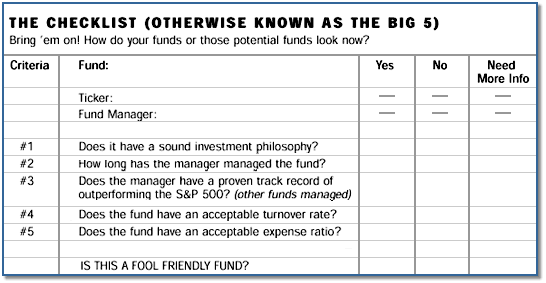 NOTE: If you have a mutual fund already, the odds are good that it does not meet our criteria -- very few funds do. That does not mean that should sell immediately. There are a lot of factors that must go into that decision.
It's important to be aware not only of expenses and performance, but also the quality of the managers. In the end, your returns from a fund come from the manager's ability to allocate profitably the assets under his charge.
Now to the more hands-on analysis. . .
5. Hand-on Analysis
It's crunch time!
We've helped you narrow down the field to the 7 essential things you need to look for in a mutual fund. A quick recap -- look for funds that have:
a. No loads
NOTE: If you have a mutual fund already, the odds are good that it does not meet our criteria -- very few funds do. That does not mean that should sell immediately. There are a lot of factors that must go into that decision.
It's important to be aware not only of expenses and performance, but also the quality of the managers. In the end, your returns from a fund come from the manager's ability to allocate profitably the assets under his charge.
Now to the more hands-on analysis. . .
5. Hand-on Analysis
It's crunch time!
We've helped you narrow down the field to the 7 essential things you need to look for in a mutual fund. A quick recap -- look for funds that have:
a. No loads b. Turnover of no higher than 50%
c. Expense ratio below 1.75%
d. A manager who has a proven track record of outperforming the S&P 500
e. A manager with a sound investment philosophy
f. A manager with a long tenure So how do you get at this information? It's easier than you think.