The Information Page
You will wake up there in five seconds, or click here:
www.oocities.org/doniacorp/prisoner/prisonerpage.html
"The world of Number 6 isn't much of a place. A little village, some pleasant shopping, a bit of culture. But in its own way it's quite sinister. Nobody leaves this town. No one even knows where it is. Its inhabitants don't have too much to say except 'Be seeing you.' And nobody, neither viewers nor residents, ever knows exactly what's going on."
Overview of "The Prisoner"
Rating the Episodes
Ordering the Episodes
Prisoner Fiction
Write a Letter from the Village (Fun with MadLibs)
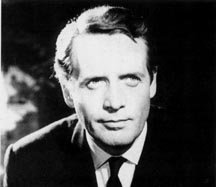
Patrick McGoohan was the highest paid television actor in the world when, in 1966, he walked away from his wildly popular series "Danger Man" ("Secret Agent" in the U.S.) to pursue a new project. Called “The Prisoner,” he envisioned it as a seven-episode story arc about a former spy held captive in a mysterious prison complex called the Village. Sir Lew Grade, legendary head of ITC Television, OK’d the idea, with the stipulation that a full series be made (to facilitate worldwide distribution deals). McGoohan got to work, and eventually 17 episodes of “The Prisoner” aired in 1967 (1968 in the U.S.).
From the beginning it was like nothing television had ever seen before. The opening credits lay out the incredible premise: McGoohan, looking tense and angry, drives a custom-built Lotus 7 to the underground headquarters of his employers (presumably British Intelligence). He turns in a handwritten letter of resignation, setting off a chain of events in which his official ID is eradicated and dropped in a bank of file cabinets. Meanwhile, he returns to his flat; we see him packing for an unknown destination. Outside, a mysterious black car pulls up to the curb; moments later, gas fills his living room; he collapses, unconscious.
Upon awakening, still in his living room, McGoohan’s character is disoriented. He creeps to the window and opens the blinds. The familiar London skyline has disappeared; in its place is an incongruously cheery resort town, an architectural playground on the coast of an unknown ocean. McGoohan – whose character we never know by any name other than Number 6 – has been transported to this place and installed in a tidy cottage meticulously copied from his own flat.
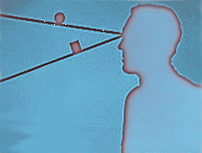
Who are his captors? The question is left tantalizingly ambiguous throughout the series. What do they want? Their standard answer: “We want information.” Specifically, they want to know why he resigned – information the Prisoner stubbornly refuses to give out. “I want to mind my own business,” he snarls, but the business of the Village, as his prison is known, is information: protecting it and extracting it, by any means necessary. The Village masters wage a systematic campaign to get at the knowledge in our hero’s head. Do they want to break him or convert him? They use various methods of physical, psychological and pharmaceutical torture, but are constrained by a directive from a never-seen superior: “Musn’t damage the tissues.”

There are no names in the Village. “For administrative purposes, everyone has a number. Yours is Number 6.” That includes the ever-changing string of Chief Bureaucrats, known collectively as Number 2. Number 6 resists this and other assaults on his individuality. In some episodes he achieves limited success – limited, of course, by his failure to escape the sunny confines of the Village itself. In other episodes, he is defeated, sometimes brutally, by his captors. Almost unheard-of for a television series at the time, in "The Prisoner," the hero does not always win in the end.
"The Prisoner" was a visually striking production, even for the psychedelic Sixties. From the brightly colored uniforms of the Village “citizens” to innovative quick-cut editing techniques, the look of the show was dynamic, edgy, and arresting. McGoohan was involved in every aspect of the show – he was known to be nearly obsessive in his attention to detail – and the result is a highly cohesive vision of a nightmare society in which technology and mysticism work hand in hand to erode the ideals of freedom, individuality, and the right to be left alone.
Many people have labored for many hours to keep interest in and – yes - information about "The Prisoner" alive and readily available. One of best sources for pictures, history, and updates is Six of One, the official Prisoner Appreciation Society. Point your browser to Six of One; you won’t be disappointed.
Patrick McGoohan, the driving force behind "The Prisoner," is a remarkable actor and a man of formidable intelligence and talent. His official home page recently was taken offline, but for a wonderfully comprehensive look at his life and his work, before, during and after "The Prisoner," check out Will Leslie's Unofficial Patrick McGoohan Home Page.
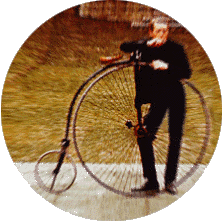
Patrick McGoohan Top 10
Bonus Link #2!
Larry Hall's "A Prisoner Christmas"
Latest updates at alt.tv.prisoner

