McDonnell-Douglas
F/A-18 Hornet |
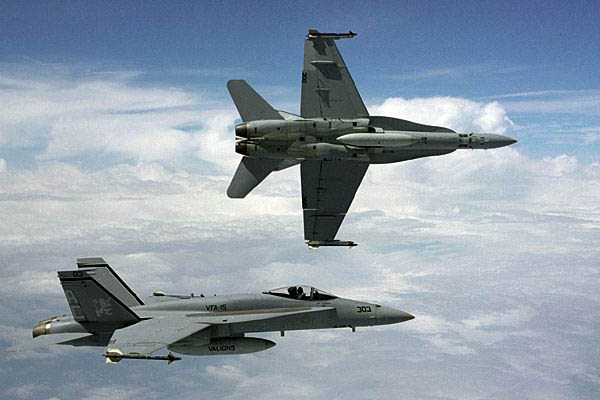
The F/A-18 Hornet evolved from the Northrop YF-17 "Cobra", which was
rejected by the US Air Force in favour of the YF-16. The F/A-18 is a twin engine, mid
wing, multi mission tactical aircraft. The F/A-18A and C are single seat aircraft. The
F/A-18B and D are dual seaters. The B model is used primarily for training while the D
model is the current Navy aircraft for attack, tactical air control, forward air control,
and reconnaissance operations. The latest models, the E and F were rolled out at McDonnell
Douglas on 17 September 1995 and are currently undergoing tests at the Patuxent Naval Air
Station in Maryland. The E is a single seater while the F is a two seater.
The Hornets are the U.S. Navy's close-in air-superiority fighter that defends aircraft
carrier task forces. They are also the Marine Corps' premier attack aircraft, supporting
its ground forces. Whether used by the Navy or the Marine Corps, the Hornet is the same
plane; the "F" and "A" designations simply describe its role as either
a fighter jet or an attack jet. The F/A-18 Hornets supplement the F-14
Tomcat in fleet air defense. They are also proudly flown by the United States Navy's
....
Blue Angels Flight
Demonstration Squadron.
Full scale development (FSD)
of the F/A-18 was rolled out at St Louis on 18 September 1978.The first flight took place
at Lambert Field, St Louis on 18 November 1978 with test pilot Jack E. Krings at the
control. The F/A-18 did not officially enter service until 1983. Since then, there have
been many improvements made to the single-seater fighter bomber over the years. 
The F/A-18 introduced a genuinely multi-role
capability. The pilot's well-designed cockpit has three multi-function CRT type displays
and true hands on throttle and stick (HOTAS) controls, enabling him to switch easily from
the air-to-ground role to air-to-air or defence suppression duties. The F/A-18's
dogfighting capabilities is remarkable due to the advanced wing design with large slotted
leading edge root extensions (LERXes) which give the F/A-18 excellent turn performance.
Similarly, the multi- mode APG-65 radar is as effective at putting bombs with high
accuracy on target as it is at detecting and engaging multiple airborne targets.
The F/A-18C is the improved variant of the single-seat F/A-18A and was first flown in
September 1986. It has a very similar cockpit configuration to the F/A-18E/F single- and
two-seat Super Hornet scheduled to enter U.S. Navy squadrons in 2001. The primary
difference between the cockpit of the Super Hornet and earlier Hornets is the installation
of the touch screen upfront control panel below the Smiths head-up display. The F/A-18E/F
Super Hornet offers carrier pilots a fighter/attack aircraft that has improved
performance, longer range, greater weapon payload, a slower landing speed and overall
better handling characteristics.
The Marine Corps became the first force to deploy an operational Hornet squadron in
January of 1983. The "Black
Knights" of VMFA-314 were the first front-line F/A-18A unit . By the way,
VMFA-314 was also the squadron that featured in the film "Independence Day".
The
Marines pride themselves with this motto:
"First
to fight, last to leave."
| F/A-18C Specifications |
| Length: |
17.07 m |
| Height: |
4.66 m |
| Wingspan: |
12.31m |
| Wingspan
( folded ): |
8.38 m |
| Wing
area: |
37.16
sq.m |
| Performance |
| Empty
weight: |
10,455 kg |
| Take off
weight for fighter mission: |
16,652 kg |
| Take off
weight for attack mission: |
23,541 kg |
| Maximum
speed: |
Mach 1.7+ |
| Rate of
climb: |
13,715 m
per minute |
| Combat
radius: |
over 400
nm ( 740 km) |
| Range
w/external tanks: |
2,537 km |
| Propulsion |
Two F404-GE-402 enhanced turbofan engines.
each rated at 78.73 kN with afterburning. |
| Armament |
|
One 20 mm MK-61A1 Vulcan cannon
with 570 rounds. Maximum
ordnance up to 7,031 kg.
In its fighter configuration, the Hornet carries
- AIM-7
Sparrow on the underwings and
- AIM-9
Sidewinder air-to-air missiles on wingtip racks.
For attack/fighter bomber
missions, the F/A-18 Hornet's armourer can select from:-
- conventional or nuclear bombs,
- AGM-65 Maverick
air-to-ground missiles,
- AGM-84 Harpoon
antiship missiles,
- AGM-88 HARM
antiradar missiles.
|
Click on the thumbnails below to view a larger image. |

|
 |
 |
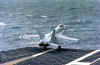 |
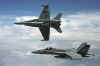 |
| Bombs away ! |
Deck - launching |
Catapulting off |
2-ship Hornets |
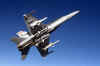 |
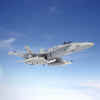 |
 |
 |
| Lethal weapons |
Bandits 10 o'clock ! |
Guardians of the sky |
Missile launched !
|
| Hornet Variants |
| P-530 |
Early
development design, dubbed "Cobra". |
| YF- 17 |
Lightweight
Fighter (LWF) contest variant. |
| F/A-18A |
First
production single-seat aircraft. |
| F/A-18B |
First
production two-seat training aircraft. |
| F/A-18C |
Enhanced
single-seat variant. |
| F/A-18D |
Two-seat
variant, night attack aircraft for the USMC. |
| F/A-18E |
Latest, most
advanced single-seat variant. |
| F/A-18F |
Latest, most
advanced two-seat variant. |
| Hornet
Operators |
| Country |
Total
Aircraft |
F/A-18As |
F/A-18Bs |
F/A-18Cs |
F/A-18Ds |
| Australia
|
72 |
60 |
12 |
0 |
0 |
| Canada |
1138 |
98 |
40 |
0 |
0 |
| Finland |
64 |
0 |
0 |
57 |
7 |
| Kuwait |
40 |
0 |
0 |
32 |
8 |
| Malaysia |
8 |
0 |
0 |
0 |
8 |
| Spain |
75 |
57 |
18 |
0 |
0 |
| Switzerland |
34 |
0 |
0 |
26 |
8 |
| Total |
431 |
215 |
70 |
115 |
31 |
Hornet's

This page was edited on Friday, 17 January 2003.

