THE VARANGIAN HANDBOOK
THE VARANGIAN GUARD
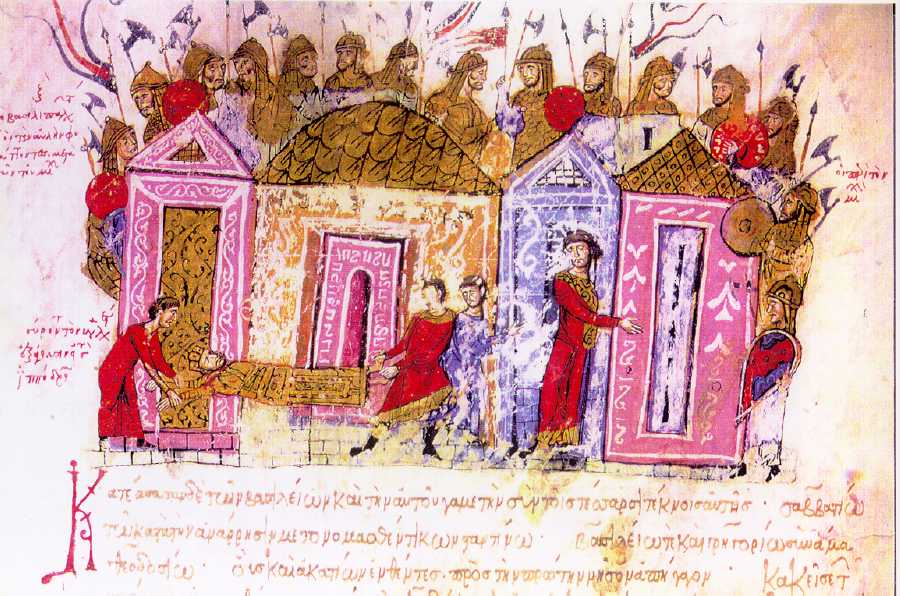
A contemporary illustration of the Varangian Guards from the Chronicle of John Skylitzes (late 12th century)
HISTORY:
The Varangian Guard was an elite force of Viking warriors who served the Byzantine (Eastern Roman) Empire.It is believed they acted as the Emperor’s personal bodyguards from the late tenth to the early 13th centuries CE.
From the early 9th century, Viking adventurers and traders travelled from Scandinavia down the rivers of Russia, raiding and trading as far south as the Black Sea and as far east as Baghdad and Bulgar on the Caspian Sea. They founded settlements and principalities in Russia – Kiev, Novgorod and Ladoga, and became the overlords of a largely Slavic population.
They were known as Rus, and gave their name to Russia. Those who traded down the rivers also took the name Vaeringir - sharers in an oath. From these came the name Varangian . Several times the Vikings of Russia unleashed massive attacks on the Empire, but independently of this, Rus warriors began joining the Imperial army from the mid 9th century.
The origin of the Varangian Guard as a separate unit is thought to date to 988 CE, when Tsar Vladimir (from Old Norse Valdemar) of Kiev sent 6000 Swedish warriors to Emperor Basil (Vasileos) II as part of a treaty agreement. Vladimir had imported these warriors to help him put down a rebellion, and when he had succeeded found himself with 6000 unemployed warriors on his hands, armed to the teeth. It is quite likely he killed two birds with one stone by sending them to Basil, ridding himself of a potentially troublesome army while gaining concessions (such a an Imperial Princess to wife) from the Empire.

Basil made great use of his guardsmen in his campaigns, in Syria, Asia Minor and Bulgaria from 988 till his death in 1025.
The Vikings were tall, ferocious and exceptionally loyal. They were known by the Byzantines as the pelekephoroi, axe-bearers, from the large two-handed axes they used in battle.
They were used as shock troops, often held in reserve until no other means would serve. At Beroe in 1122 under John II, they turned the tide of the battle. The Patzinaks had made a fort of their wagons, which had proved impregnable against attacks of Greek, Norman and Flemish contingents. The Emperor was persuaded to send in his “winebags” – his Varangians – against the wagon fort. In a ferocious charge with their axes, they broke into the fort and forced a victory.
The Varangian Guard was an élite group, and membership was not automatic. When Thormoth Indrithason wanted to join the Guard, the Emperor thought he was too small and said he would not be able to do a man’s job. He was convinced otherwise by seeing Thormoth slaughter an enormous bull, hewing its head off with a single stroke.
In 1034 the nineteen year old prince Harald Sigurdsson (Hardrada) of Norway entered Imperial service, bringing 500 warriors with him. Harald ‘served on the galleys with the force that went into the Grecian Sea’. He took part in campaigns in Sicily and southern Italy land was awarded the Byzantine rank of Manglavites. He was later raised to the rank of Spartharokandidatos for his part in crushing a Bulgarian revolt. He may have taken part in attacks on Arab pirates who preyed on Byzantine shipping, and perhaps even visited Jerusalem.
In 1042 he was been imprisoned by Emperor Michael V, probably for corruption -the sagas make great mention of the large amount of riches Harald had accumulated while in Byzantium - but released when Michael, who was very unpopular, was overthrown and blinded by the mob. Uncharacteristically, even the Varangians took part in his overthrow. Shortly afterwards Harald left for Russia and then Scandinavia to claim the throne of Norway. He reigned for 24 years, dying in 1066 in an unsuccessful invasion of England, three weeks before the Battle of Hastings.
After the Norman Conquest of England, contingents of English exiles joined the Varangian Guard. They had the opportunity to face their old foes in 1081, when Robert Guiscard, the Norman adventurer who had carved out a realm in southern Italy, invaded the Empire, besieging the Adriatic port of Dyrrakhion (modern Durres in Albania). The initial charge of the Varangians pushed the Normans back to the sea shore, but they became separated from the main body of the army. Exhausted, they took refuge in the Church of St Michael, but the Normans set fire to it and most died in the flames. The Empire continued to strenuously oppose the invasion, culminating in the Battle of Larissa, where the tide turned. The invasion ground to a halt and fell apart, and Dyrrakhion was back in Imperial hands by 1084.
The Varangians were stationed at various places within Constantinople. They are known to have had quarters at the Brazen Gate (Khalke), in the Imperial Palace of Boukoleon, at the Vlakhernai Palace at the northern end of the Land Walls, and north of Hagia Sofia, by the Bosphorus Straits, near where the Topkapi Palace is today – possibly at the Mangana Palace, or the Hodegon monastery, or perhaps both.
Though very loyal, they were known for their drunkenness, and they could be unpredictable and troublesome. In 1000 CE while on campaign together, an argument between a Varangian and an Iberian soldier over a bale of hay escalated into a huge fight, in which the Iberian Grand Prince was among thirty Georgian men of rank killed.
In 1032 a soldier “of the Russian people” sent on an errand to the Emir of Harran lost his temper and took a swing at the Emir with his axe.
In one incident in 1077 they even tried to kill Emperor Nikephoros Botaniates. A band of Varangians stationed in the Imperial Palace got drunk and attacked the Imperial party, killing one of the Emperor’s companions with an arrow and wounding others. The Emperor, an old warrior, was able to defend himself long enough for help to arrive. Curiously the punishments handed out to the offenders seem to have been relatively mild – perhaps reflecting the importance of the Varangians to the Emperor.
As well as palace Guards and shock troops, the Varangians appear to have been used as Imperial “bully boys”. Because they were independent of City politics, and had no loyalties except to the Emperor, they could be used for duties the Byzantine troops were unwilling to carry out, such as arresting political prisoners, and even a troublesome Patriarch the Emperor didn’t like.
After the catastrophic battle of Manzikert in 1071, when Emperor Romanos Diogenes was defeated and captured, the Varangians were used to terrify the Empress into acquiescence with the coup which toppled Romanos and replaced him with Michael VII. The Varangians are not mentioned by name in accounts of Manzikert, but given the scratch make-up of the army that fought there, there is a good chance that a contingent was present. If so, they are not likely to have survived.
During the Fourth Crusade of 1204, a force of Franks and Venetians attacked and sacked Constantinople. The Varangian Guards were in the forefront of the City’s defense, and repulsed several attacks. However, as the Franks broke through the walls and advanced into the City, and the Emperor fled, the Varangians tried to bargain the new Emperor into giving them a pay rise before they would fight for him.
The fall of the City to the Franks effectively spelt the end of the Varangian Guards. A pale echo survived to serve the Emperors in exile in Nikea, and are mentioned in campaigns against its enemies. There are indications that the short-lived Frankish Latin Empire tried to continue the Varangian tradition as well. But the glory days of the Varangians had passed – the Viking period was over in any case, and henceforth mercenaries hired by the Empire came from other sources – Catalunia, Genoa and elsewhere. However, there are survivals from the Varangians to our own times – several surnames hark back to these times, including Varangos and Varangopoulos (son of the Varangian).
At least one Varangian left his mark in Constantinople. In the cathedral of Hagia Sofia the name Halfdan is scratched in Viking runes on the railing of the southern gallery. It is interesting to think of a Varangian Guard, assigned to protect the Emperor, bored witless by a church service in a language he didn’t understand, scratching his name to pass the time. One wonders if he was ever punished for it.
The Guard were renowned for their loyalty to the Emperors, an unusual thing in a society as riddled with intrigue as Byzantium. They stayed in Imperial service for over two centuries, seeing the greatness and decline of the Byzantine Empire. The New Varangian Guard models itself on the activities and lifestyle of these times.
Deciding Who To be
HANDBOOK
INDEX PAGE
Copyright (c) 2002 by Steven Lowe.
The material in this page is for research purposes only. Permission to reproduce material from this manual with author acknowledgment is granted for non-commercial purposes
Last Updated 4 November 2002
