True Story of Creation...
The Birth of the Sun and Allied Phenomena...
Modern science does not provide with any specific knowledge about the birth of the Sun. It only says that the sun was born front a gas cloud in a vast volume of space. It gradually contracted and grew denser, and thus reached present temperature and pressure. Therefore the knowledge about birth of Sun is very limited.
Special Characteristics of the Sun...
The Sun us 1 300 000 times larger than Earth and 745 time heavier than combined mass of all planets. Its surface temperature is 6000°C while temperature at the core is 15 million°C. The black spots on the Sun are regions of lower temperature an hence, appear dark. The flames rising from the surface reach height several thousand miles. The extreme high temperature is due to nuclear reaction inside the core. The nuclei of Hydrogen combine to form Helium nuclei. Every second 4mn tons of matter is converted to energy. thus illuminating all planets and moon million of miles away. Modern observation shows that the Sun revolves around a Galaciatic core at a speed of 250km/s. It takes about 200-270mn yrs to complete one revolution. (Vedas give a precise figure of 240mn yrs.)
However the difficulty with the modern view is...
1. Is it possible to attain a temperature of 15mn°C merely by process of gravitational collapse ?
2. Did not the temperature inside the sun reach the stage of balancing forces due to gravitational collapse before attaining such high temperature ?
3. Could gravitational collapse bring nuclei as close as 10-12cm necessary for nuclear interaction ?
4. What role did the massive Galaciatic core play in the birth of Sun ?
The Vedic Truth of Birth of Sun...
The Vedas say that the elementary particles (mainly consisting of protons and electrons) were constantly formed from the "space energy". Accumulation of these created the sun in its primordial form. Galaciatic core was formed from the accumulation of these primordial suns. Thus many suns moved to a point to give birth to Galaciatic core. Those which did not were forced to revolve around "him" due to gravitational pull. The forces of Gravitational collapse, electromagnetic forces and the nuclear forces made the Galaciatic core fully "ripe" i.e. it had gained extremely high temperature and pressure. All Galaciatic core of the universe are called "first bearers". They bear suns that give birth to planets and finally planets give birth to the moons.
The first stage of interaction of the elementary particles gave birth to "Aryama" (neutrons). After being formed in large numbers under forces of gravitational collapse they came close enough to form light nuclei as deuterons and the alpha particles. Nuclear energy thus released in large amounts was one of the "fuels" of generation of high temperature in Galaciatic core.
But soon the process of creation came to a standstill since, generation of high pressure and temperature was balance by gravitational collapse. The Galaciatic core then began to rotate about its own axis. Also its mass kept on increasing due to transformation of "space-energy" into matter. Very high centrifugal force was responsible for the birth of the suns. The first generation of the suns were "Trits" i.e. the suns that gave birth to planets which in turn gave birth to moons. The next generation of suns to be born were "Dwits" i.e. the suns that gave birth to planets. But the planets thus formed were not active enough for the birth of moons. "Ekats" the third generation suns without planets and thus also moons . The "productivity" of the suns dropped an account of falling pressure and temperature after birth of each sun.
The Vedas mention the twin of the our Sun which share the same orbit. It has a retinue of planets as our Sun. It could be opposite to the Sun in its orbit and is 5000 light years away. An experimental research for this twin is important for the search of extra terrestrial intelligence in the Universe.
The Two Mothers of the Sun...
The two mothers of the Sun are space energy and Galaciatic core. The Sun is the embryo of space energy and gets transplanted in Galaciatic core in an immature and ripe state. It matures from the unripe state under extreme conditions and then delivered. The Sun is fed by radiations consisting of light and heat.
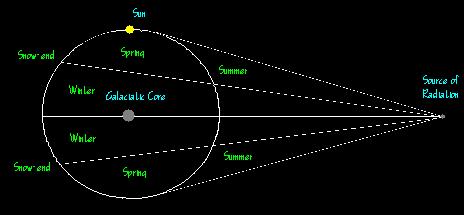
The life span of Sun (and its twin) is claimed to be 100 cosmic years. According to a Mantra in Vedas, all the suns in neighborhood of ours have same life span. Atharva Veda gives clue that one cosmic year is equivalent to 20bn terrestrial years. Also mentioned is the phenomenon of Cosmic Seasons. The four seasons are winter, snow-end, spring and summer. During winter the temperature of the sun falls to 5000°C while in summer the temperature rises to 7000°C. This is due to varying degrees of solar activity occurring in the sun, due to continue particle radiation which falls from central part an neighboring suns. But the greatest contributor is "powerful source of radiation" where the stars have surface temperature as high as 30 000°C. "Lubhdhak" is one such source of strong radiation.
Solar Seasons in two halves of the sun's orbit.
Per half cycle, the duration of the seasons are:
Winter - 12mn yrs
Snow end - 24mn yrs
Spring - 36mn yrs
Summer - 48mn yrs
The actual rise and fall of the temperature could be greater than 1000°C. During solar winter the temperature could fall by 2000°C, since, the sun would be 50 000 light years away than it was in summer. The sun loses its brightness and appear dull. This would be almost death like for the sun as glowing luminary.
e-Mail me at enchantedinfinities@yahoo.com