HALL OF ANTIQUITIESOF THEINTERIOR SYRIA
|
TELL REF’AT ( ARFAD(Excavations of the English Mission Tell Ref'at (Arfad) lies at a distance of 35 Km to the North of Aleppo . It was excavated by an English Mission , conducted by Mrs . Seton Williams , who carried out a number of campaigns at this mound . Despite the importance of the mound . this mission has not been able to conduct its explorations regularly and on a wide scale . It is hoped that the future excavations at this, very tell , would bring to light sufficient data in archaeology and history concerning a particular period about which we need more information . Through the excavations which have been carried out so far , we were able to determine the different strata of this tell . They are from top to bottom as follows . 1st Stratum : goes back to the Roman and the Hellenistic Periods ( from the 4th Century B. C. to the 1st Century A. C. ) 2nd Stratum: goes back to the Roman and Hellenistic Periods (the 4th Century B.C. ) and the Assyrlan and Aramaean Periods (between the 10th and 6th Century B. C. ) 3rd Stratum : from the Aramaean era down to the Bronze Age ( between the 14th and 12th Century B. C. ) 4th Strum : goes back to the Bronze Age ( between the 23rd and 20th Century B. C. ) 5th Stratum : goes back to the Jew Stone Age ( Neolithic) i.e. the 5th and 4th millennium B. C.
|
||||||
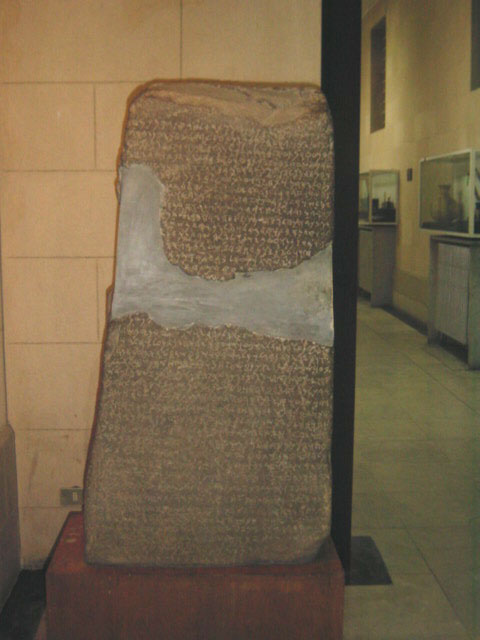
| Aramaean Stole of Sfire : This big basalt stele was discovered at the Canal of Sagin and , later on was transported to Sfire a village near Aleppo . This stele is considered to be the most ancient document written in Aramaic . Its letter forms are akin to the ancient Phoenician inscriptions . They were engraved with care and in a manner which makes them easy to read from afar . The beauty of the calligraphy gives us a good idea of the Aramaean script of the 8th century B. C. The stele reveals the text of a treaty concluded between two kings of North Syria : ( Bar-gayah ) , king of Kittak , and ( Mati-El), king of Arfad, ( ? Tell Ref’at). King Mati-El whose name signifies (God preserve) is known in the Assyrian texts as the adversary of Tiglath-Pilser I who destroyed the kingdom of Arfad in 740 B. C. after a siege of four years . The treaty in question threatens Mati-El and his kingdom with severe punishment in case of the breach of his faith . The text of the accord is a long inscription covering the two faces of the Stele . The inscription reads :
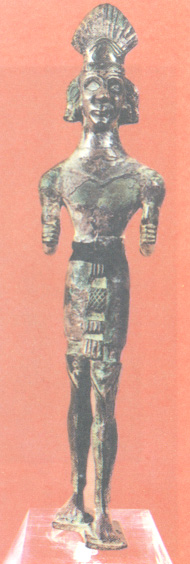
Bronze statue of a Baal a god of the Phoenicians : It was entirely recovered with a thin coat of silver , nothing of which remained save some traces . The god is arrayed in a short loin-cloth , tightened round the slim waist by a belt . The striped part of the belt is divided into four zones and is hanging down from the front by three grooves , which were formerly encrusted with gold or ivory. The legs are in the attitude of the march . The feet are bare . The god is standing on a pedestal . The face is beardless and the lineaments express youth and force . The eyes and eye-brows were encrusted . The hair is hanging loose and ending with spiral locks around the neck .He is putting on a crown surrounded by a band . The crown ends with a flat semi-oval form on which the sun-rays are engraved . The neck looks strong , the shoulders broad and the chest large . The arms are stretched forward and the palms are closed , possibly they were holding something (a weapon or an attitude of god) lost with the passage of time . End of the 2nd millennium B.C. H 43.3 cm. W. 97 cm.
|