ISLAMIC ARAB GLASS
A
historical glance of development of glass making :
The art of glass making flourished in Syria before Islam.
Its chief centers were Sidon , Tyre and Antioch. The industry continued to
develop during the Islamic-Arab periods where other important centers arose
at Ar-Raqqah . Aleppo and Damascus . The industry then maintained the
conventional methods :
-
Glassblowing , i.e. the method known in Syria since the Roman Period.
-
Ornamentation of glass with thin or thick glass threads and sometimes with
cords forming animal motifs.
-
Ornamentauon of glass with discs and additional protuberances.
-
Revival of the old technique used before the discovery of blowing ( glass
decorated with threads sunk inside the glass). The technique is summed up
as follows: The glassworker prepares a mould from wet sand pressed on a
certain form. An adhesive substance may be poured on it to
secure its cohesion. The mould is then dipped in the fused glass by
means of a rod fixed at its tip. Sometimes the fused glass is poured on
the mould until a layer of glass covers it and in that manner the vessel
is formed . The vessel is decorated with a thread
of soft glass to be wound round it before putting it back into the
furnace. when the vessel is taken out of the furnace, the thread is drawn
by a tongs to create the festoons. After that the vessel is reheated and
rolled on a solid object so that the festoon should penetrate the body of
the vessel.
-
Blowing of glass in mould ornamented with motifs in
relief.
-
Incision of the vessel surface to create various motifs.
-
Filling the surface of the thick or crystalline vessel to create motifs by
means of cutting go get uneven surfaces. This method is usually executed
on crystal and is considered the most important industry of glass. Egypt
was famous of this industry during the Fatimid Period. The pieces of this
variety are considered the most important Islamic masterpiece.
-
Ornamentation of glass with decorations having golden luster : This
industry started in the Abbasid Age. The glass-worker prepared a coat
formed of the silver oxide with which he decorated the glass vessels.
Ar-Raqqah and Fustat were famous of this particular industry which was not
known in Damascus. However I have deciphered these words on a cup found at
ar-Raqqah " Made in Damascus ". I have pointed out this point in my
commentary on the glass of ar-Raqqah.
-
Gilding of glass : by mixing the powder of gold with mercury. The vessel
is coated with this mixture and put in a furnace.
The mercury is burnt and the gold remains fast. This method was not known
before Islam: The Byzantines used to apply a layer of gold to the glass.
This art was current in the Abbasid Age : Al-Washha mentions that "
Aliyyah, daughter of al-Mahdi " used to write verses in gold on the cups.
If this is true, it means that gilding existed in the second century of
al-Hijra. In fact we have not recognized any gilded piece of this Age.
There is only one of the 5th C.A.H. = 11 A.D. which we will refer to duly.
-
Overlaying of glass with gold and enamel : Opaque glass substance mixed
with lead, to be crushed well and mixed with the oxides of colored metals,
and is being melted a little in water. The decorations are overlaid with
it before being put in the furnace .
It is noteworthy that the art of enameling on glass is the most important
achievement of the Arabs and Muslims in the 6th century A.H. = 12 A.D. The
archaeologists have been able to distinguish three centers for the
art of enameling : The oldest of which is ar-Raqqah, the second is
Aleppo and the third is Damascus. Three types of glass are attributed to the
above noted centers : ar-Raqqah type (6 - 7 A.H.). The first type of Aleppo
(6 - 7 A.H.). Both dates correspond with. the Ayyubid Period. The second
type of Aleppo (7 - 8 A.H. ) and the type of Damascus ( 7 - 9 A.H.). Both
dates correspond with the Mamluk Period.
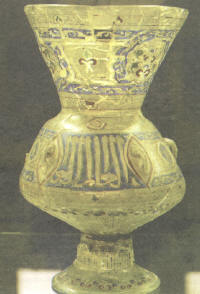
Mosque lamp overlayed with enamel and gold
7-8 century A.H. = 13-14 A.D.
Found at Hems |
