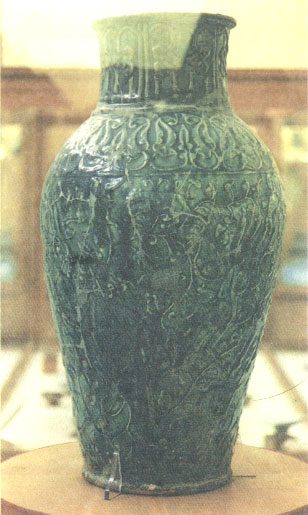
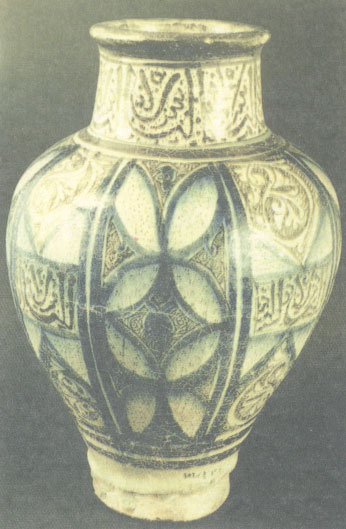
HALL OF THE CERAMIC
Ceramic is made of pure, compact clay. The best quality of clay is the
Kaolin which is found in China and in certain regions of Europe like
Bohemia. The clay of Syria is not as good as the Kaolin, that is why it
is always coated with a whitish layer. As soon as the vessel is modeled
and backed, it is coated with this material. After that, the vessel is
again baked, colored and dipped in a solution of Mardasanj ( soluble
powder in water ).When the vessel is placed in the oven, a glassy
material flows on all its surface. This coat of
glass, named enamel, protects the vessel and enhance its beauty.
Man discovered glass by chance in Egypt and in Mesopotamia in the 3rd
millennium B.C. In fact, when the mineralls of copper found, the silica
attached to the copper appeared on the surface. It was transformed into
crystals of silica mixed with the oxide of copper of a bluish green
color. At the beginning this material was thrown out as useless. Later
on, man thought of coating the pottery with this beautiful blue material
when it was in the state of liquidity and as such a new and useful
industry was discovered. The new discovery was developed and used in
Egypt, Mesopotamia, Syria and Persia during the second millennium B.C.
Persia has practiced the ceramic craft since the 7th C B.C. They made
vessels, statues and panels out of this material. They also formed
beautiful mural decorations of small squares.
The Arabs and Muslims learnt this craft from Persia and Byzantium. They
manufactured ceramic vessels of different forms
and dimensions according to their needs, notably plates, bowls,jars,
amphorae, pitchers, goblets, lamps, flagons, inkstands, squares, steles,
grave-stones and pegs etc.
The production of ceramic developed considerably in the Muslim world of
the 5 - 9 A.H. = 11 - 15 A.D. The Arab travelers told us a lot about its
abundance and its modest price in spite of its value and beauty. Certain
towns ( Qashan, Raqqah, Damascus)
were famous for the manufacture of the different forms of ceramic which
was named after them: ceramic of Qashan, ceramic of Raqqah and ceramic
of Damascus.
|