A
total of 11,046 species of plants and animals are threatened,
thus facing a high risk of extinction in the near future.
This includes twenty four percent (one in four) of mammal
species and twelve percent (one in eight) of bird species.
The total number of threatened animal species has increased
from 5,205 to 5,435.
Since the last assessment in 1996, Critically Endangered
primates increased from 13 to 19. Freshwater turtles, heavily
exploited for food and medicinal use in Asia, went from
10 to 24 Critically Endangered species in just four years.
(2000 IUCN Red List of Threatened Species)
more info >>
|
|
nvThis
months featured animals
 The
population of the beloved koala has dropped by 90% in less
than a decade! This is due to the destruction of their natural
habitat, a narrow crescent on the eastern coast of Australia.
Logging, agriculture and urban development have not only
reduced the area available to them, but added other dangers.
Their habitat has been criss-crossed by roads, resulting
in many road kills, and attacks by neighboring pet dogs
now are frequent. Disease, too, has taken its toll. The
population of the beloved koala has dropped by 90% in less
than a decade! This is due to the destruction of their natural
habitat, a narrow crescent on the eastern coast of Australia.
Logging, agriculture and urban development have not only
reduced the area available to them, but added other dangers.
Their habitat has been criss-crossed by roads, resulting
in many road kills, and attacks by neighboring pet dogs
now are frequent. Disease, too, has taken its toll.
more
info>>
Rhinoceros
- Appendix I
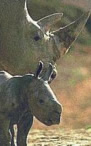 In
the 1970s the demand for rhino horn, to be carved into dagger
handles, caused a major decline for this animal. A ban in
rhino horn trade is now in place, but the trade still exists
on the black market. In the 1960's rhino populations were
estimated at 100,000, there are now about 13,000.
In
the 1970s the demand for rhino horn, to be carved into dagger
handles, caused a major decline for this animal. A ban in
rhino horn trade is now in place, but the trade still exists
on the black market. In the 1960's rhino populations were
estimated at 100,000, there are now about 13,000.
more
info >>
Tiger
- Appendix I
Three out of the eight sub-species of tigers are now extinct.
The five remaining sub-species are also in danger of becoming
extinct. Due to poaching their numbers have dramatically
declined and despite the warnings poaching still continues.
At the turn of the century there were 100,000 tigers, now:
Bengal tiger: 3,000-4,000
Indochinese tiger: 1,000-1,700
Chinese tiger: fewer than 30
Siberian tiger: 200 in the wild
Sumatran tiger: 400-500
Caspian tiger: extinct
Javan tiger: extinct
Bali tiger: extinct
more
info >>
Giant
Panda - Appendix I
 Fewer
than 1,000 giant pandas can be found in the forests of China.
Since the solitary animals live among steep, rugged terrain,
they can easily hide from researchers. So scientists collect
hair and fecal samples that will allow them to genetically
identify which panda is where. Fewer
than 1,000 giant pandas can be found in the forests of China.
Since the solitary animals live among steep, rugged terrain,
they can easily hide from researchers. So scientists collect
hair and fecal samples that will allow them to genetically
identify which panda is where.
more
info >>
Wolves
- Appendix I & II
Today
about 2,200 wolves live in the wild in Minnesota, fewer
than twenty on Lake Superior's Isle Royale, about 120 in
Michigan's Upper Peninsula, 120 in Wisconsin, and about
240 in the northern Rocky Mountains of Montana, Idaho and
Wyoming. Wolves currently are being reintroduced to Arizona
and New Mexico. An occasional wolf is seen in Washington
State, North Dakota, or South Dakota. Populations fluctuate
with food availability and strife within packs, and, primarily,
to killing by people.
more
info >>
|
|
|
Bald
Eagle (Haliaeetus leucocephalus) - Appendix I
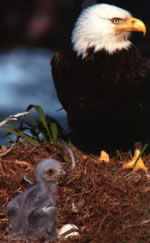
Cause:
Habitat destruction and degradation, illegal shooting and
contaminations of its food source, most notably due to the
pesticide DDT.
Location: Dramatically varying populations exist in all
states but Hawaii where the species is not known to exist.
Numbers: Maybe as many as 80,000.
more
info >>
Kirtland's
Warbler (Dendroica kirtlandii)
Cause: Limited habitat and cowbird parasitism (cowbirds
lay their eggs in warbler nests and the warblers then raise
cowbird young instead of their own.
Location: Jack pine forest area in Michigan.
Numbers: Under 1000.
more
info >>
Least
Tern (Sterna antillarum)
Cause: Habitat loss or degradation due to development of
river system habitat, and disturbance by recreational activities.
Location: Arkansas, Colorado, Illinois, Indiana, Kansas,
Kentucky, Louisiana, Missoui, Mississippi, Montana, Nebraska,
New Mexico, North Dakota, Oklahoma, South Dakota, Tennessee
and Texas.
Numbers: As little as 1000 nests.
more
info >>
Peregrine
Falcon (Falco peregrinus) - Appendix I
Cause: Chemical use of DDT.
Location: Historically, they were common in the Appalachian
and nearby mountains and valleys from New England to Georgia,
Upper Mississippi River valleys, and the Rocky Mountains.
Others live in mountain ranges and islands along the Pacific
coast, from Mexico to Alaska and the Arctic tundra.
Number: Varying reports.
more
info >>
Piping
Plover (Charadrius melodus)
Cause: Habitat loss or degradation due to prime habitat
along coastal beaches where commercial, residential and
recreational development commonly occurs. Nest disturbance
and predation are also factors due to people and animals.
Location: Found from Montana to Maine in the north, Texas
to Florida in the south and along the entire east coast.
Numbers: 5400 adults in US & Canada.
more
info >>
|
Spanish
Lynx - V Endangered
- Appendix I
The Spanish lynx is considered to be the most endangered
feline in the world. Hopes are that it will not become
the first extinction of a wild cat species for at least
2,000 years.
To some the Spanish lynx is not a valid species but a
sub species of the Eurasian lynx, however they are generally
smaller than their northern counterparts and their yellow/brown
coat is lighter in colour and the spotted markings more
noticeable. Although the animal is protect in the reserve
it is still legal to hunt it elsewhere.
more
info >>
Cheetahs
- Endangered - Appendix I
At
the turn of the twentieth century, scientists estimate
there were approximately one hundred thousand cheetahs
living in the wild. Over time, their population began
to diminish not only because of the domestication of their
traditional habitat, but also because the ranchers and
farmers considered the cheetah as a danger to their domesticated
stocks and killed them as a stock protection measure.
Member
states of the Convention on International Trades in Endangered
Species of Wild Fauna and Flora listed the cheetah on
Appendix I in 1975. According to the Redlist of the International
Union for Conservation of Nature and Natural Resources
(IUCN), the wild cheetah population currently ranges between
9,000 and 12,000 thousand. Namibia is home to the largest
cheetah population (approximately 2,500).
more
info >>
|
|