William Blake

In English - In Spanish (Text Only) - Some Poems

William Blake (1757-1827) is considered one of the greatest and most original English poets, painters and engravers. Son of a hosier, he was born on 28th November 1757 in London, where he lived almost all his life. He grew up among what he chose to read and his father's teaching about Emmanuel Swedemborg and his theological and philosophical movement. When he was ten years old, he started his drawing studies, what took him to be the learner of the engraver James Basire as soon as he was fourteen, with whom he used to draw sculptures that he used as a model and begun knowing better and praising a more gothic art.
Almost completely self-taught, he tried to study in the Royal Academy but, finally, he decided to quit the institution owing to his reluctance to accept the aesthetic rules of the school. In spite of that, he kept on having excellent relations with academics as the neoclassic sculptor John Flaxman and Henry Fusely, from whom he realised of the importance of the precision in art.

In 1782 he married Catherine Boucher and, in 1784, he established his own print shop without enough commercial success so as to maintain it open more than three years. In spite of this first "defeat", his gifts as engraver and illustrator, his revolutionary technique of "Illuminated Printing" (an impression with a copper plate whose characters have been previously delimited with acid) and, by the year 1784, a shop he founded together with his brother Robert, enabled him to live in wealth during all his life.

William Blake Portrait

William Blake begun to write poetry at the early age of 12 and he gathered his first works in the a volume called "Poetical Sketches", as a collection of youthful, lively and innocent verses. This first book was not widely appreciated in the society of the time, since they have been inspired in the Elizabethan style, as a contrast with the Baroque- in fashion in that moment- that Blake despised. For his dislike for all that the Neoclassicism represented, he is also called a "Pre-romantic" artist. In those early pieces of poetry, Blake had also shown a vague influence of his previous lectures, among which we may highlight Shakespeare's plays and Dante Aligheri's "Divina Comedia".
In 1789 he publishes was would be his most popular poems, the "Songs of Innocence" and, as a culmination of a saga, in 1794 he made public his "Song of Experience". Both works were the detonant for William Blake beginning to fashion what would be his most important artistic works, illustrating his own poems.

The "Songs of Experience" were for him a way of manifesting his pessimism and disillusioned of Human Race and its behaviour. Meanwhile, he spent his time in writing what would be his "Prophetic Books" among which we find large poems as "The French Revolution" (1791); Visions of the "Daughters of Albion" (England) and "America, a Prophecy" both in 1793, "Europe, a Prophecy" and the "Book of Urizen" (1794), in which the author highlights the evil and obscurity of politic, social and Theological tyranny. "The Book of Thel" and "The Marriage of Heaven and Hell" were other productions in the same period where it is as remarkable the influence of the Bible than that of Milton, whose works Blake used to illustrate.
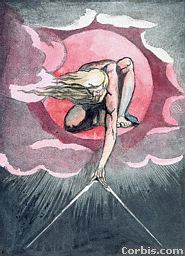
"Ancient of Days": frontispiece made by Blake for "Europe".

He also wrote "The Book of Los", "The Song of Los" and "Vala or the Four Zoas" (redone by the year 1800). His disagreement with life in those times was obvious in every one and each of the poems and made him create his own mythology of capricious gods that had created the world by an evil mistake with the presence of a unique saviour o renewing force, Christ. The Mankind would be saved owing to its ethics and moral, for its faith (quoting Jesus' own words) and not by reason.

In the year 1800 Blake left his house in Lambert, in London outskirts, to live in the seaside town of Faltham, in W.Hayley's home.

Blake ceased to be on August 21st 1827, having renewed completely its own poetry, creating new characters, backgrounds, ways of writing, new lines of free verses, points from which make reality clearer and even his also mentioned form of impression.
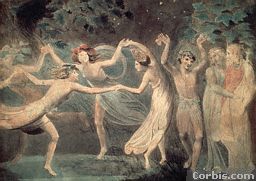
"A Midsummer Night's Dream", by William Blake inspired in Shakespeare's play.

"Behemoth and Leviathan" from Blake's "Book of Job".

Hear the Voice (Intro to Songs of Experience)

Hear the voice of the Bard,
Who present, past and future, sees;
Whose ears have heard
The Holy Word
That walk'd among the ancient trees;

Calling the lapsàed soul,
And weeping in the evening dew;
That might control
The starry pole,
And fallen, fallen light renew!

'O Earth, O Earth, return!
Arise from out the dewy grass!
Night is worn,
And the morn
Rises from the slumbrous mass.'

'Turn away no more;
Why wilt thou turn away?
The starry floor,
The watery shore,
Is given thee till the break of day.'

The Tiger (Songs of Experience)

Tiger, tiger, burning bright
In the forests of the night,
What immortal hand or eye
Dare frame thy fearful symmetry?

In what distant deeps or skies or skies
Burnt the fire of thine eyes?
On what wings dare he aspire?
What the hand dare seize the fire?

And what shoulder and what art
Could twist the sinews of thy heart?
And, when thy heart begun to beat,
What dread hand and what dread feet?

What the hammer? What the chain?
In what furnace was thy brain?
What the anvil? What dread gasp
Dare its deadly terrors clasp?

When the stars threw down their spears,
And water'd heaven with their tears,
Did He smile His work to see?
Did He who made the lamb make thee?

Tiger, tiger, burning bright
In the forests of the night,
What immortal hand or eye,
Dare frame thy fearful symmetry?

A Divine Image

Cruelty has a Human heart
And Jealousy a Human Face,
Terror, the Human Form Divine,
And Secrecy, the Human Dress.

The Human Dress is forgéd Iron,
The Human Form, a fiery Forge,
The Human Face, a Furnace seal'd,
The Human Heart, its hungry Gorge.


Never Seek to Tell Thy Love
...

Never seek to tell thy love
Love that never told can be;
For the gentle wind does move
Silently, invisibly.

I told my love, I told my love,
I told her all my heart,
Trembling, cold, in ghastly fears--
Ah, she doth depart.

Soon as she was gone from me
A traveler came by
Silently, invisibly--
O, was no deny.

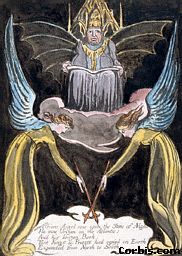
Blake Drawing for

From "Europe, a Prophecy"

Links:

www.library.utoronto.ca/utel/rp/authors/blake.html

www.bibliomania.com/poetry/blake/collected/index.html

http://www.blakearchive.org/

http://www.oocities.org/mspeg.geo/blake.htm

http://www.betatesters.com/penn/blake.htm

http://www.emule.com/poetry/works.cgi?author=8

Back to Literature