home :: news :: events :: games :: players :: pictures :: sponsors :: rules & regulations :: contact us :: links :: forum :: fresh meat
WFTDA Official Rules for 2006
WFTDA Minimum Skill Requirements
Roller derby rules vary from league to league, but in general, the sport is played as follows:
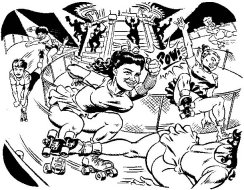
Two teams of five skaters, wearing protective gear such as helmets, mouth guards, and pads, take up positions alongside each other in a pack formation. Each team consists of either four blockers and one jammer, or three blockers and two jammers. Helmet colors or designs are typically used to differentiate between player roles.
A signal is given and the jam commences. All skating is performed counter-clockwise on a small, narrow track. Today, a few professional roller derby type leagues use a banked track, while most new leagues, and all leagues that are part of the Women's Flat Track Derby Association, use a standard flat skating rink.
Initially leading the pack are special blockers known as pivots, who set the pace and give the other blockers direction in order to strategize and keep the pack relatively tight. Blockers who stray too far from the pack may not be allowed to engage opposing players.
Blockers (including pivots) start skating at the first signal. A second signal is given to launch the jammers, who must catch up to the rear of the pack. Jammers navigate through or around the pack, then lap around the back of the pack. The first jammer to get through the pack legally (for example, without cutting the track or acquiring any penalties) is dubbed lead jammer and may call off the jam at any time.
Scoring commences when the jammers lap around the back of the pack and go through for a second time. One point is scored for each member of the opposing team passed by an inbound jammer. Blockers try to stop the opposing jammer from passing them, while defending their own jammer, who they can assist by pushing or pulling (whipping) in an attempt to advance them through the pack. The jam concludes after a fixed period of time or when the lead jammer calls off the jam. Until then, both jammers are free to lap the pack again and again.
Calling off the jam early is a strategic move to prevent the other team from having the opportunity to score. For example, it can be helpful if the lead jammer's team is at an unexpected disadvantage (due to good defense by the other team, or falling or penalized players on the jammer's team), or it can be used to solidify a lead when the jammer's team is doing exceptionally well.
Physical contact between players is frequent and sometimes violent. Body blocking is allowed, and elbowing is allowed in some leagues, but participants are not allowed to trip or intentionally punch other players. Violence may leave the track and may include striking opponents with available objects. Roller derby participants generally adopt stage names and gimmicks, evoking comparisons to professional wrestling. However, unlike professional wrestling, roller derby (in its current revival) does not involve fixed or scripted matches.
Penalties are given to skaters who block illegally, fight or behave in an unsportsmanlike manner. Penalties can be given after each jam or at the end of a period. Some penalties may result in additional points being scored; for example, in some leagues, a jammer may score a point if a blocker commits a foul against the jammer. Some leagues require penalized players to temporarily stop playing and/or participate in a post-jam challenge that may result in more points being scored.