Rules of the Game
The numbers on the field indicate the number of yards to the nearest end zone.American football is played on a rectangular field 120 yards (110 meters) long by 53? yards (49 meters) wide. The longer boundary lines are sidelines, while the shorter boundary lines are end lines. Near each end of the field is a goal line; they are 100 yards apart. A scoring area called an end zone extends 10 yards beyond each goal line to each end line.
Yard lines cross the field every 5 yards, and are numbered
from each goal line to the 50-yard line, or midfield (similar to a typical
rugby league field). Two rows of lines, known as hash marks, parallel
the side lines near the middle of the field. All plays start with the
ball on or between the hash marks.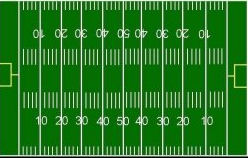
At the back of each end zone are two goal posts (also called uprights) that are 18.5 feet apart (24 feet in high school). The posts are connected by a crossbar 10 feet from the ground. Successful kicks must go above the crossbar and between the uprights. (At professional, college, and some high school fields, the uprights and crossbar are attached by a curved bar to a padded post outside the field of play, to reduce the chance of players running into the supports. Many high schools, though, use an H-shaped structure located behind the endlines, allowing the vertical legs of the structure to be used as a soccer goal as well -- a separate cross bar is required since a soccer goal is only 8 feet tall).
Each team has 11 players on the field at a time. However, teams may substitute for any or all of their players, if time allows, during the break between plays. As a result, players have very specialized roles, and almost all of the 53 players on an NFL team will play in any given game. Thus, teams are divided into three separate units: the offense, the defense and the special teams (see below). In the NFL, players' jersey numbers are distributed according to a strict system (e.g. quarterbacks always wear numbers between 1 and 19).
Game duration
A standard football game consists of four 15-minute (typically 12 minutes
in high school football) periods (called quarters), with an intermission
(called halftime) after the second quarter. The clock stops after certain
plays; therefore, a game can last considerably longer (often more than
three hours in real time). If an NFL game is tied after four quarters,
the teams play an additional period lasting up to 15 minutes. In an NFL
overtime game, the first team that scores, wins, ending the game—this
is referred to as sudden death. In a regular-season game, if neither team
scores in overtime, the game is a tie. In a post-season game, play continues
with additional overtime periods until the tie is broken, as in the 1971
Christmas Day double-overtime game between the Miami Dolphins and Kansas
City Chiefs, the longest game in NFL history (and in all of American football
until 1984) . College overtime rules are more complicated and are described
in Overtime (sport).
Advancing the ball
Advancing the ball in American football resembles the six-tackle rule
and the play-the-ball in rugby league football. The team that takes possession
of the ball (the offense) has four attempts, called downs, to advance
the ball 10 yards towards their opponent's (the defense's) end zone. When
the offense gains 10 yards, it gets a first down, or another set of four
downs to gain 10 yards. If the offense fails to gain a first down (10
yards) after 4 downs, it loses possession of the ball.
Except at the beginning of halves and after scores (see Kickoffs and free kicks below), the ball is always put into play by a snap. All players line up facing each other at the line of scrimmage (the position on the field where the play begins). One offensive player, the center, then passes (or "snaps") the ball between his legs to a teammate, usually the quarterback.
Players can then advance the ball in two ways:
By running with the ball, also known as rushing. One ball-carrier
can hand the ball to another; this is known as a handoff.
By throwing the ball to a teammate, known as a forward pass or as passing
the football. The forward pass is a key factor distinguishing American
and Canadian football from other football sports. The offense can throw
the ball forward only once on a play and only from behind the line of
scrimmage. The ball can be thrown sideways or backwards at any time. This
type of pass is known as a lateral and is less common in American football
than in rugby league or rugby union, where a backwards pass is mandatory.
A down ends, and the ball becomes dead, after any of the following:
The player with the ball is forced to the ground or has
his forward progress halted by members of the other team (as determined
by an official).
A forward pass flies out of bounds or touches the ground before it is
caught. This is known as an incomplete pass. The ball is returned to the
original line of scrimmage for the next down.
The ball or the player with the ball goes beyond the dimensions of the
field (out of bounds).
A team scores.
Officials blow a whistle to notify all players that the down is over.
At all times, players and fans must be aware of the sequence of downs and the distance to a new first down. When a team has a first down, the scoreboard or television screen flashes "1st and 10" — that is, first down and 10 yards to go. If the team gains three yards on the first play, for example, the next down will be "2nd and 7." If the team gains 6.5 yards on the next play the scoreboard may say "3rd and inches." If a team gains a first down within the ten yard line then the scoreboard or television reads "(the down) and goal."
Before each down, each team chooses a play, or coordinated movements and actions that the players should follow on a down. Sometimes, downs themselves are referred to as "plays."
Changes of possession
The offense maintains possession of the ball unless one of the following
things happens:
The team fails to get a first down, that is, move the
ball forward at least 10 yards in four downs. The defensive team takes
over the ball at the spot where the play ends. A change of possession
in this manner is commonly called a turnover on downs.

The offense scores a touchdown or field goal. The team
that scored then kicks off the ball to the other team. (See Scoring and
Kickoffs below.)
The offense punts the ball to the defense. A punt is a
kick in which a player drops the ball and kicks it before it hits the
ground. Punts are nearly always made on fourth down, when the offensive
team does not want to risk giving up the ball to the other team at its
current spot on the field (through a failed attempt to make a first down)
and feels it is too far from the other team's goal posts to attempt a
field goal.
A defensive player catches a forward pass. This is called
an interception, and the player who makes the interception can run with
the ball until he is tackled or forced out of bounds. After the intercepting
player is tackled or forced out of bounds, his team's offensive unit returns
to the field and takes over at his last position.
An offensive player drops the ball (a fumble) and a defensive player picks
it up. As with interceptions, a player recovering a fumble can run with
the ball until tackled or forced out of bounds. Lost fumbles and interceptions
are together known as turnovers.
The offensive team misses a field goal attempt. The defensive team gets
the ball at the spot where the previous play began (or, in the NFL, at
the spot of the kick). If the unsuccessful kick was attempted from within
20 yards of the end zone, the other team gets the ball at its own 20-yard
line (that is, 20 yards from the end zone).
An offensive ballcarrier is tackled, forced out of bounds, loses the ball
out of bounds, or commits certain penalties in his own end zone. This
rare occurrence is called a safety. (See Scoring below.)
Scoring
A team scores points by the following plays:
A touchdown (TD) is worth 6 points. A touchdown is scored
when a player runs the ball into or catches a pass in his opponent's end
zone.
After a touchdown, the scoring team attempts a conversion. The ball is
placed at the other team's 3-yard line (the 2-yard line in the NFL). The
team can attempt to kick it over the crossbar and through the goal posts
in the manner of a field goal for 1 point (an extra point or point after
touchdown (PAT)), or run or pass it into the end zone in the manner of
a touchdown for 2 points (a two-point conversion). In collegiate and professional
leagues, the extra point is usually preferred; its success rate is 94%
in the NFL and 93.8% in the NCAA, compared to 43% in the NFL and 43.5%
in the NCAA for two-point conversions. If the defense forces a turnover
on an attempted conversion and runs the ball back to their opponent's
endzone, they are awarded with 4 points (does not apply in the NFL).
A field goal (FG) is worth 3 points, and it is scored by kicking the ball
over the crossbar and through the goal posts. Field goals may be placekicked
(kicked when the ball is held vertically against the ground by a teammate)
or drop-kicked. A field goal is usually attempted on fourth down instead
of a punt when the ball is close to the goal line, or, when there is little
or no time left to otherwise score.
A safety is worth 2 points. A safety is scored by the defense when the
offensive player in possession of the ball is forced back into his own
end zone and is tackled there, fumbles the ball out of the end zone, or
commits intentional grounding in the end zone. Certain penalties by the
offense occurring in the end zone also result in a safety.
Kickoffs and free kicks
Each half begins with a kickoff. Teams also kick off after scoring touchdowns
and field goals. The ball is kicked from a kicking tee, which is made
from one's own 30-yard line in the NFL and from the 35-yard line in college
football. The other team's kick returner tries to catch the ball and advance
it as far as possible. Where he is stopped is the point where the offense
will begin its drive, or series of offensive plays. If a kick returner
does not want to run with the ball, he has the option to signal for a
"fair catch" by waving his hands in the air before the catch.
He will then be allowed to catch the ball without being tackled. If the
kick returner catches the ball in his own end zone, he can either run
with the ball, or elect for a touchback by kneeling in the end zone. The
receiving team then starts its offensive drive from its own 20-yard line.
A touchback also occurs when the kick goes out of the end zone. Punts
and turnovers in the end zone can also end in touchbacks.
After safeties, the team that gave up the 2 points puts the ball into play with a punt or placekick from its own 20-yard line.
Penalties
 Rule violations
are punished with penalties. Most penalties result in moving the football
either towards the defense's endzone in the case of a defensive penalty,
or away from the defense's endzone in the case of an offensive penalty.
Some defensive penalties give the offense an automatic first down. In
addition, if a penalty gives the offensive team enough yardage to gain
a first down, they get a first down as usual. If a penalty occurs during
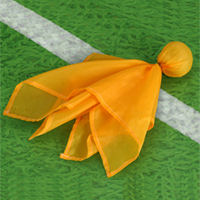
a play, an official throws a yellow flag near the spot of the foul. When
the play is over, the team that did not commit the penalty has the option
of taking either the penalty and replaying the down, or the result of
the play and advancing to the next down. For example, say a defensive
player commits an offsides penalty on first down by passing the line of
scrimmage before the snap, and the offense gains eight yards on the play.
The team with the ball has the option of taking the penalty and repeating
the first down with five yards to go, or declining the penalty and scrimmaging
with 2nd and 2.
Rule violations
are punished with penalties. Most penalties result in moving the football
either towards the defense's endzone in the case of a defensive penalty,
or away from the defense's endzone in the case of an offensive penalty.
Some defensive penalties give the offense an automatic first down. In
addition, if a penalty gives the offensive team enough yardage to gain
a first down, they get a first down as usual. If a penalty occurs during
a play, an official throws a yellow flag near the spot of the foul. When
the play is over, the team that did not commit the penalty has the option
of taking either the penalty and replaying the down, or the result of
the play and advancing to the next down. For example, say a defensive
player commits an offsides penalty on first down by passing the line of
scrimmage before the snap, and the offense gains eight yards on the play.
The team with the ball has the option of taking the penalty and repeating
the first down with five yards to go, or declining the penalty and scrimmaging
with 2nd and 2.
Some common penalties
False Start: A player on the offense, other than the
running back (who can approach the line of scrimmage then move parallel
to it) or a back or eligible receiver (who can move parallel to the line
of scrimmage) moves just prior to the snap. Only one eligible player can
be in motion at a time. Five yards. Replay of down.
Offsides: A defensive player is on the wrong side of
the ball at the start of a play. Five yards. Replay of down. Similar fouls:
Touching an opponent before the snap is Encroachment; lining up alongside
the football instead of behind it is a neutral zone infraction.
Holding: A blocker unfairly impedes a would-be tackler
or pass receiver, by grabbing the player's jersey, hooking, or tackling.
When committed by the offense, or by either team on a change of possession,
the penalty is ten yards. When committed by the defense, the penalty is
five yards and an automatic first down is awarded to the offense. If the
penalty is committed beyond the line of scrimmage by the offense, the
penalty is enforced from the spot of the foul.
Illegal block in the back: A blocker hits a would-be
tackler or pass receiver from behind, but above the waist (for the same
block below the waist, see "clipping"). Ten yards from the spot
of the foul.
Pass interference: After a pass is launched into the
air, a defender pushes, hooks, grabs, or knocks down a would-be pass receiver,
or if the receiver does the same to the defender to prevent an interception.
First down at the spot of the foul if against the defense (15 yards from
the previous spot in college football), or ten yards from the previous
spot if against the offense. Similar penalties before a pass are called
as holding or illegal contact. If a defensive pass interference occurs
in the endzone, the ball is placed on the 1-yard line.
Facemask: a player places his hand on an opponent's facemask
during a play. Five yards if the contact was accidental, or fifteen (a
personal foul) if the player hooks his fingers into the facemask or uses
the facemask to pull the player to the ground. Also called "minor
facemask" and "major facemask."
Roughing the passer/kicker: A player places a hard hit
on a passer long enough after a pass has been thrown to consider the contact
avoidable, or places a hard hit on a punter or place kicker. A major exception
to the rule exists to allow opposing players greater freedom in blocking
punts; the penalty is not called on a player who blocks a kicked ball
by diving into the path of the ball and, after touching the ball, incidentaly
collides with the kicker. Fifteen yards and automatic first down.
Running into the kicker: Contact on a kicker after a
kick has been made. Five yards.
Intentional grounding: The passer throws a forward pass not near any eligible
receiver, without first leaving the area behind where the blocking linemen
were standing before the snap (the "pocket"), or the passer
throws a forward pass outside of the pocket which does not reach the original
line of scrimmage and is not near any eligible receiver. Ten yards or
the spot of the foul (whichever is a greater penalty) plus loss of down,
except if the penalty occurred in the end zone, then it is ruled a safety,
and the defense is awarded 2 points. In college football and high school
football, the defense is also credited with a quarterback sack. Note that
spiking the ball to stop the clock is exempt from this.
Ineligible receiver downfield: On every play the offense
must have 7 players on the line of scrimmage, the player furthest from
the ball on each side are eligible receivers; the interior five players
are considered ineligible to receive passes. This penalty is called if
one of the 5 interior players is more than five yards past the line of
scrimmage during a forward pass.
Dead ball personal foul: After the play is blown dead,
a player tackles or makes rough contact with a player on the other team.
Fifteen yards, automatic first down if on defense. May result in an ejection
if severe enough.
Unnecessary roughness: A catch-all for rough play that
doesn't merit its own foul. An example is an avoidable late hit on a ball
carrier who has run out of bounds. Fifteen yards.
Unsportsmanlike conduct: Another catch-all call, commonly
used for taunting, excessive celebration after a touchdown, and certain
banned forms of pantomime (like slashing the throat). Fifteen yards.
Clipping is a block that occurs from behind - below the waist.
Due to the high possibility of injury it is a major penalty.
15 yards. Automatic first down. Possible ejection. At one time, all blocks
from behind were considered "clipping," but due to the somewhat
lesser risk of injury with blocks above the waist, the "illegal block"
penalty was created.
Spearing when a player leads with his head into another
player. Is slightly different from "helmet to helmet contact."
Major penalty. 15 yards. Automatic first down. Possible ejection.
Delay of game is failure to start the play before the
play clock reaches zero. Five yard penalty. Replay of down.
Illegal procedure Used to indicate a number of infractions, including
an illegal snap, having less than seven players on the offense's line
of scrimmage, and taking more than two steps after making a fair catch.
Five yard penalty. Replay of down.
Players
As noted above, most football players have highly specialized roles. At
the college and NFL levels, most play only offense or only defense.
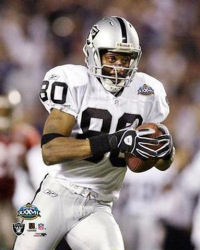 Offense
The offensive line consists of five players whose job is to protect the
passer and clear the way for runners by blocking members of the defense.
Except for the center, offensive linemen generally do not handle the ball.
The quarterback (QB) receives the ball on most plays. He then hands or
tosses it to a running back, throws it to a receiver or runs with it himself.
Running backs line up behind or beside the QB and specialize in rushing
with the ball. They also block, catch passes and, on rare occasions, pass
the ball to others.
Wide receivers line up near the sidelines. They specialize in catching
passes.
Tight ends line up outside the offensive line. They can either play like
wide receivers (try to catch passes) or like offensive linemen (protect
the QB or create spaces for runners).
Not all of these types of players will be in on every offensive play.
Teams can vary the number of wide receivers, tight ends and running backs
on the field at one time.
Defense
 The defensive
line consists of three to five players who line up across from the offensive
line. They try to tackle the running backs before they can gain yardage
or the quarterback before he can throw a pass.
The defensive
line consists of three to five players who line up across from the offensive
line. They try to tackle the running backs before they can gain yardage
or the quarterback before he can throw a pass.
At least three players line up as defensive backs. They cover the receivers
and try to stop pass completions. They occasionally rush the quarterback.
The other players on the defense are known as linebackers. They line up
between the defensive line and defensive backs and may either rush the
quarterback or cover potential receivers.
Special teams
The units of players who handle kicking plays are known as special teams.
Two important special-teams players are the punter, who handles punts,
and the placekicker or kicker, who kicks off and attempts field goals
and extra points. It is rare, but not unheard of, for these two positions
to be filled by the same player. The reasoning behind this is because
the kicking actions of the punter and placekicker are very different.
It is even possible for a team to carry three kickers. One to punt, one
to kick off, and one to handle PATs and field goals.