The Beginning
1887-1890
The Early School
Action was quickly taken to acquire the land from Tait and Davies, and in early 1887 a tender from John O'Brien for £492 was accepted for the erection of a school building. By August the brick building on a stone foundation was ready for occupation and the Department appointed William Gallaway, from the school at Marrickville, as the first principal.
An article appeared in the Goulburn Herald, Tuesday 6th September, 1887.
The Public School which has recently been built in the suburb of Eastgrove at the junction of Park-road, leanor-street, and Emma-street was opened yesterday morning (Monday). As was reported previously in these columns, Mr W. Gallaway has been appointed teacher. The School opened with the very satisfactory attendance of nearly ninety scholars, thus fully justifying the existence of the establishment. The building stands upon a site of two acres, and comprises a school-room, 13fi by 21ft 6ins, class-room of the same dimensions, and a lavatory and hat-room, 43ft x 6ft 6 ins. The main rooms measure 12ft clear from the floor to the ceiling, thus giving a large breathing space for the scholars. The school has normal accommodation for about 120 pupils. It may reasonably be asked whether it would not have been more prudent on the part of the Education Department
to have made provisions for the increase of population in Eastgrove and erected a more commodious building. The present accommodation will certainly be too restricted in a very short time, and the slightest enquiry would have shown that. A very slight additional expense would have given Eastgrove a school capable of meeting all requirements for several years to come.
As it is, the probability will be that before very long the question of enlarged accommodation will be forced upon the authorities. The building is of brick on a stone foundation, and is roofed with galvanized iron. Mr C.J. O'Brien of Auburn Street South, was the successful tenderer, and the work throughout has been done to the satisfaction of the Clerk of Works. The following were the sub-contractors; painting, Messrs Adams and Sons; plumbing, Mr W. Kingsell; stone-work, Mr J. Wright. The amount of the tender was £492.19s. A few extras have raised the total cost to about £500.
The building consisted of a main room called the schoolroom, partitioned from the smaller room, called the classroom. The schoolroom was 29 by 20 feet and was the area where most of the teaching took place; the classroom was only 20 by 13 feet and, while it was used for teaching purposes when the schoolroom become overcrowded, it was designed essentially as a withdrawal room where visiting clergy could take their flock for special religious education. The rooms were furnished with long desks and forms, each 7 ft 6 ins long, located on a floor stepped like the floor of a theatre. The teacher was provided with a table and chair, there was a blackboard and easel and a press for the children's books; a few maps decorated the walls, and the windows were frosted or coloured to prevent pupils' attention from wandering to the outside world. There was little else in the room to distract the pupils' or our attention. Outside the school had two iron tanks for the children's water needs and the site was surrounded by a 5ft paling fence.
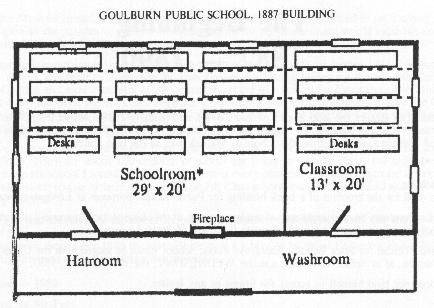 |
No plans of the 1887 school have been located and it is possible that the classroom and the schoolroom have been reversed
At the Department's normal rate of 8 square feet of floor space per pupil the school could accommodate 105 pupils which was soon
exceeded by the end of 1887 when the cnrolment reached 148 and the average attendance 104. Until the end of the year William Gallaway had all the children to teach by himself. Early in 1888 two pupil-teachers were appointed, Herbert Pollack whose father worked at the gaol, and Edith Booth, a local girl. These pupil-teachers were a type of apprentice who each taught a class of the younger children all day and received instruction from the principal after school in teaching methods and subject content. This was the normal way teachers came into the service in the 19th century. If pupil-teachers went well in their 4-year course they were offered a chance
to undertake further training at the Department's training school at Fort Street for men, or at Hurlstone for women. It was also normal for pupil-teachers to teach in the same room as the principals so that they could learn from the way they organised their classes and taught; an added advantage was that the pupil-teacher could draw on the principal's powers of discipline, so that even though pupil-teachers might be as young as 14 years of age, they had no problem in keeping control.
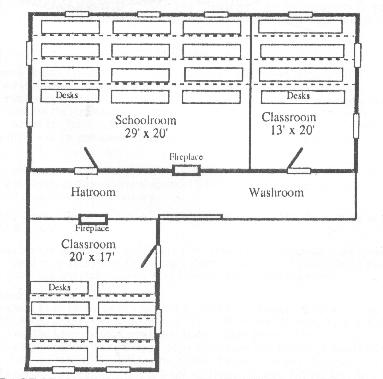
Gallaway in July 1888 asked for the school to be enlarged because although he had space for 105 pupils he had nearly 120 attending daily. The schoolroom was being used by second and third classes and the classroom was being used continually for the 50 first class pupils. These classes cannot be compared to present-day classes of the same name. First class last century extended over at least two years and it was common for most schools, except the larger ones, to only go to third class, at which stage children left school to enter the workforce. Only in the large Goulburn Public School would there have been a fifth class, but it would have been offering advanced work more akin to junior secondary work, such as languages and various branches of mathematics and science. At Eastgrove the use of the classroom all day by one of the pupil-teachers meant that Gallaway could not exercise his normal supervision over the pupil-teacher's progress. He suggested that another room be added to the school so that an infants' partment under a mistress could be established. Inspector Dwyer agreed that an additional room was needed and the Department erected one during I889, but
the hoped-for infants' department was not established. At the same time two weather sheds
were erected, one for boys and the other for girls, as the school playground was separated into girls and boys' areas.
 |
Gardening and Vandalism
In 1890 Frederick Longley replaced Gallaway as principal. Longley was in his mid-thirties and had taught at numerous other schools since he began teaching in 1874, his most recent school having been Oberon. In 1891 Albert Gale, the Department's expert on things horticultural and agricultural, visited Eastgrove school to examine the progress made in
beautifying the grounds by Longley. Gale wrote:
This school is pleasantly situated on a gentle slope and contains 2½ acres of a sandy soil that is rather poor, but with attention can be made productive. There are three indigenous shade trees on the grounds, two in the girls' playground and one in the boys' that has been lately ringbarked which is to be regretted.
Late last season improvements were being and are now being continued. They consist of upwards of 100 holes for tree planting and designing of flower and vegetable gardens for both boys and girls. It contains the nucleus of a well designed and laid out playground.