School History

danger getting to town
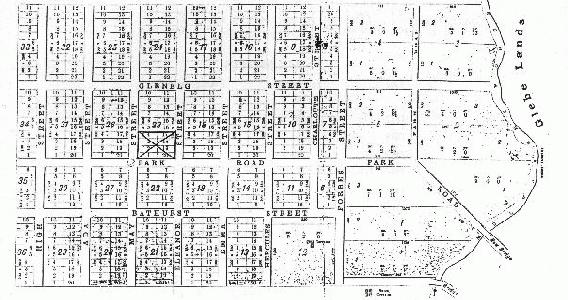
to street names
The Campaign for a School in 1884
The Final Assault
1883 Application
In August 1883 William Davies filled in an official application form for a public school and sent it to the Department of Education. Davies claimed that there were 57 children of school age available and that by the end of the year he expected 100 children to be in Eastgrove. He explained that a school was necessary because of the danger to children in crossing the railway line to attend one of the three public schools in Goulburn, and that the Mulwaree was often difficult to negotiate after rain, preventing children from attending school. While Davies had filled in the main details on the form, the Rev. TaR had hawked it around the families in Eastgrove to obtain parents' signatures promising that they would send their children to the school if established.
In accordance with long established practice the Department of Education instructed the local inspector of schools to visit Eastgrove, examine the situation and report on the need or otherwise for a school there. The Inspector was William Dwyer, an experienced officer who had been in Goulburn for the previous two years and knew the area well. Dwyer visited the 20 or so houses that made up Eastgrove and checked the distance the children had to walk to Goulburn, Goulburn North or Goulburn South Public Schools. He found that of the 57 children listed on the application, only 39 were of school age. Of these 29 were already attending one of the Goulburn schools, leaving only 10 children of school age unaccounted for. None of them had to walk more than 1.5 miles, which was not an unreasonable distance to walk in an era when people walked a great deal more than they do these days.

Dwyer then turned to the question of the danger from the railway crossing and the problem posed by the Mulwaree:

It is to be stated that the Mulwaree Creek which runs through Eastgrove, is crossed by 2 bridges and that the railway line is crossed by 3 roads protected by gates and duly superintended, two of these crossings being to the north and one to the south of the Station. These routes lead to the central, south and north parts of Goulburn and the most distant school (from Eastgrove) North Goulburn, is within, at most, 20 minutes walk of the northern portions of the suburb, the other schools being within from 10 to 20 minutes walk of its central and southern portions. Such being the case the alleged danger seems imaginary and not to be compared to that arising from ordinary street traffic about which people make no complaints.
Regarding the second special ground, viz., the alleged impossibility of crossing the flat in time of flood, it is to be stated that the flat referred to has been known to have been under water once in about 10 years for a couple of days, and to be very muddy after heavy rains; but in such weather, even the city schools are badly attended, and the mud in the streets is a serious obstacle. Weather of this kind is not very frequent in Goulburn nor of very long duration, and when a break comes, the ground soon dries, and things resume their wonted aspect.
Dwyer was well aware that the pressure for the establishment of a school at Eastgrove was coming only from the land developers. He mentioned in passing that none of the parents had complained about sending their children to the existing schools in Goulburn, and that the promoters of the school, Davies and Tait, were principals of the land company and owned the land proposed for the site of the school. In Dwyer's discussion with Tait over the price of the land (which incidentally was the site that the school was eventually built on in 1887), Tait told him it was worth £1 a foot of frontage, but that he would accept 15/- a foot for it. For a 2-acre area, which was the traditional size of a school site, this meant a cost of about £300, whereas Dwyer noted that land nearby, equally as suitable as a school site, could be had for about £200 for 2 acres.
Clearly Dwyer was not in favour of establishing a school at Eastgrove, at least not yet; and he added a final argument against it:
If a school were now to be established at Eastgrove it could only rank as an 8th or at most a 7th Class; as such it would be placed in charge of a 3rd Class teacher who, being inferior in classification to the teachers of the city schools could not long, under ordinary cirumstances, meet the aspirations of the parents to provide a first class education for their children, who, not withstanding distance and danger would be sent to the city schools, leaving that (supposed to be) at Eastgrove to the babies unless population was to increase beyond the most sanguine expectation and beyond all present indications.
Some explanation of the way the Department staffed school at the time is necessary to appreciate Dwyer's argument about waiting until there were enough children for a larger school. Schools were divided into 10 classes, with the very smallest bush school in the 10th class and the largest city school in the 1 st class. Teachers were also divided into grades, with the most experienced and best trained in the first grade and the least experienced and worst teachers in the lowest grade. The Department matched schools to teachers so that the teachers in the top grade got the biggest schools and were able to offer a more comprehensive course of studies, including what we would these days regard as junior secondary work. At the other end the worst teachers got the smallest schools and were able to provide a correspondingly limited education. The existing schools in Goulburn were of the larger variety and Goulbum Public School was offering languages, and advanced subjects such as algebra and science. if possible Dwyer wanted to avoid a limited little school at Eastgrove.
Given Dwyer's negative report the Minister for Education decided not to establish the school and Davies and Tait were informed accordingly.


STREET NAMES

Ada Street:
believed to be the name of one of the daughters of the owner and subdivider.

Bathurst Street:
Earl Bathurst Henry Bathurst 3rd Earl (1762-1827}. Secretary for war and the Colonies 1812-1827.

Blackshaw Road:
after Major H. Blackshaw O.C. Goulbum volunteer Rifles Infantry and E Company 6th Regiment Australian Rifles, 1897. Family early brewers in Goulburn. Prominent local cricketer. after Queen Charlotte, wife of George III.

Charlotte Street:
after Queen Charlotte, wife of George III.

Chiswick Street:
from Chiswick a municipal borough of London situated on the Thames. located in East Goulburn.

Farm Road:
so named from river fiat original farm area.

Forbes Street:
after Sir Francis Forbes ( 1748-1841 ). First Chief Justice of N.S.W. Arrived in the colony 1824, knighted 1837. Instrumental in the establishment of trial by jury.

Glenelg Street:
after Baron Glenelg Charles Grant {1778-1868t. Secretary for war and the colonies 1835-1839.

Henry Street:
appears to be named after the Henry families of which there were several in the 1860's and 1870's.

Hercules Street:
after Sir Hercules Robinson (1789-1865) Governor of N.S.W.

High Street:
the highest level street in Eastgrove at the time.

Park Road:
a large frontage to Eastgrove Park.

The Campaign for a School in 1884

Tquestion of a school for Eastgrove was raised again early in 1884 by Henry Goldsmith, a school attendance officer, who visited Eastgrove in the course of his duties. The Public Instruction Act of 1880 had introduced compulsory education for children between 6 and 14 years of age, making it necessary for them to attend school at least 70 days every 6 months. School attendance officers had the responsibility of prosecuting those parents who did not comply with the Act. At Eastgrove, Goldsmith found a number of children of school age who were not attending any school and reported that any attempt to prosecute parents for the non-attendance of their children would founder because they would raise in court the 2 or 3 miles children had to travel to school, the dangers of crossing the railway line and the obstable caused by the river.
Goldsmith rather suspiciously began his report by denying he had neither "personal nor social interest" in the establishment of the school: he said he did not know when he first visited Eastgrove who owned the land there. "Indeed", he protested, perhaps too much,
if I were offered land for nothing on condition of living or building there I would not accept if", Inspector Dwyer later confessed that he could not understand what Goldsmith meant by such a statement but he knew well enough that the land developers were interested in furthering the sale of land by establishing a school and were prepared to be generous to anyone who could help them.
Goldsmith reported that he had walked the route the children took to Goulbum Public School and found that it took him 35 minutes at a steady 3.5 miles an hour. Unfortunately for the case he was making, when he listed the name and addresses of the children at Eastgrove he noted that none of them were even 2 miles from the nearest school. Ignoring this contradiction he went on:
Eastgrove is situated on the side and at the foot of a very steep hill (or mountain) which I have seen literally covered with a sheet of water, driving all before it. On this mountain side are erected fin most part) small fragile wooden houses on little blocks, placed on the ground. Between this settlement and Goalbum I have seen a flood river a mile wide and from 20 to 30 feet deep, carrying down stacks of hay and wheat, barns, horses, cattle and everything in fact that stood in its way. And after its subsidence this wide flat has been covered with lagoons for months.
As for the railway line he explained how he himself had "snatched a child from destruction" out of the path of an engine. For all of these reasons he felt it would be difficult to prosecute successfully parents who failed to send their children to school.
Dwyer was quite unimpressed by Goldsmith's arguments and repeated his earlier comments on the lack of danger posed by the railway, and how the Mulwaree, even in flood, was crossable by safe bridges. He concluded: "It is worthwhile to mention that the only persons who moved in the establishment of a school in this locality were those gentlemen named in my report who are interested in the sale of the land". Dwyer was certainly not going to do anything that would help these gentlemen make more money. His senior officers in Sydney agreed that although the odd child might be disadvantaged by not having a school at Eastgrove, the vast majority could without difficulty attend a school. The Minister again declined to establish a school at Eastgrove.
In June 1884 the Minister received from Eastgrove residents another application for the establishment of a public school, this time signed by William Davies, a number of aldermen, the local member of parliament, and other notable residents of Goalburn. They claimed there were now 94 children available for a school, and in an attached memo Davies again outlined the danger of the rail crossing and the inconvenience of the Mulwaree to the children from Eastgrove who attended Goalburn schools. Dwyer was still not impressed with the reasons given and said so. He believed that most of the names added to the application were done merely to add weight to the document, and pointed out that in recent weeks the heaviest rain known in Goalburn for many years had fallen but none of the fiats were under water nor were the roads impassable. Again the application was refused.
The promoters of the school then took another tack and wrote for help to Henry Parkes, the former premier of New South Wales, and the man who had put through the Public Instruction Act of 1880 and was regarded as the father of public education in New South Wales. Parkes contacted the Minister for Education but confessed that he knew nothing about the case except what the promoters had told him; yet he felt that the number of children at Eastgrove suggested that a school might be necessary. At the same time William Davies called a public meeting in Goulburn to discuss the Eastgrove school question. The local newspaper reported that the meeting was very poorly attended and most of those who attended came from Eastgrove. After some discussion, mainly by aldermen, a resolulion was adopted which emphasised the dangers of the rail crossing and the distance children had to travel to school. The resolution was forwarded to the Minister.
By this stage Dwyer must have been sick of the sight of Eastgrove. But he was again called on to give an opinion on Parkes' etter and the resolution from the public meeting. All he could do was to point to his four earlier reports and explain that nothing had hanged. "As the matter now stands," he complained, "it is, in my opinion, nothing more nor less than a bold and painstaking effort to succeed in an undertaking calculated to benefit this locality concerned by an expenditure of public money". Despite this he realised that eventually a school would be needed at Eastgrove but he hoped that the Department could withstand the pressure and not provide a chool until a relatively large one could be established, one which would provide a sound education for pupils. For the moment Dwyer ot his wish and Henry Parkes and the Improvement Committee at Eastgrove were informed that Eastgrove had within its reach dequate educational facilities and that the Department did not contemplate establishing a school there.
The Final Assault

In March 1886 the Eastgrove Improvement Committee got up another petition signed by parents of 113 children, asking for a school at Eastgrove for the children who were, they said, "but partially enabled to enjoy the benefits of our most liberal educational system" because of the distance to other schools in the area, the danger of the rail crossing and the "virtually unbridged" Mulwaree River. Naturally the petition was referred to Dwyer for his comments. Dwyer pointed to the answers in his previous reports to answer the points raised in the petition, but did add some additional information:
The only new features in connection with this matter, developed since my last report is the erection of a Sunday School by the C.E., Denomination, which is now opened as a private day school. At this school I found 41 children (18 boys, 23 girlsl present yesterday, of whom 29, varying in age from 6 to 13 years, had been attending the Goalburn Schools; the remaining 12 were infants from 3 to 5 years old; 4 others, of whom 3 are under 6 and 1 over have not yet artended but are expected to attend, making in all 16 infants capable of being instructed.
Considering that this school is open only a couple of weeks, that the want of it according to the representations of the Improve ment Committee was so great and the number of children considerable, and the charges so moderate... a much higher attendance might be reasonably expected; instead of which the total is only a few of whom most were taken from South Goalburn and the Superior Pub (Goalburn Public School) where they had attended and where some of their brothers and sisters still attend. There is really nothing in this case involving hardship to children or parents, the children who are obliged to attend school being able to walk in 10 or 15 minutes to South of central Goalburn, and those under 6 years being too few to warrant the opening of a branch Infant School for their special accommodation.

Dwyer suggested, and the Minister agreed, that as the Improvement Committee was determined to get a school, no matter what, that it be informed that as soon as the number of infants children reached 60 the Department would establish an infants school as an annex of Goulburn South Public School.

This reply was only temporarily satisfying to those in Eastgrove pressing for a school. In September 1886 Goulburn Municipal Council, a resolution of the new mayor, seconded by Alderman William Davies, was passed asking for the Minister for Education to receive a deputation from the Council and local members of parliament in regard to a school for Eastgrove. The Minister was prepared to meet the deputation but asked the Department's Chief Inspector for an urgent report on the Eastgrove case. The Chief Inspector visited Eastgrove, spoke to the promoters of the school and inspected the area; there was no indication given that he spoke to Dwyer about the matter, but it is unlikely he would have neglected to do so. He reported:

I visited Eastgrove this morning. It is separated from Goulburn proper by the railway, the river and fiat lands subject to inundations in time of flood. There are about 100 children of school age living in a group about 1.5 miles from the nearest school in Goulburn. At a private school I found 75 attending. There is every prospect of a steady increase in population, and the erection of a school must come sooner or later. A good 6th or 7th Class school could be maintained without entering into competition with existing schools.

In his discussions with Tait and Davies over the site of the school they generously offered to sell the land in Eleanor Street for 10/- a foot, which the Chief Inspector considered reasonable when land nearby was selling from 12/- to £1 a foot. On the basis of this report the Minister approved in September 1886 the establishment of a school to be called Eastgrove Public School, the name it had until 1900. Consequently the need for a deputation disappeared.

To the TopBack to Welcome pageThis will take you to the next page