 |
| The Hangar |
| RAF Fighters |
| Hawker Tempest I, II, III & VI Pictures |
|
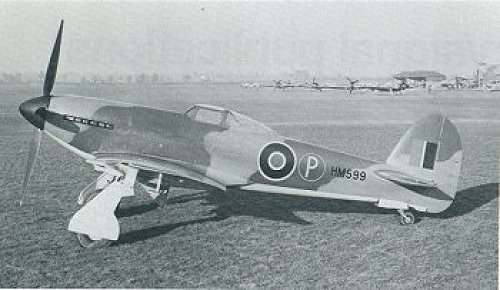
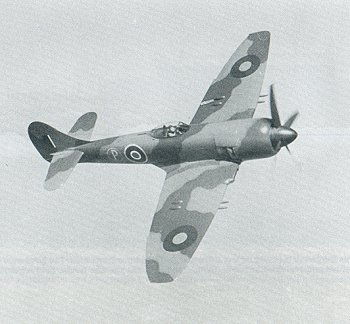
| The Tempest I prototype HM599. Powered by a Napier Sabre IV engine and hosting a new eliptical planform wing design. Note the 'P' prototype marking on the fuselage. |
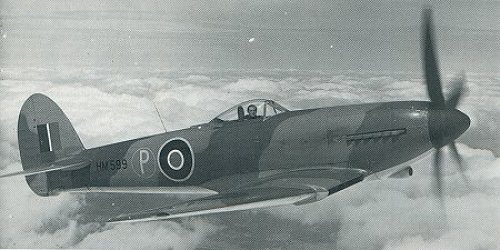 |
| The Tempest I prototype's maiden flight was on 24th February 1943. During its air trails the Tempest I exceeded speeds of 470 mph, making it one of the fastest piston engined fighters around. |
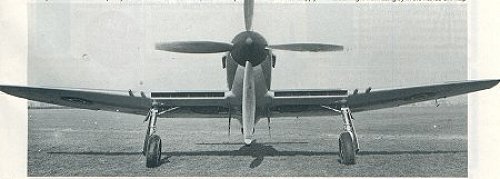 |
| The Tempest I incorporated wing radiators to do away with the drag inducing chin radiator as seen on its predecessor the Typhoon. Similar examples can be seen on the de Haviland Mosquito. The Air Ministry didn't warm to the idea and the Tempest I was never to see production. |
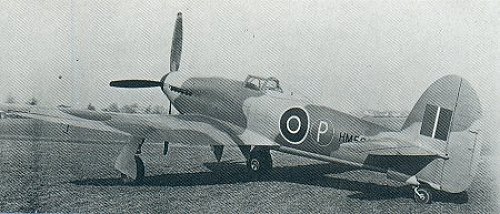 |
| The Tempest I was originally fitted with a 'car-door canopy' but this was changed in favour of the glass bubble hood for better visability. |
 |
| The Tempest II prototype LA602 with the Bristol Centaurus CE45 air-cooled radial engine. |
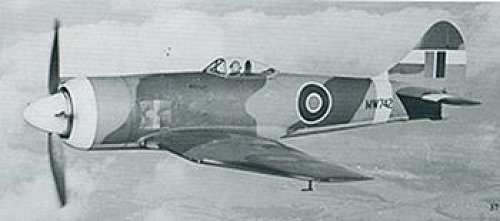 |
| The Tempest II didn't make its maiden flight until 28th june 1943, but didn't roll off the production line until February 1945 because of several technical problems and also finding a manufacturer that could handle the capacity. |
 |
| This shot shows the guts of the Air-cooled radial Centuarus engine in the Tempest II. 2,210hp, 18 cylinders and a top speed of 440 mph. |
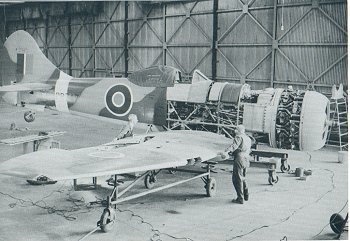 |
| The Tempest II was designed to be constructed for use in the Middle/Far East theatre of operations. Note that none of the 20mm Hispanos cannons have been installed yet. |
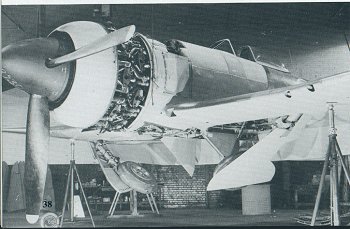 |
| The testing of the Gear system on a Tempest II. Like all the Hawker aircraft it used a wide gate gear for stability rather than the narrow system used in planes like the Spitfire and Me 109. |
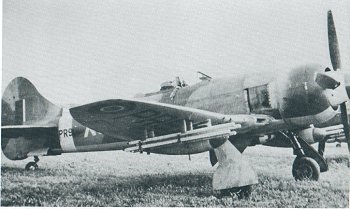 |
| A Tempest II armed with 8 rockets on double racks. You'll also see drop tanks slung under each wing. The Tempest was basically designed to be a 'fixed' Typhoon, but more of a fighter than low level ground attack like the Typhoon. |
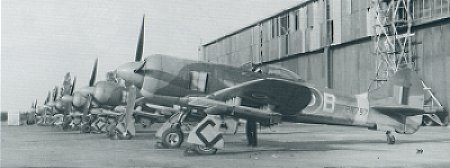 |
| A line-up shot of Tempest II's armed with rocket launchers on the wings. The standard armament for a Tempest II was 4 x 20mm Mk V Hispano cannons buried in the wings. |
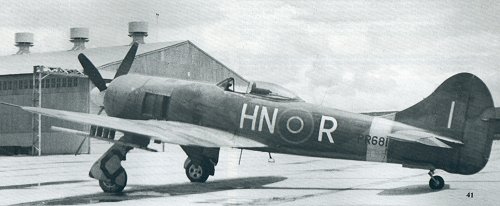 |
| Another Tempest II, but this time actually in the Far East theatre of operations. The Tempest II saw action in the Far East, but was rapidly overtaken by the new era of Jet aircraft design. Many Tempest II's were taken on by the Indian and Pakistani Airforces. |
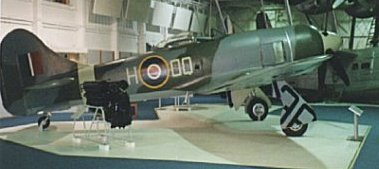 |
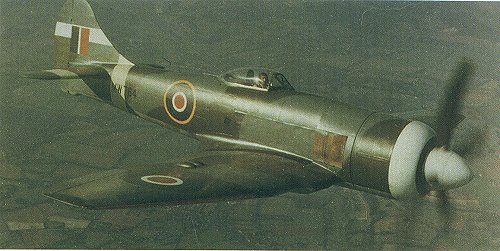
| A Tempest II as seen at the RAF Museum at Hendon. It shows the classic lines and camouflage scheme of the Tempest II. |
 |
| This piccie shows the way that the later marque Hispano cannons were embedded entirely in the wing. |
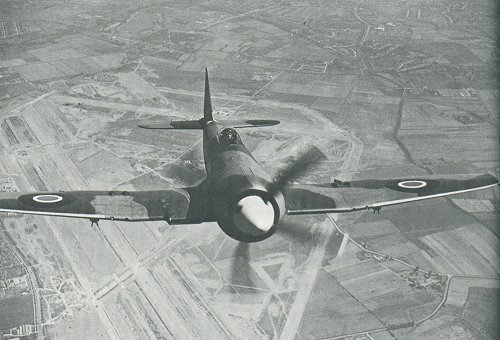 |
| A fearsome opponent, study and reliable. This Tempest II is flying over the construction of Heathrow Airport!! |
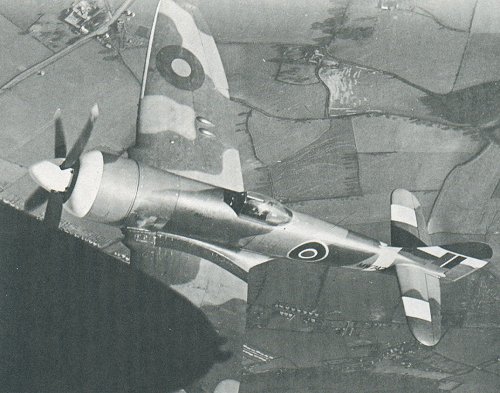 |
| Close up of a Tempest II during a Press shoot. Note the two cannon blisters on the wing. |
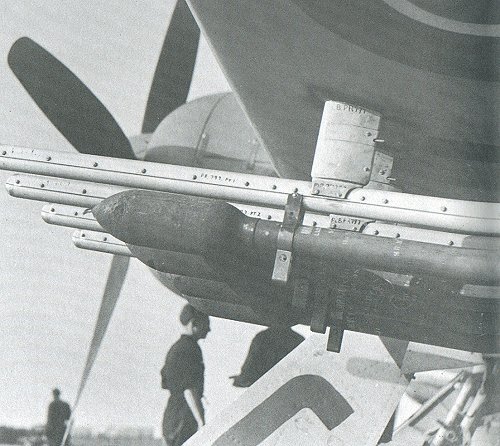 |
| The 60 pound rocket.... the scourge of many a Tank Commander. Seen here on a Tempest II. |
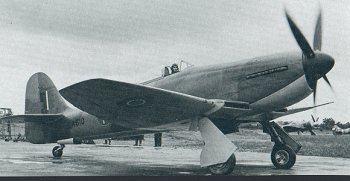 |
| The prototype Tempest III, LA610. Designed to be mass produced and a successor to the Hurricane, the Tempest III never reached production because the Typhoon became the mainstay low level ground attack aircraft in the RAF. |
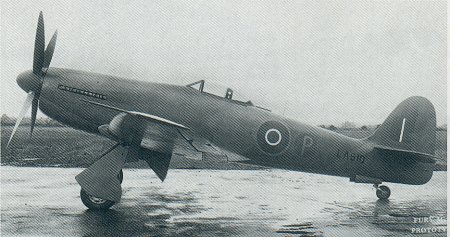 |
| The Tempest III was designed to carry the Griffon II and then the Griffon 61 engine, but time delays on engine production meant that LA610 became the Griffon Fury protoype and LA614 was cancelled. |
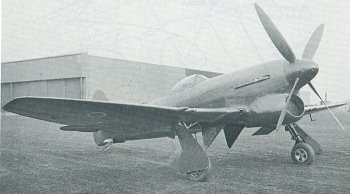 |
| The Tempest VI was an updated version of the Mk V. A bigger airframe was needed to house the Napier Sabre V engine. The prototype VI was in fact HM595 the prototype used for the Mk V. |
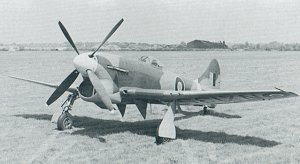 |
| The Tempest Mk VI was designed for operations in the Middle East so tropical filters were added. It also incorporated Mk II improvements such wing air intakes to allow a larger engine coolant radiator. |
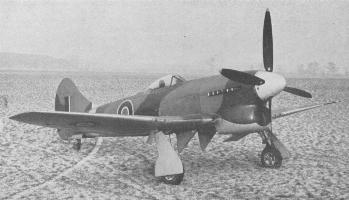 |
| 142 Tempest VI's were produced virtually all of them going to the Middle East. 249 Squadron based in Iraq were the first to re-equip in Dec 1946. Soon after No's 6 and 213 in Cyprus re-equipped. |