*Table Covers*

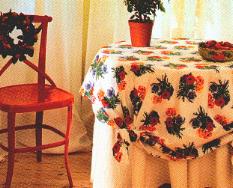
Jazz up a plain cloth, or hide stains, with a brightly colored tablecloth placed on top.- Choose a fabric that matches the original cloth.
- Sew a circular cloth that falls only halfway down the side of the table.
- Center it over the old cloth for a layered look. Then knot the corners for a casually stylish touch.
*Making A Tablecloth*
Unless using very wide fabric, it will be necessary to join widths together to make up the tablecloth. Making a paper pattern helps in cutting a perfect circle.
Measuring Up
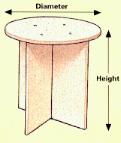
- For the diameter of a finished floor-length cloth, add the diameter of the tabletop to twice the height of the table. Add an extra 1 1/2" to allow for a 3/4" double fold hem all around.
- The total equals the outer dimensions of the square of fabric needed to make the circular cloth.

Joining Fabric Widths
If the fabric is narrower than the overall diameter of the planned tablecloth, join fabric widths before cutting out the circular cloth.
- Avoid seams that will fall across tabletops. They are unsightly and impractical.
- Use a full width of fabric for the central panel of the cloth. Join half widths of fabric down either side of the main panel as shown in the picture.
- Join the selvages with a flat seam (right sides together and edges matching). If necessary, clip into the selvage to ensure that the seams lie flat.
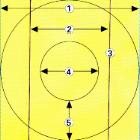
- Overall measurement of cloth (including hems)
- Full width of fabric
- Position of seams
- Diameter of tablecloth
- Height of table plus hem allowance
*Cutting and Hemming The Tablecloth*
- Tie one end of a piece of string to a pencil. Measure from the pencil along the string a distance equal to half the cloth diameter(incl. hem) and mark. Tie a thumb tack to the string at this mark. Trim string.
- Take a square sheet of paper slightly larger than the length of the string. Lay the paper on a work surface and push the tack in at one corner. Pull string taut and draw a quarter circle. Cut out carefully.
- Fold the fabric in half, and then in half again to make a smaller square. Place the paper pattern so the point is at the center point of the folded cloth and pin in place. Cut out the fabric around the pattern curve.
- Unfold the cloth and press. Machine stitch around the cloth 3/4" from the raw edge of the fabric. This line of stitching forms the hemline.
- Turn up the hem allowance and press to form a crisp edge. The stitching should roll over naturally to the wrong side to create a clean edge. Turn under half the hem allowance and press again.
- Pin the hem in place and baste if you wish. Stitch by machine just inside the folded edge. Alternately, stitch by hand for a nearly invisible finish. Remove any remaining pins or basting and press.
NOTE: Sheeting fabric is available in extra-wide widths, eliminating the need for seams on larger tablecloths. It is also an economical and easily washable type of fabric.
An old fringed shawl makes a neat and easy cover for a circular tablecloth.
Graphic set by:

Visit my other pages!
Home
Main Directory
My Family ~ Country Cookin'
Craft Projects ~ Webrings ~ Favorite Links
Decorating Center ~ Household Tips ~ Rainy Day Projects
Holidays ~ Awards Received ~ Winners ~ Make and Save ~ Bookstore
Parenting Funnies ~ Computer Humor ~ Special Causes
Favorite Short Stories ~ Banner Exchange
Gifts Received
Sign My Guestbook
 View My Guestbook

 View My Guestbook