

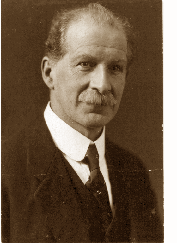
Horace Shepherd Folker was born at Brighton on 17 June 1859 and was the fourth in a family of five children. At that time the family lived at 20 Russell Square. He was educated at Brighton Grammar School.
The family moved to Guildford about 1875 where Horace's father took The Bowling Green public house for a year or so. They then moved to 6 Lea Pale Road in the centre of town where his father established a business as an auctioneer.
Horace had been a founder member of the Guildford Rowing Club which had come into existence around 1880. He had been instrumental in securing the Duke of Albany as patron and the arms of the Duke were borne by the club. One hundred and ten years later, this club was the oldest sporting organisation in the town and it's boathouse was still in the same place near the Jolly Farmer public house. In recognition of his services, Horace was appointed life vice-president.
In 1881 Horace became a partner with his father and they moved to Almorah Lodge in Woodbridge Road, Guildford. The business was named Folker & Son and they established the office at 64 High Street, Guildford moving later to Guildford Chambers in North Street about 1883. The partnership was dissolved in 1884 and Horace set up on his own in competition with his father at 74 High Street. He also left home and moved to 1 Khartoum Villas, Artillery Terrace, Guildford. The location his office and that of his father were close to the market which was held in North Street.
According to the advertisements in Andrew's Guildford Almanace & Directory, Horace undertook valuations for probate and business transfers. He was also the sole proprieter of the Guildford Poultry Market which had been founded by his father in 1876 and was held every Tuesday at 11 o'clock.
By 1887, he was secretary to the West Surrey Licensed Victuallers Protection Association.
Horace moved to 41 High Street in about 1888. In 1889 he was elected a fellow of the Auctioneers Institute of the United Kingdom and at his death became the oldest living member. His father had been a founder of the Institute.
In 1890 was joined in partnership by Mr Percy Horton at which time the firm became known as Folker & Horton and by 1891 the business had moved to Trinity Chambers at 9 High Street.
In March 1892, Horace was elected to the post of general honorary secretary of the National Fire Brigade's Union, a position which he held for sixteen years.
By 1893 he had become the chief officer of the Guildford fire brigade at which he donated gifts of a silver model of an early steam fire engine, two table games and 80 volumes with which to start a library for the brigade.
Besides those already listed, Horace was engaged in a number of other activities outside his auctioneering business. He was largely instrumental in the organisation of international tournaments at the Royal Agricultural Hall, Islington in 1893 and 1896. He was also at some time secretary of the golf club and County Club.
In 1895, Horace was living at Norton Lodge, Guildford. On 6 June, he married Margaret Barratt, daughter of George Osborne Barratt, at St Luke's church, Willesden.
Soon after their marriage, Horace and Margaret were living at Stroud House, Dene Road in Guildford which is where their three children were born. Their first son, Leonard Barratt Folker was born on 8 September 1897.
Horace was elected as a member of the Guildford Town Council in a by-election in December 1898 along with C H Brown. In 1899 Horace was elected for the East Stoke Ward for which he served for three years then did not seek re-election.
Also in 1899, he was given a presentation by the West Surrey and District Licencesed Victuallers Protection Association to mark the appreciation of his services as secretary.
By 1901 the business had expanded to include an office in Godalming. Horace and Margaret's third child, Stuart Shepherd Folker was born on 14 February of that year.
As part of his involvement with the fire brigade, Horace had been largely instrumental in the organisation of Fire Brigade camps. These had been held at Blenheim Palace, Woodstock, Birmingham, Basingstoke and in 1906 at Shalford Park Guildford. Among those in Guildford with whom Horace was associated in the Fire Brigade was Major W H Harris of Amesbury, Stoke Road, Guildford who was assistant secretary to the National Fire Brigades Union.
Horace retired from business in 1908. His partner, Percy Horton retired the following year and was succeeded by two members of the staff, Mr J H Gifford of Guildford who had been with the firm for seventeen years and Mr A E Furnell of Godalming who had fourteen years service. The business of Folker and Horton continued until about 1959, being located until then from about 1913 at 1 The Quadrant, Bridge Street, Guildford.
On his retirement, Horace and Margaret moved to Wroxham, Overton Road, Sutton, Surrey.
Horace's wife Margaret was drowned in Kent on 5 April 1909. In her memory, Horace gave Guildford's Holy Trinity church a baptistry in her memory and endowed for the upkeep of the lighting. He later increased the gift towards rewiring the baptistry. Some years previously, he had donated a gift of mosaic paving, the event being remembered on a ceramic plaque in the baptistry .
Horace was a member of the British Fire Prevention Committee and until 1914 was a member of the International Fire Service Council. The latter, in his own words, took him before every crowned head in Europe and his achievments in this respect are listed in a book of Contemporary Biographics and also in Who Was Who. He was a membre d'honneur des Federations des Sapeurs-Pompiers in France, Belgium, Italy, Luxembourg, Russia, America, New Zealand, Etc; was presented with the Gold Medal with ribbon of St Stanislas by His Majesty the Emperor of Russia; the Red Cross 3rd class of Prussia by His Majesty the Emperor of Germany; the Silver Medal 1st class by the President of the French Republic. He also received four Belles Actions, gold and silver medals, in France and the Civic Cross 1st class in Belgium.
From the outbreak of the First World war up until 1920, Horace had been director of the uniform and equipment department of the British Red Cross and Joint War Committee. For this work he was appointed on 1 January 1918 to be a Commander of the Most Excellent Order of the British Empire which had been instituted the previous year to recognise wartime work by civilians. Furthermore, King George V bestowed him with the King's Police and Fire Brigade Medal for his voluntary work in connection with the Fire Brigade and Red Cross. He was the first volunteer to receive that coveted decoration.
There seems to have been an interest by Horace in the marriage of his great grandfather Samuel Folker to Sarah Shepherd. The name of Shepherd had come down through the following three generations via Horace's father, Horace himself and his son Stuart Shepherd Folker. Horace applied for and on 24 November 1919 was granted Arms. The Arms comprised a black bull (for Folker) and a white ram (for Shepherd) over a quartered shield around which is written For God and the Empire and below which is the motto Vi et Perseveranta.
The grant was in the name of Horace Shepherd Shepherd-Folker (formerly Horace Shepherd Folker). It seems that the family surname had been changed to Shepherd-Folker at about this time. The reason for this interest in the union of the Folker and Shepherd families is unclear. It is true that Samual Folker's sea chest had survived and been passed down through the family along with a large lock of his hair.
There was a connection with Isaac Netwon through Horace's grandmother's family (Thorp) and the name Newton has persisted in the family down the generations. Horace's brother carried this name. Horace commissioned a family pedigree Arnold, Compton & Co which they produced on 23 April 1923 and which showed the connection with the Newton family. This pedigree survives in original form.
Horace made his Will on 1st May 1928 at which time he had moved away from Guildford and was living at Ashurst, Sutton Court Road, Sutton, Surrey. One of the beneficiaries named was Kate Jean Whittle who was probably a servant in his household at Guildford.
Horace suffered failing health for a long period in his later years. An entry in the Birthday Book of his sister-in-law, Hannah Folker, notes that 'Horace Returned from Jersey - very poorly'. The date was August 30 but the year is not given.
He died peacefully at his home at Charnwood, 79 Grove Road, Sutton on 18 April 1938. He was aged 78. At his request, he was buried in the family grave (No.37588 square 147) at Highgate cemetery on Friday 22 April, the plot being adjacent to those of members of his wife's family and relations. His generosity persisted after his death as he had bequeathed a gift of £100 to the Widows Orphans and Benevolent Fund of the National Fire Brigades Association.
There was a lengthy and detailed obituary of Horace published in The Surrey Advertiser and County Times on Saturday April 23 1938.
Return to the top of the page.
Return to the Biographies index page.
Return to the front page.
 Get your own Free Home Page