


Sydney was born on 26 July 1888 at Islington, the youngest child of Alfred and Hannah Folker. He was named Sydney as a result of his father being in Sydney, Australia at the time he was born.
He started his working life at the age of 15. He joined W.A.S.Benson & Co. Ltd. on 4 May 1904 as a junior clerk at their Bond Street showrooms but left on 31 December the same year due to illness. This information came from the letter which remains as a keepsake, however, it is not known if Sydney actually worked for the Council.
Sydney joined the Royal Crown Derby Porcelain Co. Ltd. at their London Showrooms at 16 Charterhouse Street as a clerk about 1905 and later became a traveller for them. He had followed in his fathers footsteps who also worked for Crown Derby.
Sydney was very interested in the works of Charles Dickens, so much so that he later named his daughter, his house and his dog from names in Dickens novels. He used to perform monologue sketches in vaudeville and it is likely that he was doing this during his spare time whilst working for Crown Derby. On 9 May 1905 he played the part of Barty Hayseed in a musical romance called 'Jan the Jester'. It was performed by the Cauducean Club at the Kings Hall, Convent Garden.
He was living with his parents at 12 Park Road, Harlesden at the time of his marriage on 16 December 1911. Although his wife was registered as Gertrude Bentley Cook at birth, she adopted the christian names Vera Gwseeni and this is how she was known. Vera was living at 5 Crown Terrace, Cricklewood but they moved to 12 Crown Terrace which is where their daughter, Dora, known as Doady, was born on 3 September 1913.
The family moved after a couple of years to 103 Fowlers Walk, Brentham, Middlesex. This was a house situated at the end of a cul-de-sac on a new estate. Some photos taken there show family and relatives sitting under an awning in the back garden in surroundings which still looks quite rural. The estate was still under development at this time. Sydney and Vera used to take part in amateur theatrical productions at the theatre at Brentham. They were also both members of the Greystoke Manor golf club which was set in the grounds of Greystoke House and which was adjacent to their home. There is a photograph of the club team, which includes Sydney, when they were winners of the Inter-Club Challenge Shield in 1926.
In 1914, Sydney went into the York and Lancaster regiment, being a mounted regiment. His brothers Edgar and Arthur also joined the same regiment. It is a point of interest to note that a gentleman called John Robert Folker who lived at Windsor also served in this regiment and died of wounds in Italy in 1918. They do not appear to have been directly related. One wonders how they both came to be in a regiment from outside their area. Was it perhaps that had been a recruiting drive in the area ?
Sydney spent some time at Clipstone camp in Nottinghamshire during which time Vera and Doady stayed in the village. He was also possibly stationed at Bulford camp for a while. He was despatched to France early in the first world war but was recalled, without getting off the boat, to train others in musketry. He also trained horse gun carriage crews on land belonging to Twyford Abbey which was close to his home in Brentham. He had reached the rank of sergeant when invalided out of the army due to his weak chest.
He next got into films, probably through contacts he had from his earlier theatrical days. There were a number of his friends living locally who were in the film business already. He worked variously for the London, Alliance and several other film companies. He appeared with the actress Vesta Tilley in a film directed by Alexander Butler and which was called 'The Girl Who Loved A Sailor'. Sydney starred with Owen Nares and also appeared in another film with George Robey.
By 1922 he had made a name for himself and was considered a worthy successor to Sidney Drew. He was then working for Quality Films as an actor but also designed and built sets and did stage management. He was quite adept at drawing and painting and some of his sketches for stage backdrops still survive. His first film for this company was called 'The White Rat' being released in November 1922 for which Sydney was noted in Pictures and Picturegoer magazine of January 1923 as the juvenile lead (at age 34 !). This was the first in a series of domestic comedies produced by Quality Films and directed by George A Cooper. Other titles included such as 'Question of Principle', 'Geraldine's First Year', 'The Cunninghams Economise', 'Keeping Man Interested' and 'Her Dancing partner'. Each of these titles were 'one reeler' episodes and were released fortnightly from 6 November 1922 and 9 April 1923. They were silent films and the audience would have a program which described the story.
Sydney was in a film shot at Cockington Forge and directed by a German called Willy Brun. There are some photos taken at that time further on in this profile. Sydney also appeared in a production of 'Beckett' with Matheson Lang and a copy of this exists in the National Film Archive.
There are some references at the National Film Archive relating to Sydney. Doady and her son Malcolm visited the archive when it was located in the West End of London and viewed the copy of 'Becket' They found that the famous scene of the killing of Thomas A'Beckett at the altar of Canterbury cathedral has not survived. Doady donated some programmes of films in which Vesta Tilley had appeared also a set of photographs which had belonged to Sydney and which showed some of the stars, sets and stage hands of the films in which he had participated. The originals were kept by the Archive but they took copies of the photos and these are with the other keepsakes of Sydney. During the visit, Doady also met by chance the biographer of the film director Samuelson who had been commissioned by Samuelson's son. Sydney had worked under Samuelson at studios at Isleworth and Doady had recollections of watching her father when she was about eight years old. The studios were near St. Margaret's railway station and adjacent was a furniture warehouse from which the production team would rent furniture for their sets.
Among Sydney's keepsakes is an album of photos and cuttings from his acting and stage management days. There is a letter from a fan praising his acting and noting that an article in the Motion Picture Studio magazine said that he would soon play in the Harma film 'The Corner Man'. There are two letters from Quality Film Plays Ltd from 1923 referring to what appears to be difficult times. There is also a typed script dated 1924 for a silent film play called 'The Fools of the Past' for Stoll Picture Productions Ltd and with Sydney's name handwritten on the cover.
The Samuelson's film company had a holiday camp at Cliftonville in Kent where employees would take their holidays. There are many photos of this period amongst Sydney's keepsakes.
During the period in which Sydney was in films, he had a Violet Bogay car.
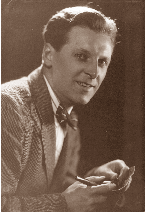
A picture of Sydney appears in a set of cigarette cards which comprises an alphabetic set of film stars. He used to tell his friends that the only reason that he was on these was that there was no-one else with a name that began with the letter F.
Sydney next went into business with F.E.Bracey into a company called Commercial Films. Their business card here reads 'Specialists in Advertising Cinematography & Patentees of the only efficient daylight projection screen. They had the first such screen which was reputedly located on the facade of Selfridges in Oxford Street, London. However, their claim to the patent was made too soon as someone else had their patent registered first.
Sydney was out of work for some time after leaving films when the industry suddenly declined. He considered, at one stage, emigrating to Australia. The family were ready to go but, for some reason, they never did.
Both Sydney and Vera spent quite a bit of time caravanning. They used to go to Climping in Sussex then later had two caravans at the Windmill caravan park at Selsey in Sussex.
Sydney was a Free Mason having been introduced by T G Austin who was a neighbour at Brentham and with whom he played golf. He was formally initiated on 24 November 1929 at Highbury Lodge (No.2192) where he worked his way up to Worshipful Master. T G Austin became Secretary of that Lodge. After Sydney died, his regalia was returned to his Lodge at their request.
In about 1928, the family, including the spaniel dog, moved to a new semi-detached house at 80 Gresham Road, Osterley, Middlesex. Sydney had a Pink Pearl rhododendron planted in the front garden. At the rear he made a sunken garden with a pond in the centre and a beehive at the bottom of the garden. He called the house Tappee after a tappee which had been brought from the Pacific Islands by Samuel Folker, Sydney's great great grandfather. It was a rather obvious phallic fertility symbol which displeased Vera.
Sydney is shown as a china, pottery and glass manufacturer's agent on his wife's death certificate. When his father retired, Sydney took over his job as the European Representative for Crown Derby and between them they represented that company for over 50 years. His first showrooms were at Ely Place, Holborn then he moved before the first world war to Premier House at 12/13 Hatton Garden, London, E.C.1. At the end of the war he moved again to 2 Dyers Buildings, Holborn, E.C.1. After Sydney's death, his assistant Eric J.Day continued with the business.
The showrooms variously stocked Royal Crown Derby pottery, Hammersley pottery, Copenhagen pottery, Westons Folk Ware and Poole pottery. Also stocked was Edinburgh & Leith crystal glassware. The Copenhagen pottery was supplied by a man called Ole Sievenson and was mostly bought by Germans with whom it was popular.
Sydney's obituary in the Pottery Gazette stated that "Mr.Folker had a charming personality which made a visit to his showrooms a pleasure in itself".
From 1945, Sydney was a member of the board of management of The Pottery & Glass Trades Benevolent Institution as was his father before him.
Sydney and Vera moved to Marlow Bottom in 1941 where they bought a three acre field. Their intention was to become self-sufficient which was probably an extension of their love of the outdoors as shown by their caravanning over previous years. Sydney undertook to build the house himself and bought himself the necessary tool kits for each of the trades to complete the house. There was a Spear and Jackson carpentry tool kit which cost four guineas and has survived in the keep of his daughter, Doady. There were also lead beaters tools, bricklayers trowels and plasterers floats. It is likely that he also designed the house himself.
During the period that the house was being built, they lived either in their caravan or in a chalet which was already on the premises. Sydney was also active in the local Civil Defence Committee during the war period.
The house was built at the back of the field which sloped up from the road to beech woods at the back. There were fields on either side and more woodland opposite. The house was named Dingley Dell after a house in Charles Dickens novel, Pickwick Papers. The main room of the house was itself like something from a Dickens novel and resembled the inside of an old ale house. It had an inglenook fireplace with high-backed wooden pews each side. The floor was of terra cotta tiles.
The intention of being self-sufficient was largely realised although Sydney continued at his showrooms. About two acres of the land was used to harvest lucerne and hay which was stored in a Dutch barn at the bottom of the field and sold off. There was a small ornamental garden with a pond at the front of the house. In front of that was a vegetable plot which Sydney used to till with a petrol cultivator. At the side of the house were beehives and at the rear were kept chickens, ducks and three pedigree goats, one billy called Billy and two maiden milkers called Ariadne and Venus. There were also fruit bushes.
They stored fruit and vegetables also made jam and preserves as well as home-made wine and beer which was stored in a small cellar under the bathroom floor.
Once the house was fit to live in, they let the chalet for summer holidays.
In the early days of the second world war petrol became scarce. Sydney used to travel to London each day by train from High Wycombe but would have driven from home to the station. To get round the problem of petrol shortage, he bought himself a pony and trap which he used instead of the car. He arranged with a friend who had a garage near the station at High Wycombe to keep his horse there during the day until his return at night. The journey itself must have been quite hazardous as there is a notoriously steep hill down into High Wycombe from Marlow.
During petrol rationing in and after the war, Sydney was allowed additional petrol because he was a commercial traveller. He used to use this to advantage when visiting his daughter and her family by carrying some of his wares in the car and pretending that he was on business if he was stopped and questioned. He had a Jowett car during the war. He later bought a light green Hillman Minx registration number PKX 390.
Sydney and Vera had neighbours who lived at White Hill Cottage close to Dingley Dell. They were Swiss and called Christian and Catherine Bernet. By co-incidence, Catherine had been a neighbour at Crown Terrace in Cricklewood all those years ago.
Sydney continued his involvement with building by designing a village hall for Marlow Bottom. It was called The Witches barn and was built in an old chalk quarry beside the road. The original plans survive in the family chest. He contributed to the running of the hall and would put on productions to entertain the villagers.
Vera died in 1949 after which Sydney looked after himself. His health eventually deteriorated and he had a housekeeper called Nora Drower to look after him. She had been a neighbour to Sydney and Vera when they lived in Fowlers Walk however, the rest of the family did not get on with her too well..
Sydney was taken into the Royal Masonic Hospital in Chiswick but returned home where he died on 6 January 1955. At his own request, he was cremated at All Saints Crematorium, St. John's, Woking where there is a plaque to both himself and his wife Vera.
An obituary to Sydney which gave an outline of his career in the pottery industry appeared in the February edition of the Pottery Gazette. It also mention how Sydney's father had preceded him in the business.
In his Will of 15 August 1949, Sydney bequeathed items to his sister Evelyn, his son-in-law Archie Smith, his grand-children Malcolm, Stewart and Gillian Smith and the residue to his daughter Dora Smith.
He had added a codicil to his Will on 31 August 1951 entitling his housekeeper Nora to remain in the house for life or until such time as she married of which she did the latter. She was also bequeathed the furniture to furnish her new home and one of the items she took was a bookcase containing a complete set of the works of Charles Dickens, reputedly a signed first edition.
The area around Dingley Dell, once quiet and rural, was developed some years later and houses built close together along both sides of the road in Marlow Bottom. Dingley Dell survived this as it was set well back from the road but lost the bucolic charm for which it was created.
Return to the top of the page.
Return to the Biographies index page.
Return to the front page.
This page hosted by  Get your own Free Home Page