György Ligeti:
KEYBOARD WORKS
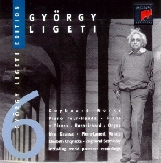 Ligeti's keyboard works are divided in two sections easily visuable, separated by a period of some scarce years of difference. First is the Ligeti prior to the 1956 Hungarian Revolution, with his style strongly influenced by the rhythms and the strong harmonies of Béla Bartók; it is the time of the Sonatina (1950) or of a piece so exemplary (meaning its structural aspects) as the Polifón etüd (1943). This period will be closed with the very inventive Capriccios (1947), Invention (1948), and Ricercare (1951). The musical gap is huge if we consider that the next work in time is the already very experimental Volumina (1961-1962), which together with the recognized Continuum (1968), on its original harpsichord version, stands out due its creative capacity and originality. The curious return to the hungarian originis on the two more actual pieces of the record (Passacaglia Ungherese and Hungarian Rock, both from 1978), shows an stupendous way to close the circle.
Induló (1942) - 2:05
Polifón etüd (1943) - 2:09
Három lakodalmi tánc (1950) - 2:38
Sonatina (1950) - 4:10
Allegro (1943) - 0:42
Irina Kataeva and Pierre-Laurent Aimard (Four-Hands Piano)
Capriccio No.1 (1947) - 2:33
Invention (1948) - 1:12
Capriccio No.2 (1947) - 1:47
Irina Kataeva (Piano)
Drei stücke für zwei klaviere (1976) - 17:03
Irina Kataeva and Pierre-Laurent Aimard (Pianos)
Passacaglia Ungherese (1978) - 5:02
Hungarian Rock (1978) - 5:08
Continuum (1968) - 3:36
Elisabeth Chojnacka (Harpsichord)
Ricercare (1951) - 4:34
Harmonies (1967) - 6:42
Coulée (1969) - 4:03
Volumina (1961-1962) - 14:41
Zsigmond Szathmáry (Organ)
SONY CLASSICAL SK62307 / 78'

Back to
20th Century Music |
Hosted by

|

Ask Us! |