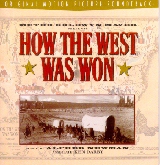
 How The West Was Won (1962) its a film which appeared in a time when film business had declared war on television, and in a desperate attempt to recover audience, the Studios jump to make films with everything the TV couldn't offer, like a multitudinarious cast of Stars or a bigger screen format (Cinemascope, Todd-Ao, Cinerama, Vistavision...), capable to evolve the spectator on its seat. Filmed in Cinerama, and with a list of Stars hard to surpass (even the narrator was a well-known actor, Spencer Tracy), its composer should be one more Star, and so it was called Dimitri Tiomkin, because besides to control the genre he was in an excellent moment of popularity. However Tiomkin, even very interested on the project, couldn't make it due to the necessity of being surgical operate on the eyes, which take him definitely away of the film. Then it comes Alfred Newman, whom has left 20th Century Fox after more than two decades as chief of the Studio's Musical Department, and with an experience on his shoulders without any doubt. As expected, he accepted, and with him his extraordinary collaborator and choral conductor Ken Darby.
The film was a candy for any composer; structured on five episodes, it tells the avatars of the Prescott family on their desires to colonize the West, and this offered many musical possibilities, because on the episodes there is everything, from romance and adventures, till tragedies and action scenes. Newman's first big success was to couple, on each episode, american folk songs which, due its lyrics, fit perfectly on it; suffice to mention, for example, I´m Bound For The Promise Land, for the first episode, where the colonists yearn for a metaphorically promised land; or When Johnny Comes Marching Home, to ilustrate John Ford's terrific episode on the Civil War. The score has two main themes: Home in the Meadow, which isn't Newman's but an adaptation of the old song Greenleaves which a lot of historians atribute to none other than Henry VIII himself, and which here fulfil, among other functions, to be a nexus between all the Prescott family. The other theme is How The West Was Won (this one composed by Newman), which appears for the first time on the main titles, and who is endowed with a powerful percussion and a almost frantic rhythm; one of the more famous themes of his composer, till the point it is rare to find a compilation of West music which does not include it. Incomprehensibly, this theme was cut on the original record edition and on the consecutive editions of the score, and we must to wait till 1991 when the Sony label, in a reprint with themes previously not included on the official record (on a great part it was themes with dialogues and sound effects), to be available on its integrity for the first time. Rhino's edition has been expected a lot and, as for its presentation, it is a little disappointing; the CDs comes in a double pack with an absurd black and white picture over a map of the United States, and on it is eluded any reference on Cinerama, when the more logical will be an edition like Ben-Hur's (book format), on which it may be shine more. But if the presentation is not at the height of the music, it can't be said the same for the record contents -which is really what matters-, and this is frankly exceptional. This edition contains all the music on the film; it isn't matter that the fragment was small, it was selected. Even songs which, practically, goes unnoticed on the movie due its low level of recording are included (for example, the night scene on which Gregory Peck's character tries to conquer Debbie Reynold's, has at its background the splendid song Poor Wayfarin´ Stranger). Those who had the original recording, and who saw the film known that the record was very good, but that it was a pale reflection of the score from which it lack vital fragments like the Prologue, the tremendous end of the Civil War episode, the Pony Express theme, or the one for the wagon trail, among others. Now, not only are all available, but there is also extended versions of numerous cues together with a selection of recorded themes rejected on the final editing of the film. Among these it stands the sung version of No Goodbye, without a doubt one of the best themes composed by Newman on his long career.
The music soundtrack was nominated to the Academy Awards of 1962, and is, by its own right, one of the masterpieces of the Film Music. A.M.


