 TABU's FATAL ATTRACTION
It all started when Priyadarshan offered her Sazaa-E-Kalapaani a couple of years ago. It was Tabu's first brush with quality Cinema and a whole new world opened to her. Mani Ratnam's Anandam, Gulzar's Maachis, Govind Nihalani's next and Priyadarshan's Virasat followed and Tabu had found a place in the sun. In the interview that follows, Tabu discusses the directors responsible for her fatal attraction.........
MAACHIS: When I got a call from Shantiji (my secretary) in Madras, that Gulzarsaab wanted me for Maachis I thought it was a joke. Although I can safely say that I'm Gulzarsaab's greatest fan it never struck me as a possibility that I would ever get an opportunity to work with him. His films have somehow depicted most of the emotions identify with. But more than all that, was curious about him as an actress. I've always noticed that every artiste in his film, comes out with his or her best performances. I wanted to know what he does to them to inspire this kind of work. I wanted to touch him and feel what he was all about... wanted to experience his style of functioning so that I could rewind and review all that must have happened during his other films.
When I returned from Madras Shabana aunty spoke to me and insisted that I do the film "You don't have to recommend Gulzarsaab to me," I told her After all, there can't be an actor in this country who doesn't want to work with him l still remember my first meeting with Gulzarsaab which was as soft and warm as he is. He had a terrible cold and was carrying a white handkerchief into which he sniffed constantly. He narrated the story to me briefly and promised to give me a reading of the entire screenplay during our next meeting. Gulzarsaab kept his promise a few days later when he gave Rocky (my hero) and me a reading of the script.
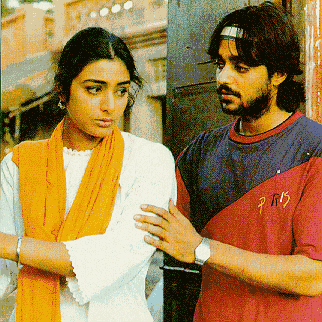 When I look back, I realise that the warmth he projected on the first day of our meeting has never waned till date, What struck me was his great asset as a filmmaker whereby he extracts an optimum performance from his actors. And he does this without asserting his status as a director. The whole process of making Maachis was simple and effortless. There was no stress or pressure while shooting to 'perform' in the conventional sense of the term. We were given bound scripts which explained in detail every nuance we were to enact. This again was thanks to Gulzarsaab. Being a writer-director, the way he conceives a scene on paper is the way he directs it. When the writer's vision matches the director's the job becomes easy for the actor. For instance, when he writes, 'she sniffs before saying,' I know exactly how I have to sniff. Acting was thus a cakewalk with him. What was different however was to 'not act' throughout. Gulzarsaab taught me that it was more important to feel the role than to enact it.
He believes that if you feel something deeply, it automatically shows on your face... in your eyes. Also, I was fascinated by the concept of an actress surrendering herself completely to the director. Since I hadn't yet met a confident director, it was great working with Gulzarsaab. It exposed me to a different style of performing. Working with him also set off a process of thinking while performing, which I never knew I was capable of. He conducts many discussions with you so that there are certain ideas that come to you automatically. For instance, there's a song where I'm sitting on a parapet of a well pining for my lover who's gone away. On the spur of the moment when the shot was on, I decided to turn my engagement ring on my finger when I refer to him in the first line and during the next line I look at the palm of my hand to suggest that he's part of my fate. lt was a small thing but Gulzarsaab recognised my contribution and appreciated the fact that my rmnd was thinking about the role without being conscious of it. He often says that these small gestures are the salf and pepper that add to a performance.
Gulzarsaab however soft and mild, always gets what he wants. But he doesn't follow one method for everyone. His method of extracting a performance from actors is unique. remember everytime I gave a good shot during the shooting he'd present me with a toffee. And at times when he probably realised that I wasn't concentrating, he would shake the toffee from behind the camera, saying 'this is waiting for you...'. I think it's little gestures like these that endeared him to me and made me want to do much better in the film. I thought it'd be a traumatic experience for me to shoot on the last day. But the feeling of separating from the unit was balanced by the fact that I'd struck an inseparable bond with Gulzarsaab. He has promised to do my kanyadaan, he's assured me that he'll publish my English poems, initiate me into Urdu poetry. I have come to depend on him a lot. I'm fortunate that this film has come to me at the right time both personally and professionally.
ANANDAM"Mani Ratnarn touches upon the artiste's psyche which helps the performer..." The first time Mani Ratnam touched my life was when he saw the rushes of Prem while casting for Thiruda Thiruda. Unfortunately, the project didn't work out. While casting for Anandam, Mani happened to see my photograph from Kalapaani, in a magazine and approached me.
He narrated my role to me when I met him. It didn't faze me that I didn't get to hear the entire script because it was very clear at the outset that mine was not the lead heroine's role. Normally, I would ask for an entire narration but with Mani I was confident he wouldn't give me anything insignificant. Besides, with such a big cast it wouldn't make a difference to me whether I heard the script or not. All I needed to know was how my character was connected to the rest of the cast. The role was not that of a stereotyped positive heroine. Mani explained to me that even though I didn't have any song in the film, I had a lot of creative scope. That was enough for me. Right from my first meeting I noticed that Mani was very soft- spoken and normally reserved. I saw a new side to him when he explained the scenes before shooting. He was full of energy and charged. He touches the artiste's psyche and consequently it becomes very easy for an actor to react to his instructions. His narration of my role was so complete with images that I could see the character in my mind.
He'd worked the details out to the T. Her behaviour, her values, her bonds, her assets, her drawbacks, her insecurities... and not all these details were used in the scenes. These aspects were told to me just so that the characfer was in flesh and blood in my mind. Although Mani is very demanding as a director and never okays a shot unless he's convinced about its perfection, he's, not unreasonable. For instance, I almost thought I'd lost the film before the first schedule. There was some misunderstanding about dates when he went ahead and shot with Gautami for my role. Later, when he realised that there was still another role that could suit me he approached me again. That speaks very highly of him. Date confusions happen to every actress and most often they can never be clarified. But he didn't hold it against me. What was further great was that this unfortunate happening never came in the way of our interaction during the film. People still ask me how I agreed to do the other role when the one narrated to me was different, but I didn't let the incident cloud my judgement. Of course, that I was working with Mani Ratnam was a major deciding factor but I also realised that the present role too was different from what I'd been offered in other films and I agreed. Whether it's better or worse will only come into focus after the film's release. What makes Anandam special is that Mani Ratnam thought of me while making one of his biggest films ever and the one that he's producing himself.
I was terribly nervous on the first day of shooting. Normally I cloak it in silence or activity but I decided to be honest about it and headed straight for him. I told him that I was scared and after that left everything to him. What made it tough was that in this film Mani has taken a lot of lengthy shots without cuts. The language being alien the dialogues posed quite a problem initially. But Mani was very helpful. My character in the film is a school teacher and hence speaks very good Tamil interspersed with a lot of poetry. Besides, I had to say the lines with the right intonations. Thanks to Mani who was very patient, I managed to do it. What sets Mani apart from my previous directors is his instant feedback. Whether what I've done in a shot is correct or wrong can only be confirmed by the director. While working with others I have felt a constant insecurity about my actions. But Mani always gives you a reaction to your shot that reassures you. I was nervous at every stage of the film but, he was sensitive to it and tried to make me feel nice whenever he could. I learnt a great lesson from Mani Ratnam that acting is easy if you are not conscious of it. Somehow people have associated this larger than life image to acting which hampers your instincts. I think all award-winning performances and films have been effortless exercises. Look at Mohanlal... I have often observed him and wondered what it is about him that gets him so many awards. And I realised it was his effortlessness. Great actors never thint about their actions or gestures before the shot. They enter the frame, feel the scene and react. That's it! Anandam has been a great boost to my self-confidence. have worked with Mani Ratnam and have managed to live upto his expectations. I have not faced any major hurdle during the shooting. This reiterated my faith that I'm a competent actress.
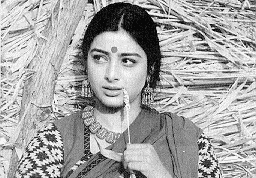 VIRASAAT"Priyan has seen so much good work and he talks so well about the craft that it's fascinating to just sit and listen." Virasat is special to me for several reasons. It was the first time in my entire career that a director was repeating me. After Kaalapaani, Priyan (Priyadarshan) and I had struck a rapport that promises to be lifelong. Besides, when Boney decided to make Thevar Magan as Virasat he'd made up his mind that I'd play Revathi's role. Of these three films, Maachis was a satisfying personal experience while Anandam has been a throughly professional high. But Virasat is a balance of these two pleasures and that's what sets it apart. It was like a homecoming for me because the entire crew of Virasat was the same as Kaalapaani. Initially I was very apprehensive about Virasat because it was a remake. But decided that I wouldn't let it hamper me. I avoided seeing Thevar Magan till I'd finished all my schedules of Virasat except one. This way Revathi's performance never weighed on my head. But it was still difficult for me to think of it as a fresh role. Somehow I managed to go with a blank mind for shooting. I was confident that Priyan would concieve the role differently so as not to repeat the character. The role was very tough because it is nowhere close to any normal girl you see anywhere. It was a challenge to create the girl in my mind without anything to fall back on. My constant fear was that I'd go wrong somewhere with a role that had fetched another actress a national award. The biggest challenge about the role was its innocence. It was impossible to feel the uninhibited shyness of the character. She is a harijan who has been put into strange circumstances and reacts to them instinctively. In the film I had to look innocent without faking it. I had to take care that no part of me crept into the role. I had to be someone else totally. Priyan was a big help in this process.
While working with Priyan I have a rule whereby I never think; I trust him completely. Besides I get scared to ask him too many questions. He's so used to having terrific actors in his cast that it's tough to live up to that. During Kaalapaani I just followed his instructions blindly and believe me I never thought I was doing anything great till I saw myself on screen. I couldn't believe it was me. With Priyan I always get the feeling that I don't know anything about acting. He's seen so much good work and he talks so well about the craft that it's fascinating to just sit and listen. One thing about Priyan that's different from my other filmmakers is that while he praises me for a good take, he screams at me for a bad one too. Gulzarsaab and Mani always saved me from any unpleasant feedback. Priyan doesn't protect me from criticism. He scolds, fires, jokes...in short doesn't handle me with kid-gloves."


