These are the texts we looked at last term, which might be worth reviewing, if you've forgotten the details or haven't seen them before!
What memes are good for
Indeterminism
Dawkins on memetics
The first point I want to develop concerns Benjamin Libet's experiments. Taylor describes them accurately, and draws the conclusion that since it is the unconscious brain where decisions to act are first made, while the conscious brain just monitors the decision shortly after, we cannot rely on people making good ethical decisions on the basis of their conscious knowledge only. It is better to arrange the human environment so that the first unconscious decision will automatically be the proper altruistic one.
That is certainly interesting and important, but Taylor, like many other writers, overlooks or chooses to ignore the disturbing aspect of Libet's experiments, that they seem to deal a fatal blow to our everyday notion of "free will". Free will decisions surely have to be conscious ones, so how can they be made unconsciously?
Last term I suggested an alternative view, that we live in an indeterministic universe and that our decisions are fundamentally random. However the precise probability of a decision depends on the contents of our brains. The concept of the "meme" came in quite useful here. We can imagine memes as ideas which are passed around among groups of humans, and which may become incorporated into the brain activity of at least some. In that case, they will influence the brain's (unconscious) decision making, and change the probability of certain decisions being made. So even without free will, there is room for discussion of ethics, altruism and so on. A suitable set of memes would increase the probability of altruistic acts being performed, and reduce the probability of self-interested ones.
I'd be glad of your thoughts about that idea. One thing that worries me about it is the lack of evidence that the universe is indeterministic rather than deterministic. It seems that although quantum changes are random, this randomness may not affect events on a larger scale. However, the physicist Hugh Everett has proposed a "many worlds" interpretation of quantum physics. According to this, whenever a probabilistic quantum event happens, the entire universe divides, with one new universe corresponding to each of the possibilities. As an example, imagine a quantum event with six possible outcomes, like the tossing of a die. The universe divides into six new universes in that case, each one corresponding to a face of the die. I feel rather uncertain about that idea - might it not be like a deterministic universe written large, so to speak? Needless to say, there is a Wikipedia article on this whole topic, which you can find here.
|
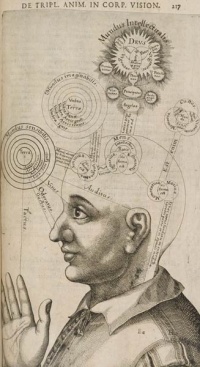
| I have always loved this picture from a book on the workings of the human mind by the mystic philosopher Robert Fludd, which was published around 1620. Whatever it was originally meant to represent, it could be viewed as a rather vivid illustration of memes and activity in the brain! I am still rather puzzled about the ultimate value of the meme concept. Memes certainly simplify explanations of how ideas spread or fade away in human societies, but is it worth thinking of them such a concrete way as they appear in the picture? I'm so unclear about this that I can't think of a good example at the moment, but perhaps we can find some in class. We might think of comparing humans and other animals, or comparing hard-wired concepts and those contained in memes. For instance, we seem to have a hard-wired concept of fairness: siblings or children together are likely to cry "That's not fair!" if they miss out on a treat the others are getting. There could have been some evolutionary advantage in that, at least in the case of siblings. Then maybe memes for altruism are generalisations of that? |
Immanuel Kant (1724 - 1804) tried to establish a system of ethics based on reason rather than sentiment. His ideas are difficult, but they may fit in well with the idea of memes, so let us try them out.
Just a bald statement of Kant's primary idea to begin with, which we can talk about in class:
Act only according to that maxim by which you can at the same time will that it would become a universal law.According to Kant, the following principles can be deduced from that one:
Act in such a way that you always treat humanity, whether in your own person or in the person of any other, never simply as a means, but always at the same time as an end.
So act as though you were, through your maxims, a law making member of a kingdom of ends.
Do as you would be done by.